Acquiring a customer costs five to seven times more than retaining one, yet most product roadmaps are dominated by new feature development and give little space to retention, onboarding, and customer health. These nineteen templates plan the work that keeps customers using your product, getting value from it, and renewing.
The collection covers the full customer retention lifecycle: onboarding new users, monitoring customer health, acting on feedback, preventing churn, recovering lost customers, and building service recovery processes. Each template is a free PowerPoint download that works in Google Slides, Keynote, and LibreOffice Impress.
Customer Success Operations
These templates plan the systems and processes that customer success teams use to manage accounts at scale.
Customer Success Roadmap
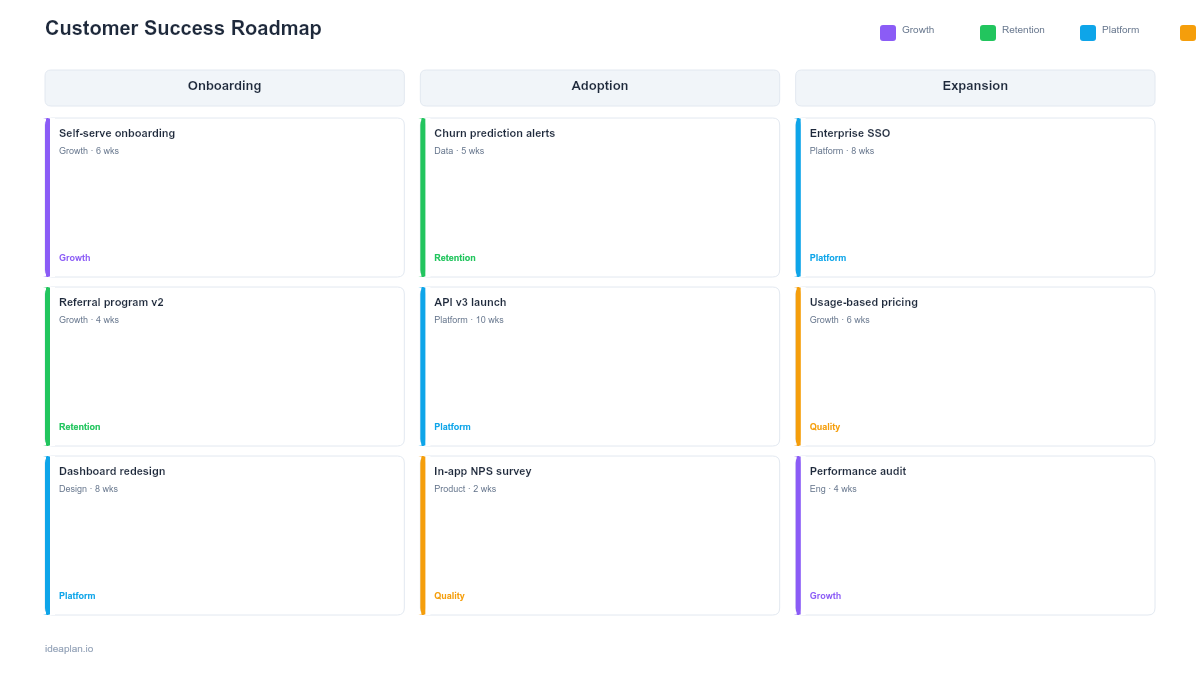
The customer success roadmap plans the overall CS function: tools, processes, playbooks, and metrics. It covers implementation of health scoring, alert systems, renewal workflows, and expansion triggers. For companies building a CS function from scratch or scaling an existing one, this template structures the investment in people, process, and tooling.
Customer Advisory Board Roadmap
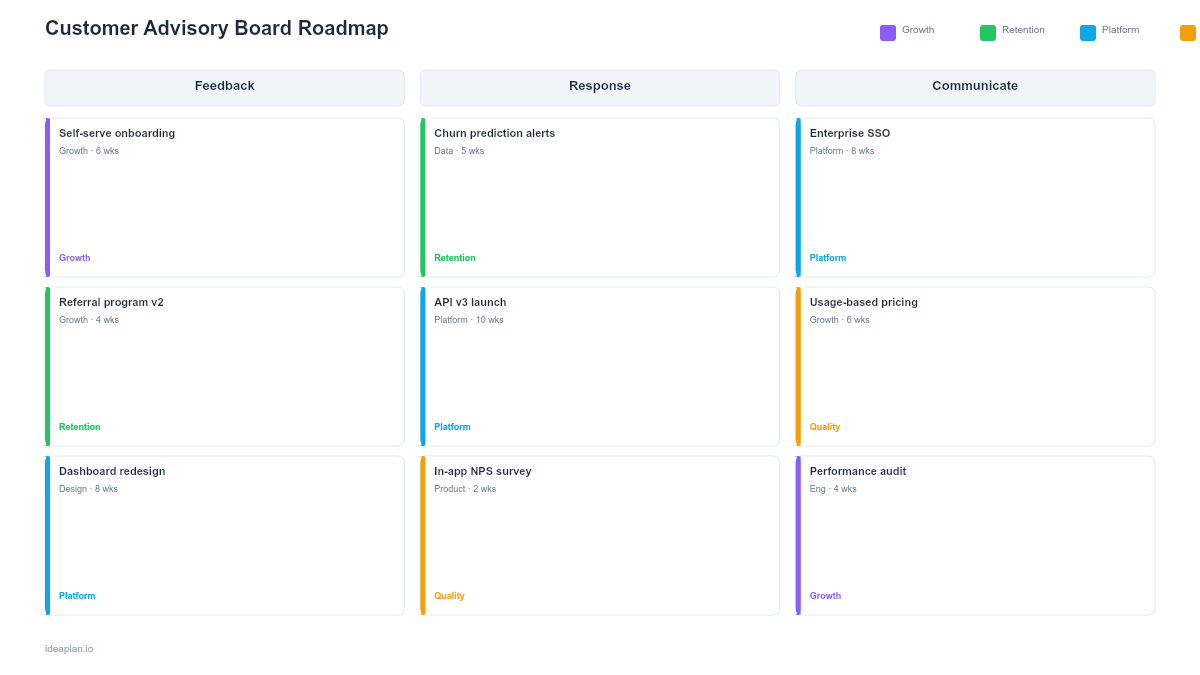
The customer advisory board roadmap plans the structure, operations, and engagement cadence of a formal customer advisory board. It covers member selection criteria, meeting formats, feedback collection processes, and how advisory input flows into product strategy. This template ensures your CAB becomes a strategic asset rather than a quarterly obligation.
Product Health Check Roadmap
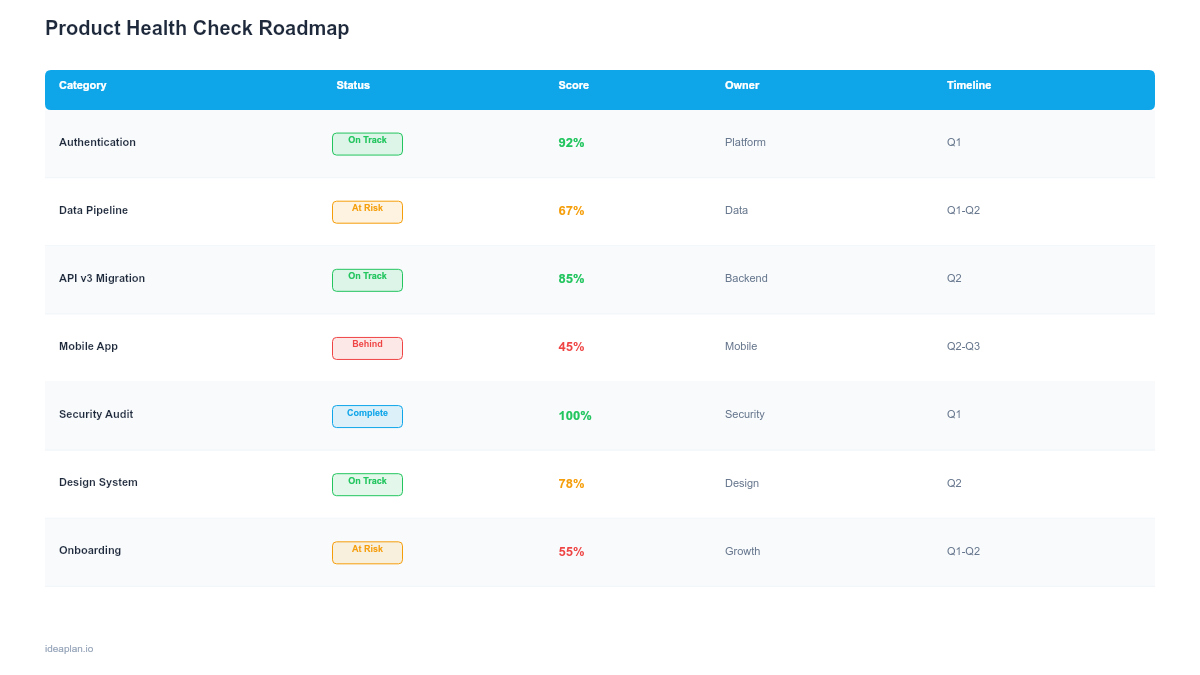
The product health check roadmap plans periodic customer health assessments: usage audits, feature adoption reviews, and proactive success planning sessions. Each health check identifies expansion opportunities, risk factors, and tailored action plans by customer segment. This template turns health monitoring from a reactive alert system into a proactive growth engine.
Customer Health Roadmap
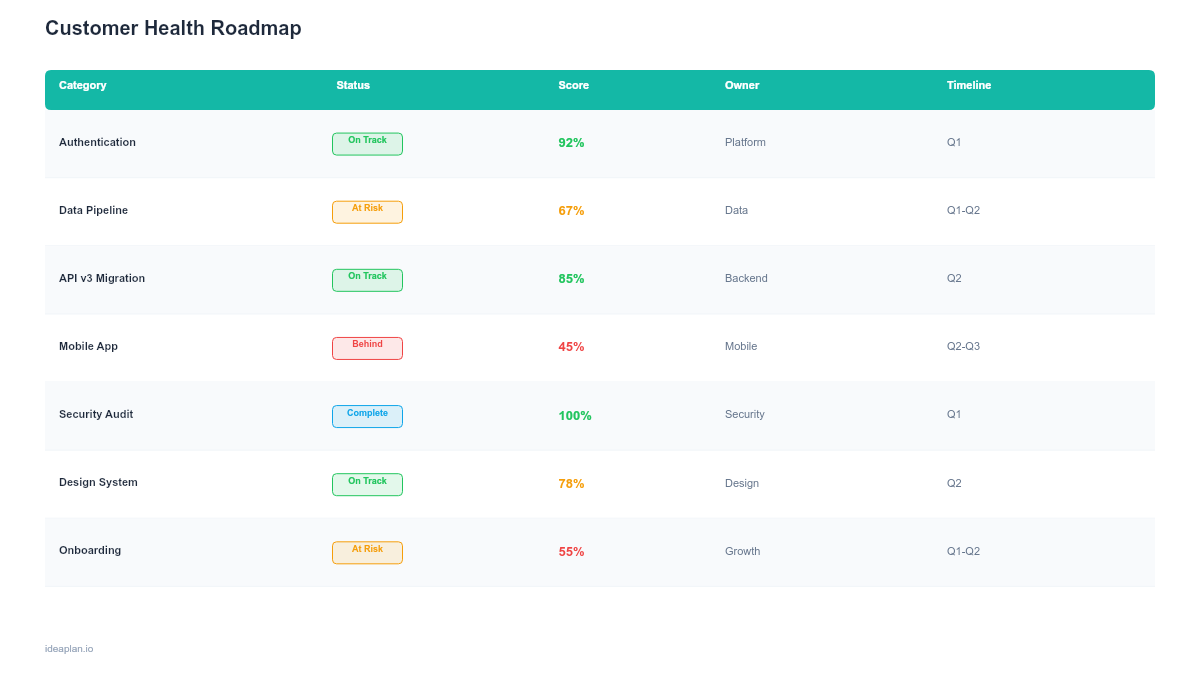
The customer health roadmap plans the development of a customer health scoring system. It covers metric selection (usage frequency, feature adoption, support tickets, NPS), scoring methodology, alert thresholds, and the playbooks that fire when a customer moves from green to yellow or red. The goal is to detect churn risk before the customer asks to cancel.
Customer Journey Roadmap
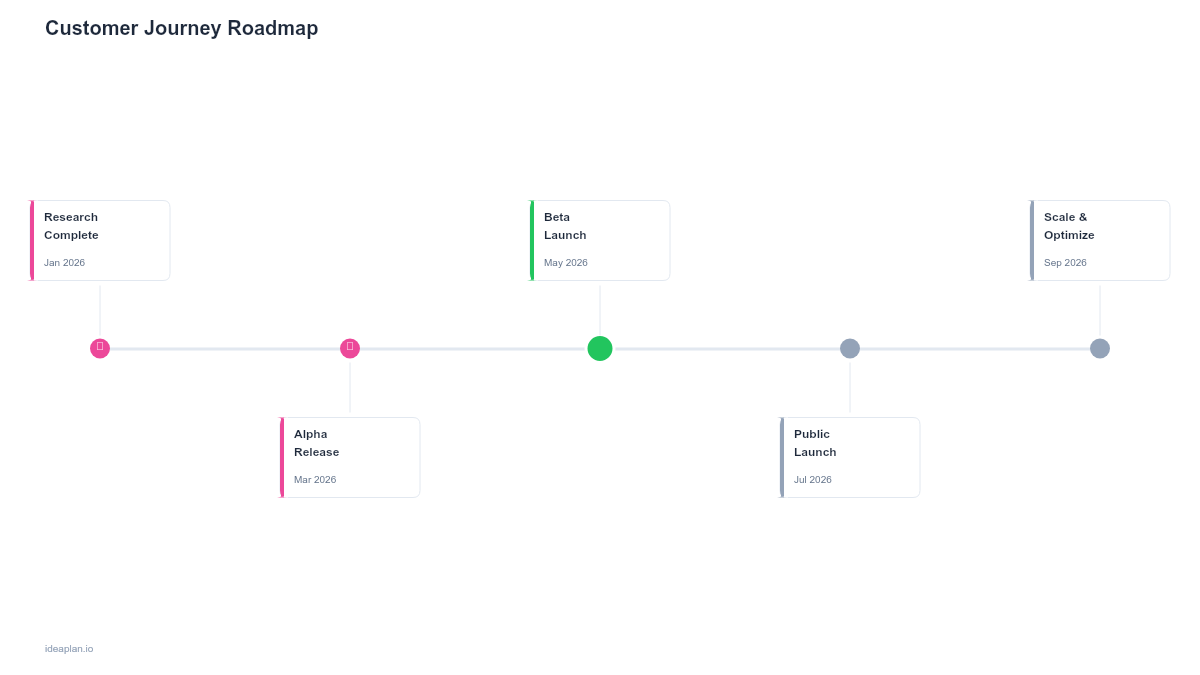
The customer journey roadmap maps the entire customer experience from first touch to renewal and expansion. Each stage has its pain points, drop-off risks, and improvement initiatives. Unlike a user flow diagram, this roadmap plans the work to improve each stage over time, treating the customer journey as a product that needs continuous improvement. Use the NPS calculator to benchmark satisfaction at each journey stage.
Onboarding
Onboarding is where most customers decide whether your product is worth their time. These templates plan the onboarding experience with the care it deserves.
Customer Onboarding Roadmap
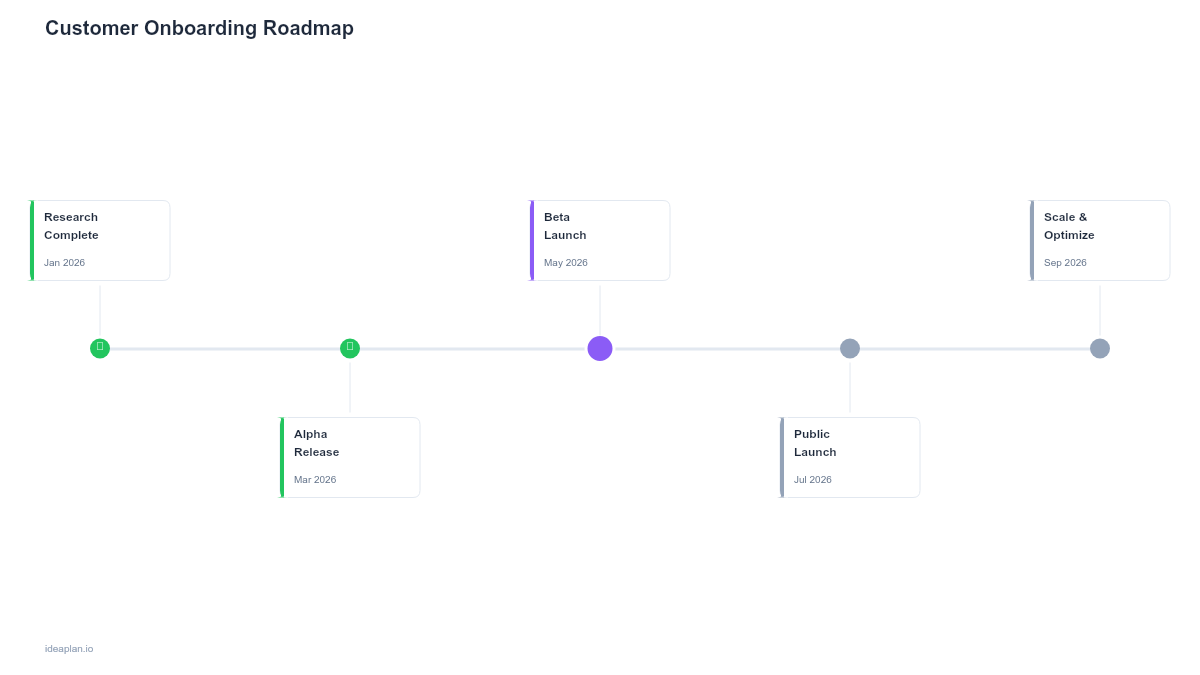
The customer onboarding roadmap plans the technical and human-touch onboarding process for new customers. It covers data migration, configuration, training sessions, success milestone definitions, and the handoff from implementation to ongoing support. For B2B products with complex setup requirements, this template ensures no customer is left stranded between signing the contract and getting value from the product.
User Onboarding Roadmap
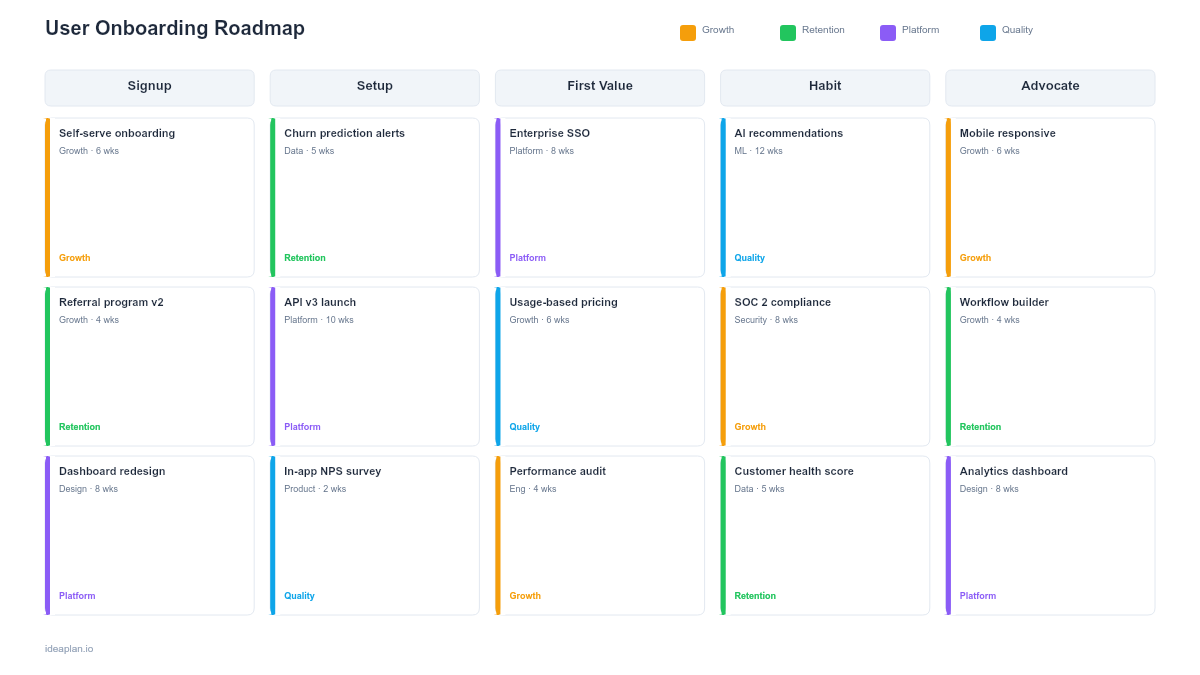
The user onboarding roadmap plans the in-product onboarding experience: welcome flows, tooltips, progressive disclosure, activation milestones, and the experiments to improve onboarding conversion rates. This is a product roadmap, not a services roadmap. It plans the engineering work to reduce time-to-value for self-serve users. Track activation rates and time-to-value to measure whether the onboarding improvements work.
Onboarding Program Roadmap
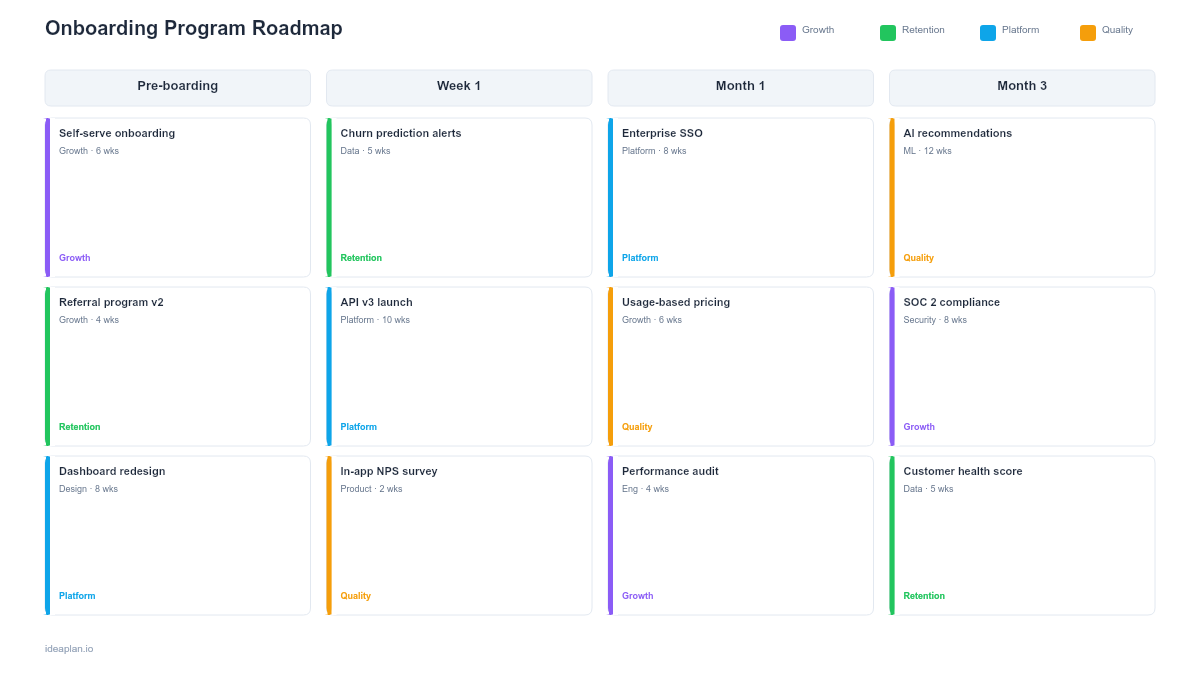
The onboarding program roadmap plans a structured onboarding program with multiple tracks: self-serve (documentation, videos, in-app guidance), assisted (CSM-led), and high-touch (dedicated implementation team). It assigns customers to tracks based on deal size, complexity, or segment. For companies scaling beyond one-size-fits-all onboarding, this template structures the transition to segmented programs.
Feedback and Voice of Customer
These templates turn customer feedback into structured improvement plans.
Customer Feedback Roadmap
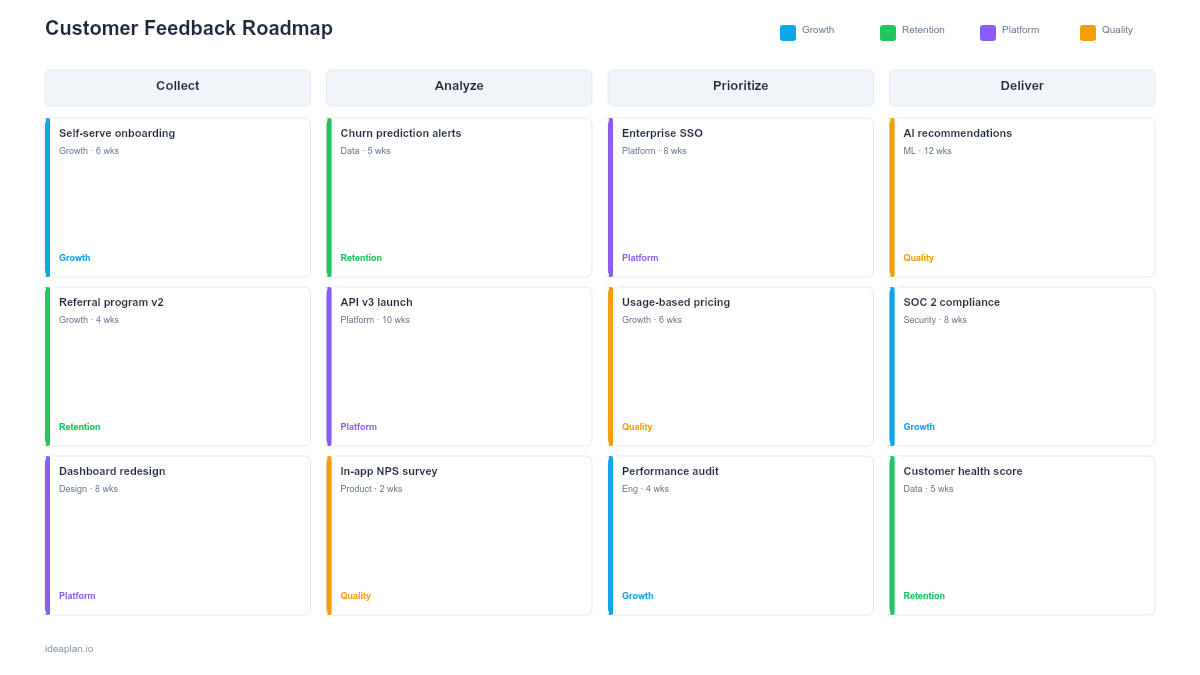
The customer feedback roadmap plans how feedback is collected, categorized, prioritized, and acted on. It covers feedback channels (in-app, support tickets, interviews, surveys), the aggregation process, and the pipeline from raw feedback to roadmap items. Most feedback programs fail not from lack of data but from lack of process. This template ensures feedback leads to action rather than sitting in a spreadsheet.
NPS Action Roadmap
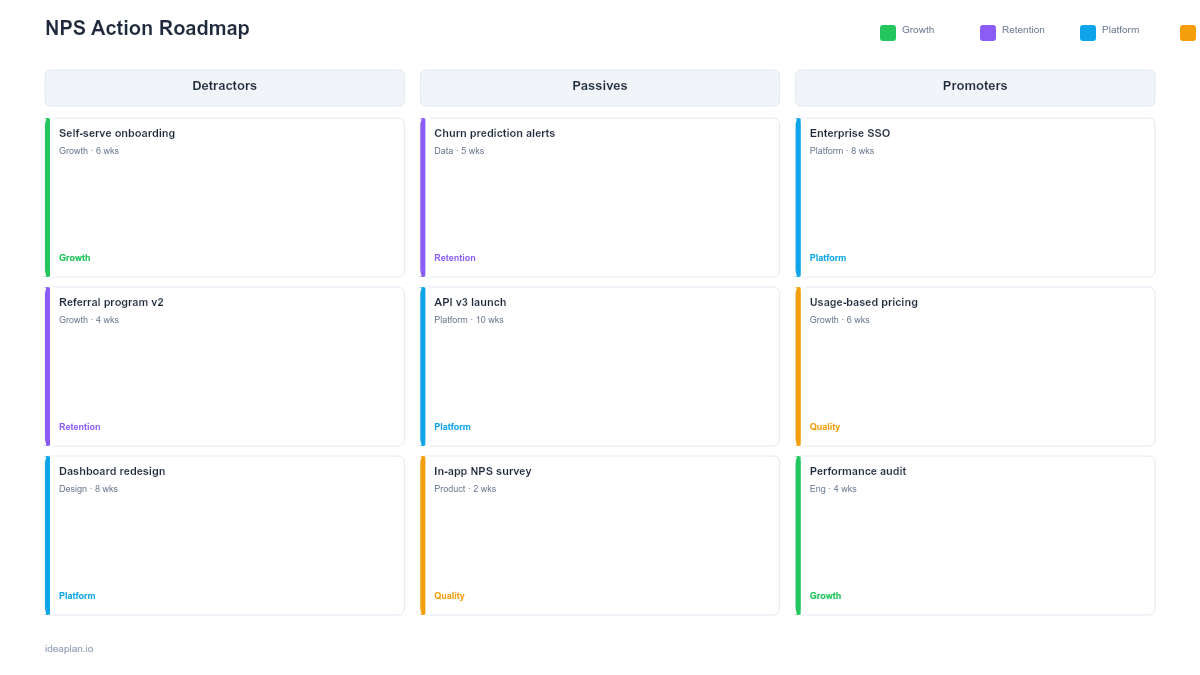
NPS surveys generate data. This roadmap plans what you do with it. It organizes detractor feedback into themes, prioritizes the themes by frequency and revenue impact, and assigns improvement initiatives to each. The template tracks NPS changes over time to measure whether your actions actually move the score. Use the NPS calculator alongside this template to track your score.
Voice of Customer Roadmap
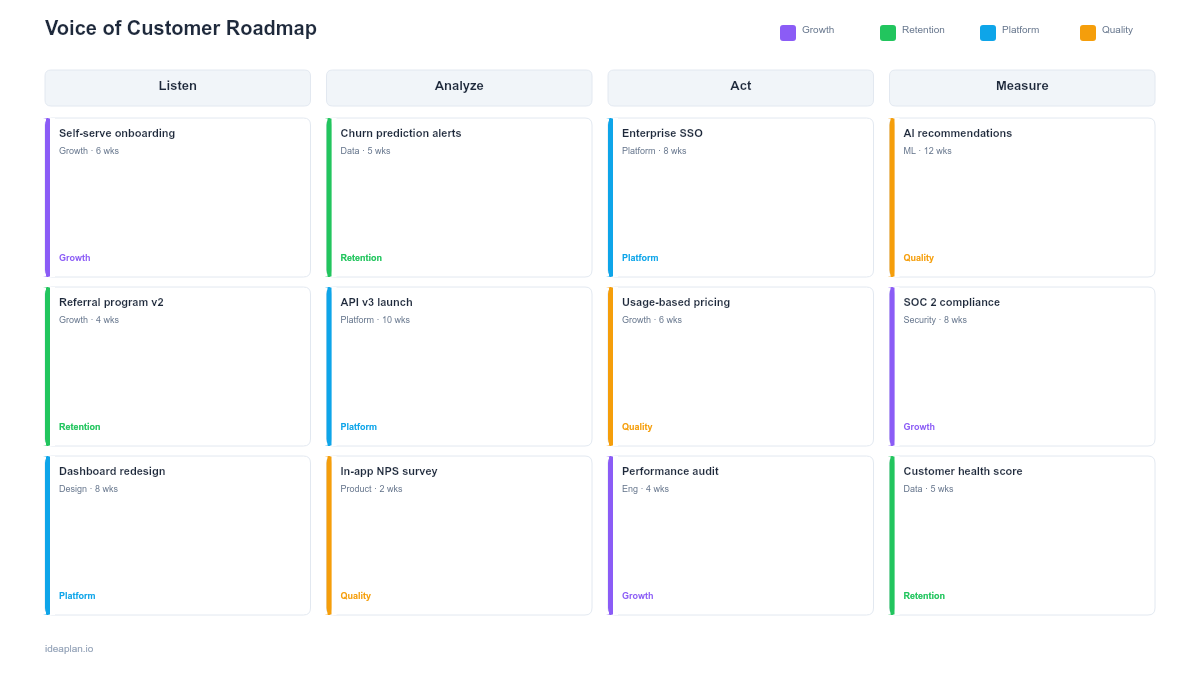
The VoC roadmap plans a formal voice-of-customer program: interview schedules, survey cadences, advisory board management, and the synthesis process that turns raw customer input into product insights. It is broader than the feedback roadmap. VoC includes proactive research (interviews, site visits, co-design sessions), not just reactive feedback collection.
Churn Prevention and Recovery
These templates address what happens when customers are at risk of leaving, or have already left.
Churn Prevention Roadmap
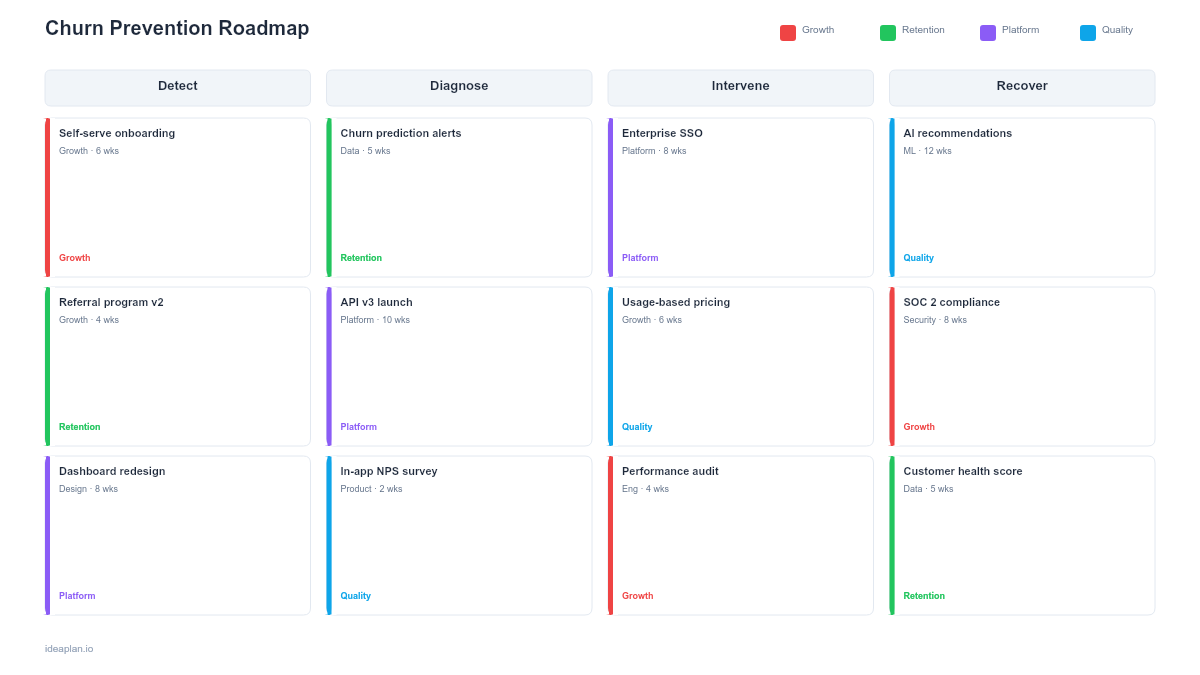
The churn prevention roadmap plans the product and process changes that reduce churn. It categorizes churn reasons (product gaps, poor onboarding, price sensitivity, competitive loss), sizes the revenue impact of each, and assigns prevention initiatives. Each initiative has a target churn segment and expected reduction. This template turns churn from a reactive problem (scrambling to save accounts) into a proactive product strategy.
Retention Strategy Roadmap
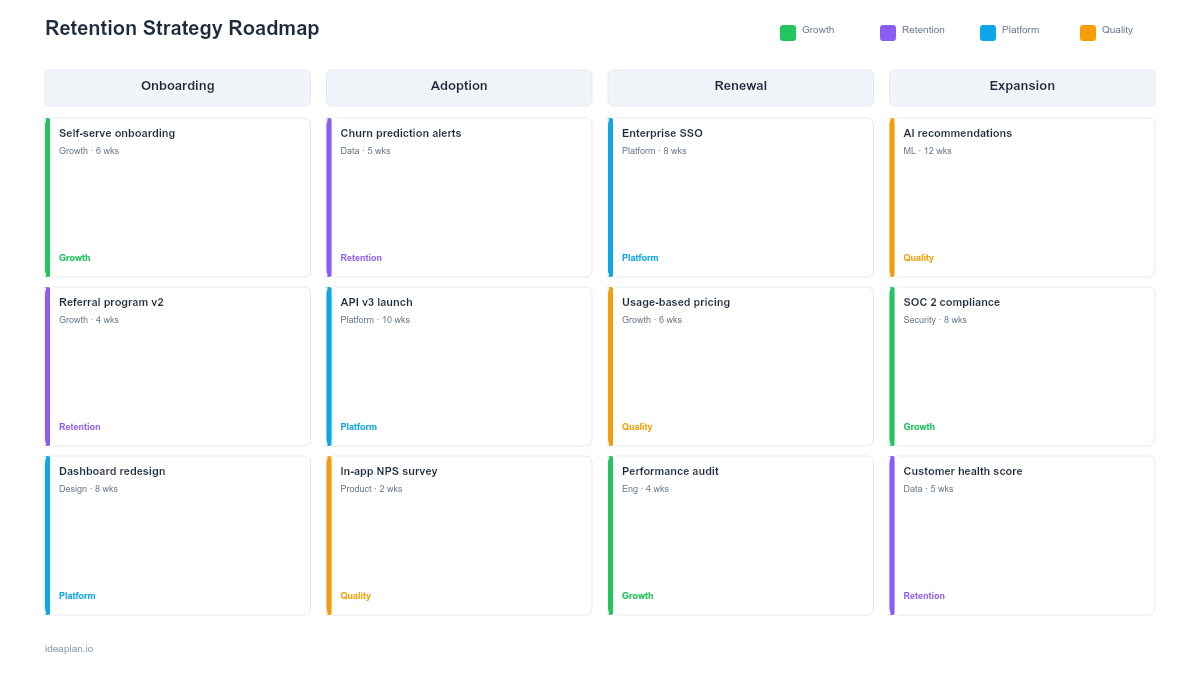
The retention strategy roadmap plans the overall retention program: engagement features, habit-forming loops, re-engagement campaigns, and the metrics framework for measuring retention cohort-by-cohort. It is broader than churn prevention (which focuses on at-risk accounts). Retention strategy covers keeping all customers engaged and expanding their usage over time.
Win-Back Roadmap
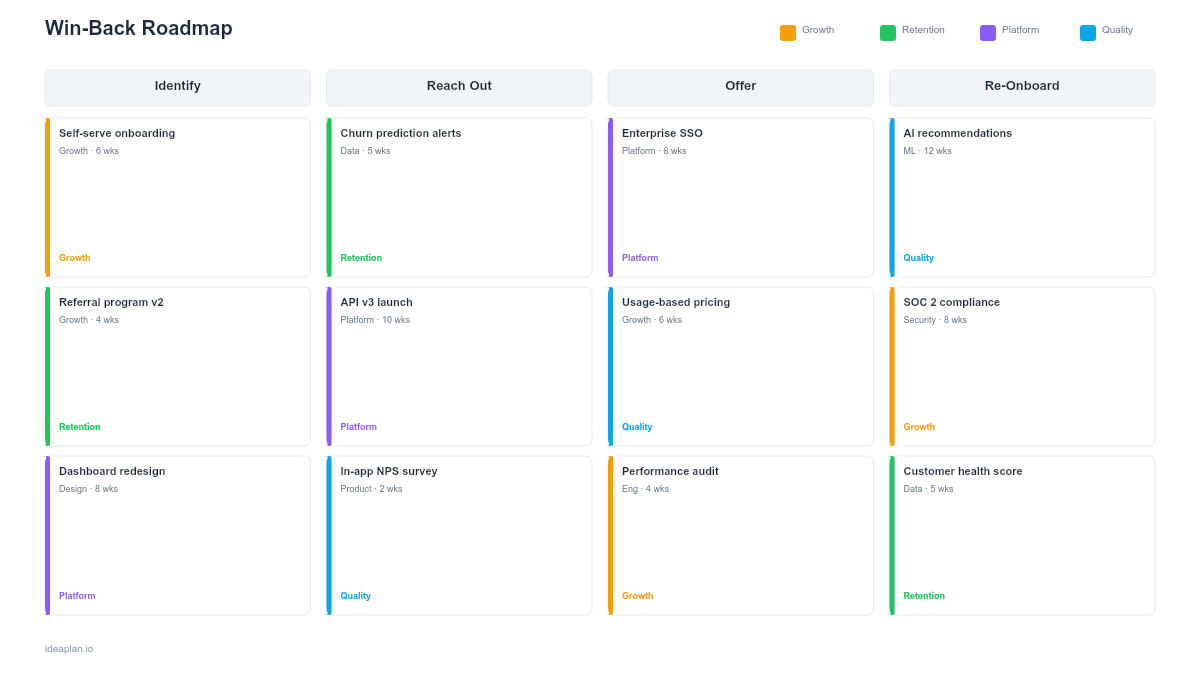
The win-back roadmap plans the program for re-engaging customers who have already churned. It covers outreach timing, messaging by churn reason, incentive structures, and the re-onboarding experience for returning customers. Win-back programs are high-ROI when churn was driven by a product gap that has since been fixed. The template tracks which churned customers are eligible for win-back based on the reason they left and what has changed since.
Change Management Roadmap
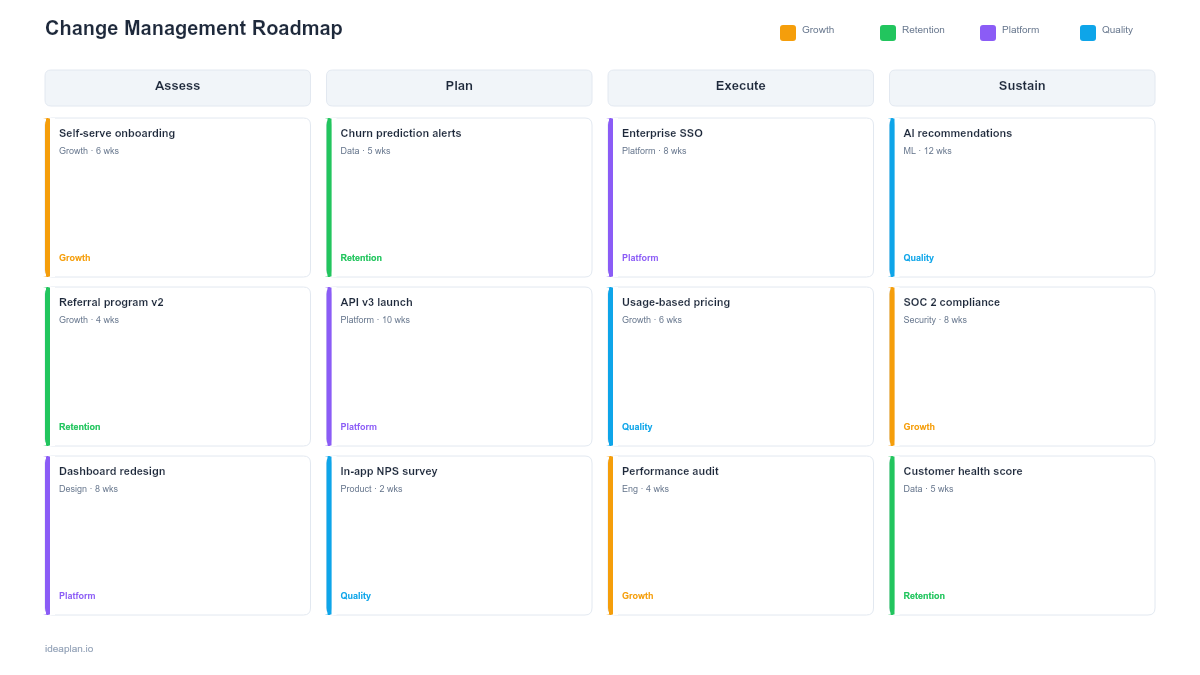
The change management roadmap plans how major product changes are rolled out to customers: communication sequencing, training plans, migration support, and fallback procedures. It ensures that large changes (pricing updates, feature deprecations, UI overhauls) are managed with customer empathy rather than sprung on users without warning.
Contract Renewal Roadmap
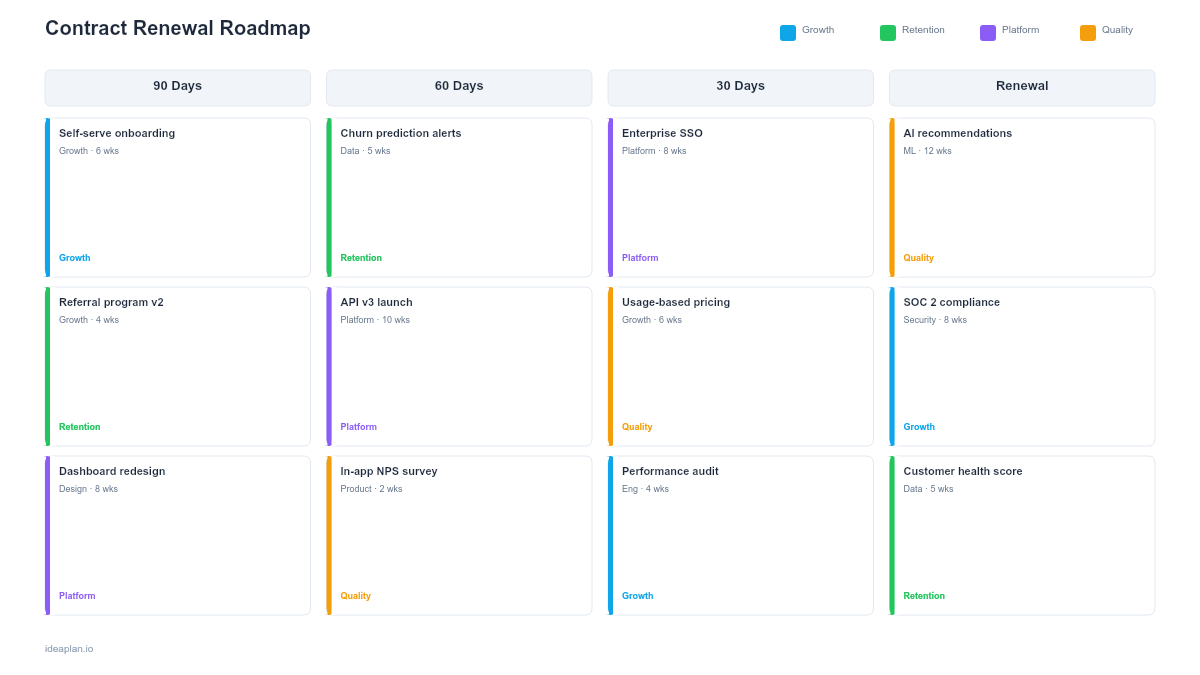
The contract renewal roadmap plans the customer success activities leading up to renewal milestones: health checks, executive business reviews, renewal risk assessment, and expansion opportunity identification. Each renewal cohort shows timing, value realization status, and renewal confidence. This template turns renewals from a scramble into a systematic process.
Service Blueprint Roadmap
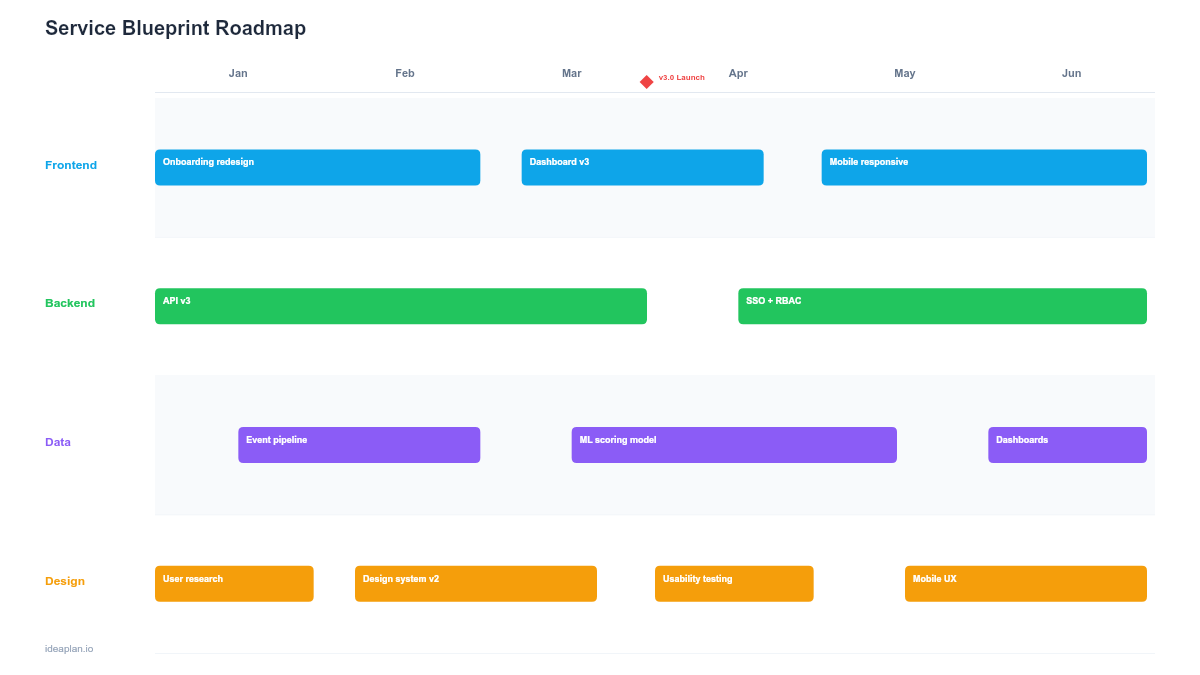
The service blueprint roadmap maps the end-to-end service delivery process including customer-facing touchpoints, internal processes, and supporting systems. It identifies friction points, service gaps, and improvement opportunities across the full service experience. This template is essential for service-oriented products where delivery quality matters as much as product features.
Customer Experience and Service
These templates plan the experience customers have when they need help or when something goes wrong.
Customer Experience Roadmap
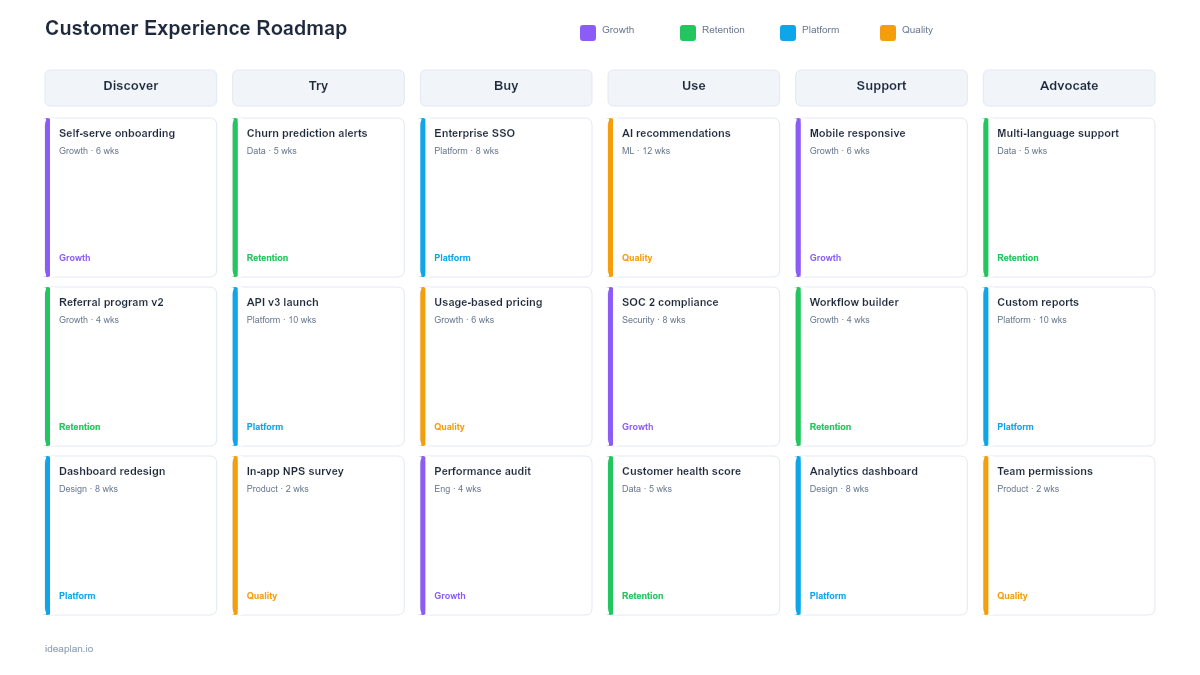
The CX roadmap plans improvements across every customer touchpoint: marketing, sales, onboarding, in-product experience, support, and renewal. Each touchpoint has satisfaction metrics and improvement initiatives. For companies where customer experience is a competitive differentiator, this template provides the cross-functional coordination that CX improvement requires.
Service Recovery Roadmap
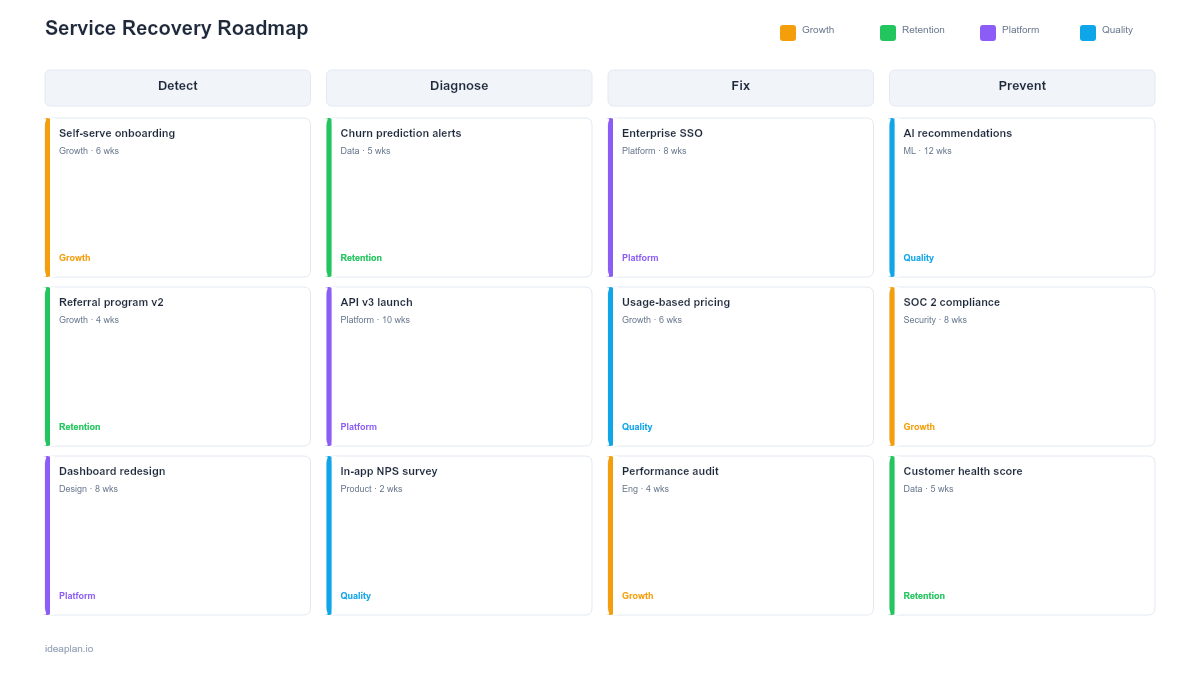
Service recovery plans what happens when things go wrong: outages, data issues, billing errors, or support failures. This roadmap covers incident detection, customer communication, remediation, and the follow-up process that turns a negative experience into a trust-building moment. Companies that recover well from failures often earn higher loyalty than companies that never fail at all. The template structures that recovery process.
How to Choose the Right Template
Start with the biggest gap in your current retention program:
- No CS function yet → Customer Success Roadmap to build the foundation
- Customers churning and you do not know why → Customer Health Roadmap + Churn Prevention Roadmap
- Poor onboarding → User Onboarding Roadmap (self-serve) or Customer Onboarding Roadmap (high-touch)
- Lots of feedback, no action → Customer Feedback Roadmap or NPS Action Roadmap
- Lost customers you want back → Win-Back Roadmap
- Improving end-to-end experience → Customer Journey Roadmap or Customer Experience Roadmap
Most mature CS organizations use three to four of these templates simultaneously: a health scoring roadmap, an onboarding improvement roadmap, a feedback-to-action roadmap, and a churn prevention roadmap. Start with the one that addresses your most urgent retention problem.
Explore More
- Top 10 Retention Metrics for SaaS Products (2026) - 10 retention metrics that reveal whether your SaaS product keeps users coming back.
- Product Management in SaaS - How PMs work in SaaS, what frameworks and metrics matter, and how to ship subscription software that retains.
- Top 10 AI Tools for Product Managers (2026) - 10 AI-powered tools that save product managers hours every week.
- Top 10 Customer Feedback Tools and Methods (2026) - 10 tools and methods for collecting, organizing, and acting on customer feedback.