Quick Answer (TL;DR)
This free PowerPoint template structures enterprise customer onboarding into four phases: kickoff, implementation, adoption, and handoff. Each slide maps the activities, owners, and success criteria that move a new customer from signed contract to realized value. Download the .pptx, customize the phases for your product, and use it as both an internal playbook and a customer-facing deliverable that sets expectations for every onboarding engagement.
What This Template Includes
- Cover slide. Customer name, contract value, target go-live date, assigned CSM, implementation lead, and the primary success metric for the engagement.
- Instructions slide. How to customize phases for your product's complexity, define success milestones, and manage the sales-to-CS handoff. Remove before presenting.
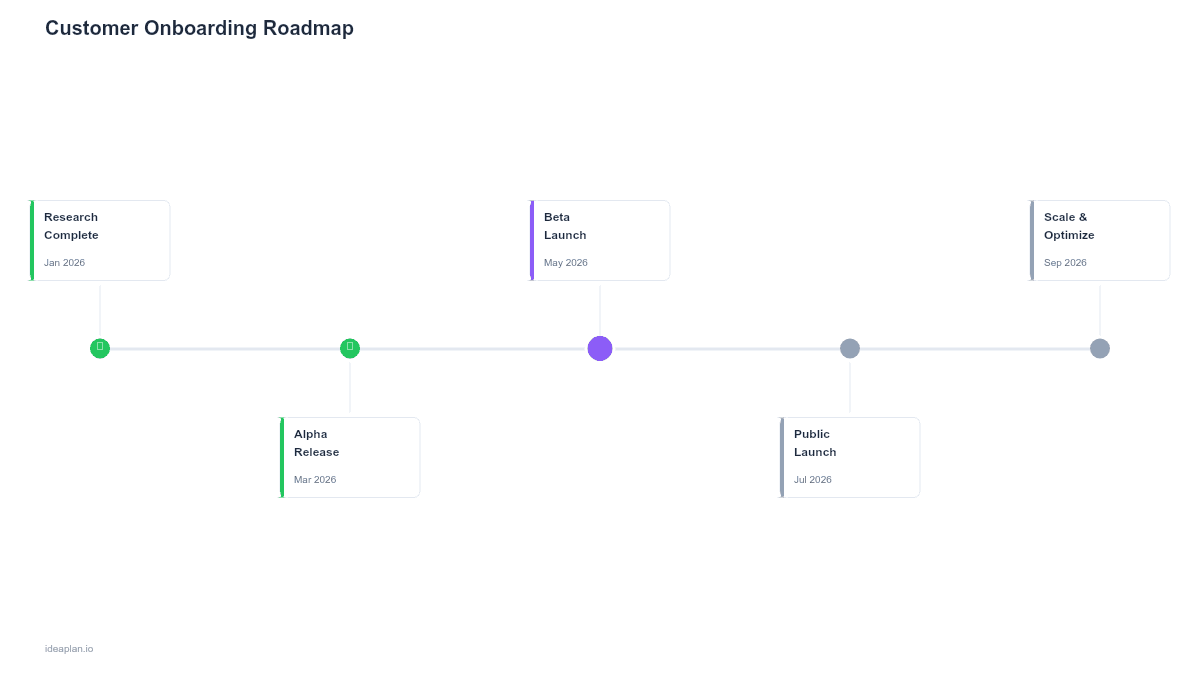
- Blank template slide. Four-phase layout (Kickoff, Implementation, Adoption, Handoff) with activity checklists, owner assignments, milestone gates, and a time-to-value tracker running across the bottom.
- Filled example slide. A B2B SaaS onboarding for a 500-seat enterprise customer over 90 days. Shows a kickoff meeting and technical requirements in Week 1-2, SSO and data migration in Week 3-6, team training and pilot launch in Week 7-10, and full rollout with handoff to ongoing CS in Week 11-12.
Why Customer Onboarding Needs a Roadmap
The first 90 days after a customer signs a contract determine whether they renew. Research across B2B SaaS consistently shows that customers who reach their first value milestone within the onboarding window renew at significantly higher rates than those who do not. Yet most companies treat onboarding as an informal process. A kickoff call, some documentation links, and a "let us know if you have questions" email.
For enterprise customers, this informal approach fails at scale. Enterprise onboarding involves technical integration, data migration, user training, change management within the customer's organization, and a handoff from the sales team that sold the deal to the CS team that will manage the relationship. Each of these steps has dependencies, and missing one delays everything downstream.
A customer onboarding roadmap turns this into a repeatable process with clear milestones, defined owners on both sides (your team and the customer's team), and measurable gates that confirm progress. The roadmap also serves as a customer-facing artifact. Sharing it in the kickoff meeting sets expectations and creates mutual accountability. For metrics that track onboarding effectiveness, see the onboarding completion rate and time-to-first-key-action metric guides.
Template Structure
Four Onboarding Phases
The roadmap moves through phases that build on each other:
- Kickoff (Week 1-2). Introductions, goal alignment, and technical discovery. The sales team presents a handoff document summarizing the customer's goals, use cases, and any commitments made during the sales process. The CS and implementation team conducts a technical discovery session to understand the customer's environment, integration requirements, and data migration needs. Outcome: a shared understanding of what success looks like and a detailed implementation plan.
- Implementation (Week 3-6). Technical setup and configuration. SSO integration, API connections, data migration, custom configuration, and environment provisioning. This phase has the most dependencies and the highest risk of delays. Each technical milestone has a clear owner (your implementation engineer or the customer's IT team) and an acceptance criteria.
- Adoption (Week 7-10). Getting actual users active in the product. Admin training, end-user training, pilot group launch, and feedback collection. The gap between "the product is configured" and "people are using it" is where many onboardings stall. This phase addresses that gap with structured enablement and a pilot program that proves value before full rollout.
- Handoff (Week 11-12). Transition from onboarding to ongoing customer success. The implementation team transfers context to the long-term CSM. A formal review confirms that success milestones were met, documents any open items, and establishes the ongoing cadence (QBRs, support channels, expansion conversations). The customer should never feel abandoned after onboarding ends.
Success Milestone Gates
Between each phase, a milestone gate confirms readiness to proceed:
- Gate 1 (Kickoff to Implementation): Technical requirements documented, customer team identified, project plan approved.
- Gate 2 (Implementation to Adoption): Technical setup complete, integration tests passing, data migration validated.
- Gate 3 (Adoption to Handoff): Pilot group active, activation rate above threshold, training completed for all user cohorts.
- Gate 4 (Handoff complete): Success criteria met, CSM relationship established, first QBR scheduled.
Time-to-Value Tracker
A bottom row tracks time-to-value. The elapsed days from contract signature to the customer achieving their first meaningful outcome. This metric is the single best predictor of renewal. The tracker shows planned TTV versus actual TTV, with variance highlighted. If actual TTV exceeds planned by more than 20%, an escalation process triggers.
How to Use This Template
1. Customize phases for your product complexity
The four-phase structure works for most B2B SaaS products, but the duration of each phase varies. Simple products with self-serve setup may compress the entire onboarding into 2-3 weeks. Complex enterprise platforms with integrations and data migration may need 3-6 months. Adjust phase durations to match your product, but keep the phase names and gate structure consistent for repeatability.
2. Define the sales-to-CS handoff document
The most common onboarding failure starts before onboarding does: a messy handoff from sales. Create a standard handoff template that sales completes before the kickoff call. It should include: customer goals, use cases discussed during sales, technical environment details, any commitments or concessions made, key stakeholders, and the customer's internal timeline or deadlines. This document prevents the CS team from re-asking questions the customer already answered.
3. Assign dual owners for every milestone
Each milestone needs an owner on your side (CSM, implementation engineer, or trainer) and a corresponding owner on the customer side (IT admin, project manager, or executive sponsor). Onboarding activities that require customer action. Providing API credentials, scheduling training for their team, approving data migration. Are the most common delay sources. Dual ownership creates accountability on both sides.
4. Present the roadmap in the kickoff meeting
Share the roadmap with the customer during the first kickoff call. Walk through each phase, confirm the timeline, and agree on the milestone gates. This sets expectations upfront and gives the customer a way to track progress. It also surfaces timeline risks early. If the customer's IT team cannot start SSO integration until Week 5, you know immediately that the implementation phase needs to extend.
5. Track time-to-value and iterate the playbook
After each onboarding engagement, record the actual duration of each phase and the final time-to-value. Identify where delays occurred and why. After 10-15 onboardings, patterns emerge: "SSO integration always takes longer than planned" or "customers who skip pilot go-live have lower adoption." Use these patterns to refine phase durations, add buffer where needed, and update the milestone checklists.
When to Use This Template
Customer onboarding roadmaps fit when:
- Enterprise deals require technical implementation involving integrations, data migration, or custom configuration that takes weeks, not minutes
- Time-to-value directly impacts renewal rates and the CS team needs a structured process to compress time from contract to first outcome
- The sales-to-CS handoff is inconsistent and customers experience a jarring transition from attentive sales rep to unfamiliar CS team
- Onboarding quality varies by CSM and the organization needs a repeatable playbook that produces consistent results regardless of who runs it
- Customers are churning in the first 6 months and analysis suggests they never fully activated during onboarding
If your focus is on self-serve product onboarding (in-app flows, welcome sequences, activation funnels) rather than high-touch enterprise implementation, the user onboarding roadmap template covers that use case.
Featured in
This template is featured in Customer Success and Retention Roadmap Templates, a curated collection of roadmap templates for this use case.
Key Takeaways
- Customer onboarding roadmaps cover four phases: kickoff, implementation, adoption, and handoff. Each with defined milestone gates that confirm readiness to proceed.
- The sales-to-CS handoff document is the most critical input; without it, onboarding starts with the CS team re-discovering what sales already learned.
- Assign dual owners (your team and the customer's team) for every milestone to create accountability for activities that require customer action.
- Track time-to-value as the primary onboarding metric. It is the strongest predictor of whether the customer will renew.
- PowerPoint format serves double duty: internal playbook for the CS team and customer-facing deliverable that sets expectations and creates mutual accountability during the kickoff meeting.
- Compatible with Google Slides, Keynote, and LibreOffice Impress. Upload the
.pptxto Google Drive to edit collaboratively in your browser.