Quick Answer (TL;DR)
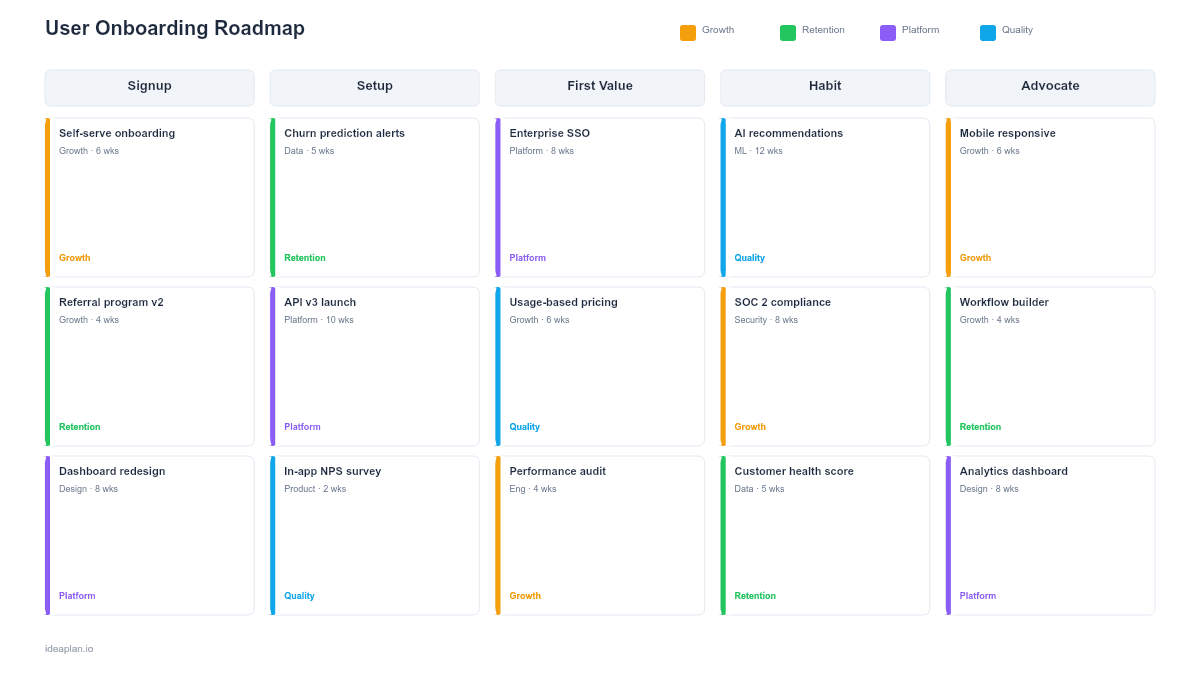
This free PowerPoint template breaks onboarding improvement into four workstreams. Signup flow, activation sequence, education touchpoints, and measurement. Each planned across three time horizons. It helps growth and product teams coordinate the dozens of small changes that add up to a meaningfully better first-run experience. Download the .pptx, map your current onboarding gaps, and build a shared plan for reducing time to value.
What This Template Includes
- Cover slide. Product name, current activation rate baseline, and target activation rate with timeframe.
- Instructions slide. How to map your onboarding funnel, identify drop-off points, and prioritize improvements. Remove before presenting.
- Blank template slide. Three time-horizon columns (Now, Next, Later) with four workstream rows. Placeholder cards for each planned improvement.
- Filled example slide. A B2B SaaS onboarding roadmap showing 16 specific improvements across signup, activation, education, and measurement, with current and target metrics for each workstream.
Why Onboarding Needs a Dedicated Roadmap
Onboarding sits at the intersection of product, growth, marketing, and customer success. Without a dedicated plan, improvements happen in fragments. Marketing tweaks the signup page, product adds a tooltip, support writes a help article. With no one tracking how these pieces connect.
The cost of a poor onboarding experience compounds over time. Every percentage point of activation rate you lose means fewer users reach the moment where your product clicks for them. For a product with 10,000 monthly signups, improving activation from 30% to 40% means 1,000 more activated users per month. Without spending a dollar on acquisition.
An onboarding roadmap makes three things explicit:
- Where users drop off. The specific steps in your funnel where people leave.
- What you are doing about each drop-off. Concrete experiments and improvements, not vague intentions.
- When each improvement ships. Timelines that growth, product, and engineering can commit to together.
For teams measuring onboarding effectiveness, the onboarding completion rate metric and aha moment completion metric provide the quantitative foundation this roadmap builds on.
Template Structure
Time Horizon Columns
Three columns use the Now-Next-Later format rather than fixed dates. Onboarding improvements are often experiments with uncertain outcomes, so time horizons work better than calendar commitments:
- Now (0-4 weeks). Improvements in progress or ready to ship. High confidence, scoped, assigned.
- Next (1-3 months). Validated ideas ready for design and engineering. Medium confidence.
- Later (3-6 months). Strategic bets and larger structural changes. Lower confidence, subject to what you learn from Now and Next experiments.
Workstream Rows
Four rows cover the full onboarding journey:
- Signup Flow. Everything from first landing page visit to account creation. Form fields, social login, email verification, plan selection.
- Activation Sequence. The guided steps that move a new user from "account exists" to "first value moment." Setup wizards, sample data, guided tours.
- Education Touchpoints. Emails, in-app messages, tooltips, and help content that support the new user outside the core activation flow.
- Measurement. Instrumentation, dashboards, and experiments needed to track whether improvements are working.
Metric Targets
Each workstream row includes a baseline metric and a target. Signup Flow might track signup completion rate (baseline: 62%, target: 75%). Activation Sequence might track time to first key action (baseline: 3.2 days, target: 1 day).
How to Use This Template
1. Map your current onboarding funnel with numbers
Document every step from first visit to activated user. Attach a conversion rate to each step. The step with the largest absolute drop-off is usually your highest-impact starting point. The customer journey mapping guide provides a method for this.
2. Categorize improvements by workstream
Sort your backlog of onboarding ideas into the four workstream rows. Some improvements span workstreams. A new setup wizard (Activation) that triggers a follow-up email (Education). Place these in the primary workstream and note the cross-dependency.
3. Prioritize within each workstream
Within each row, sequence cards by expected impact and effort. Quick wins with clear evidence (e.g., reducing form fields from 8 to 4) go in Now. Larger structural changes (e.g., rebuilding the activation wizard) go in Next or Later. The RICE framework helps when trade-offs are not obvious.
4. Set baseline and target metrics per workstream
Without metrics, you cannot tell if improvements are working. Each row needs a measurable outcome. Track day-1 retention as a lagging indicator of overall onboarding health.
5. Run experiments, measure, and rotate cards
Treat Now-column items as active experiments. When one ships and you measure results, move the card to a completed area or remove it. Pull the highest-priority Next item into Now. The roadmap should always reflect the current state of onboarding work.
When to Use This Template
The user onboarding roadmap fits when:
- Activation rates are below your target and you need a structured plan to improve them, not one-off fixes
- Multiple teams contribute to onboarding (product, growth, marketing, customer success) and need coordination
- You have data showing where users drop off but no prioritized plan for addressing each drop-off point
- Your product has recently changed (new features, new pricing, new user segments) and the onboarding flow has not caught up
- Leadership wants to see the growth investment plan and you need a single slide that shows the full scope of onboarding work
If your focus is the entire user journey beyond onboarding, the Customer Journey Roadmap PowerPoint template covers the full lifecycle. For a broader growth plan that includes acquisition and retention alongside activation, the Revenue Growth Roadmap template provides a wider lens.
Featured in
This template is featured in Customer Success and Retention Roadmap Templates, a curated collection of roadmap templates for this use case.
Key Takeaways
- Onboarding improvements compound: small gains in activation rate translate to large increases in active users over time.
- Four workstreams (signup, activation, education, measurement) ensure no part of the onboarding experience is overlooked.
- Now-Next-Later horizons match the experimental nature of growth work better than fixed calendar dates.
- Every workstream needs a baseline metric and a target. Without numbers, you cannot tell if changes are working.
- Treat the roadmap as a living experiment tracker, not a fixed plan. Update it as results come in.
- Compatible with Google Slides, Keynote, and LibreOffice Impress. Upload the
.pptxto Google Drive to edit collaboratively in your browser.