Quick Answer (TL;DR)
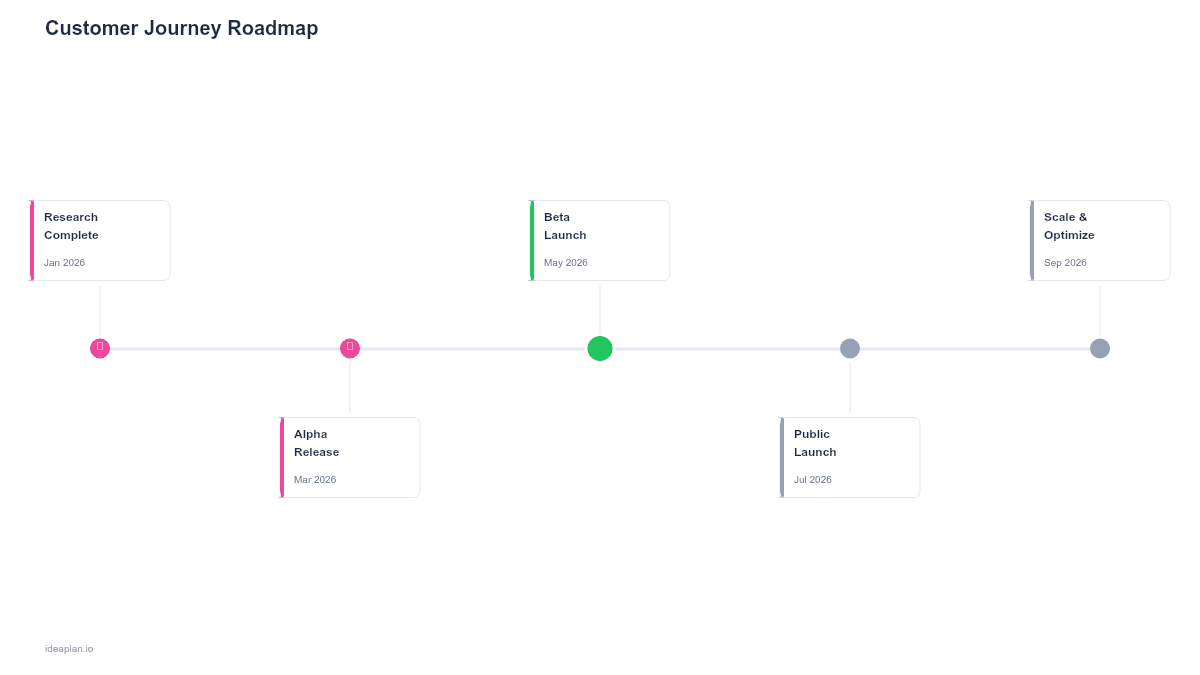
This free PowerPoint template maps product initiatives to customer journey stages: Awareness, Acquisition, Activation, Retention, Revenue, and Referral. Each stage shows its key metric, current performance, and planned initiatives. Download the .pptx, fill in your stage metrics, and use it to align product, marketing, and growth teams around the full customer lifecycle.
What This Template Includes
- Cover slide. Product name, planning period, and the lifecycle framework used (defaulting to AARRR pirate metrics).
- Instructions slide. How to define stages, assign metrics, and map initiatives. Remove before presenting.
- Blank template slide. Six stage columns (Awareness, Acquisition, Activation, Retention, Revenue, Referral) with metric cards and initiative slots per stage.
- Filled example slide. A SaaS product journey roadmap with 15 initiatives distributed across all six stages, each with a metric baseline and target.
Why Map Your Roadmap to the Customer Journey
Most product roadmaps organize work by team, quarter, or theme. A customer journey roadmap organizes work by where it impacts the user's experience. This perspective shift reveals gaps and imbalances that other formats hide.
For example, a team might have five initiatives improving the core product (Retention stage) but nothing addressing why trial users never complete onboarding (Activation stage). A standard feature roadmap would not surface this imbalance. A journey roadmap makes it obvious: the Activation column is empty.
The customer journey mapping guide covers the research process for identifying pain points at each stage. This template takes the output of that research and turns it into a prioritized plan.
Template Structure
Stage Columns
Six columns represent the customer lifecycle from first contact to advocacy:
- Awareness. How prospects discover your product. Initiatives here are typically marketing-led: content, SEO, events, partnerships.
- Acquisition. How prospects become users. Signup flow improvements, landing page optimization, free trial design.
- Activation. How new users experience first value. Onboarding flows, setup wizards, time-to-value reduction.
- Retention. How users keep coming back. Feature improvements, habit loops, re-engagement campaigns.
- Revenue. How users convert to paying customers or expand. Pricing changes, upsell prompts, plan upgrades.
- Referral. How users bring in new users. Invite features, referral programs, advocacy tools.
This framework follows the AARRR model. Adapt the stage names to match your business. Some teams merge Awareness and Acquisition, others split Retention into "Engagement" and "Renewal."
Metric Cards
Each column header includes a metric card showing:
- Primary metric. The number that defines success for this stage (e.g., signup rate, Day 7 retention, expansion revenue).
- Current baseline. Where the metric stands today.
- Target. Where you want it by the end of the planning period.
These metrics connect each initiative to a measurable outcome. If an initiative does not plausibly move a stage metric, it probably belongs on a different roadmap.
Initiative Cards
Below each metric card, 2-3 initiative cards show the planned work for that stage:
- Initiative name. Short label (e.g., "Guided onboarding v2," "Annual plan discount").
- Team owner. Product, growth, marketing, or engineering. The journey format naturally surfaces cross-functional ownership.
- Effort. T-shirt size estimate.
- Expected impact. How much this initiative should move the stage metric.
How to Use This Template
1. Define your stages
Start with the six AARRR stages and customize to fit your business. A B2B SaaS product might replace "Referral" with "Expansion" if account growth matters more than viral loops. An e-commerce product might add "Post-Purchase" between Revenue and Referral.
2. Assign metrics to each stage
Pick one primary metric per stage. Resist the urge to track multiple metrics per stage on this slide. That belongs in a metrics dashboard. The roadmap needs a single focal number. For metric selection guidance, see the product metrics guide.
3. Map current initiatives
Place your existing in-flight work into the appropriate stage columns. This step alone is revealing. Most teams discover that 60-70% of their work falls in one or two stages, leaving other stages with no planned investment.
4. Fill the gaps
Look at empty or sparse columns. If Activation has no initiatives but your signup-to-active conversion is 22%, that gap is a strategic problem. Brainstorm 1-2 high-impact initiatives for underserved stages.
5. Balance and prioritize
You do not need equal investment in every stage. But you do need conscious allocation. If 80% of your roadmap is Retention work, make sure that is a deliberate choice based on where the biggest opportunity lies, not an accident of who asked loudest.
6. Present cross-functionally
The journey format works best in meetings that include product, marketing, growth, and customer success. Each team sees their contribution in context. Marketing sees how their Awareness work feeds into Acquisition initiatives owned by product. Customer success sees how Retention features address their top churn reasons.
When to Use This Template
A customer journey roadmap is the right choice when:
- Growth is the primary focus and the team needs to identify which lifecycle stage has the biggest opportunity
- Cross-functional alignment between product, marketing, and customer success is needed
- Funnel metrics are declining and leadership wants a plan that addresses specific conversion points
- Board or executive presentations need to show how product work impacts the full user lifecycle
- New market entry where the team is building the journey from scratch and needs to plan the full journey
If your team is focused on a single lifecycle stage (e.g., pure retention work), a simpler format like the quarterly PowerPoint template may be easier to maintain. For an outcome-driven format without lifecycle structure, the Outcome-based Roadmap PowerPoint template focuses on measurable targets.
Featured in
This template is featured in Customer Success and Retention Roadmap Templates, a curated collection of roadmap templates for this use case.
Key Takeaways
- Customer journey roadmaps organize work by lifecycle stage, making investment gaps visible at a glance.
- Six AARRR stages (Awareness through Referral) provide a complete lifecycle framework.
- Metric cards per stage connect every initiative to a measurable outcome.
- The format naturally surfaces cross-functional ownership and encourages joint planning with marketing, growth, and customer success.
- PowerPoint format lets you present the journey roadmap in executive reviews and cross-functional planning sessions.
- Compatible with Google Slides, Keynote, and LibreOffice Impress. Upload the
.pptxto Google Drive to edit collaboratively in your browser.