Quick Answer (TL;DR)
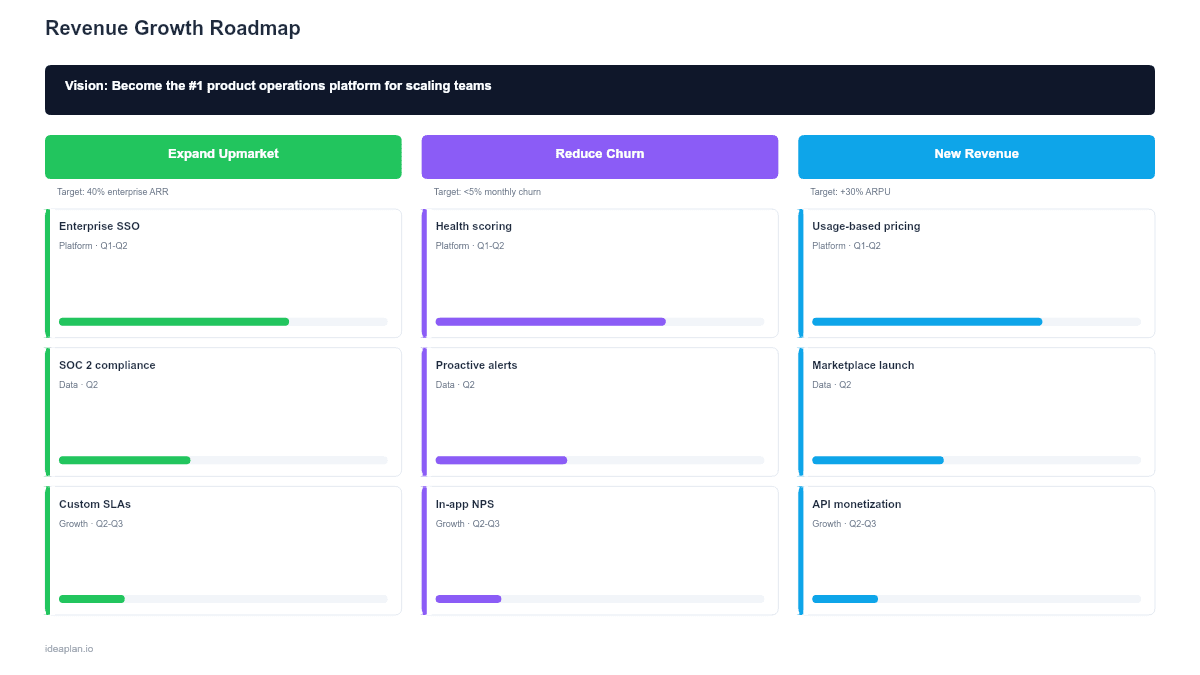
This free PowerPoint template maps product initiatives directly to revenue outcomes. ARR, NRR, expansion, and new logo targets. Each slide connects a growth lever (acquisition, activation, retention, expansion) to specific product bets with projected revenue impact. Download the .pptx, fill in your numbers, and use it to run revenue-focused planning sessions with product, sales, and finance.
What This Template Includes
- Revenue snapshot slide. Current ARR, MRR growth rate, NRR, and churn rate in a single view. Establishes the baseline before proposing initiatives.
- Growth lever breakdown slide. Four-quadrant view mapping initiatives to acquisition, activation, retention, and expansion. Each quadrant shows the top 2-3 product bets with estimated revenue impact.
- Initiative timeline slide. Quarterly gantt-style layout showing when each initiative ships and when revenue impact is expected to materialize.
- Financial model slide. Projected ARR waterfall showing how new MRR, expansion MRR, and churned MRR combine to reach the target.
- Risks and dependencies slide. Key assumptions, external dependencies, and downside scenarios that could affect the revenue forecast.
Why PowerPoint for Revenue Planning
Revenue planning involves product, sales, finance, and executive leadership. PowerPoint is the common denominator. Every function can review, annotate, and present from the same deck without tooling friction. The slide format also forces you to distill complex financial models into visual summaries that drive decisions rather than drown the audience in spreadsheet rows.
Template Structure
The template follows a "where we are, where we need to go, how we get there" structure.
Slide 1. Revenue Baseline. Current metrics set the starting point. Include ARR, MRR, NRR, gross churn, and expansion rate. Without a clear baseline, growth targets are arbitrary.
Slide 2. Growth Levers. Map each product initiative to the specific growth lever it affects. A new onboarding flow targets activation. A usage-based pricing tier targets expansion. A churn prediction feature targets retention. This mapping prevents the common mistake of building features without knowing which revenue metric they are supposed to move.
Slide 3. Initiative Timeline. Show delivery dates alongside expected revenue impact dates. Product ships in Q2, but the revenue impact may not appear until Q3. Making this lag visible prevents misaligned expectations between product and finance teams.
Slide 4. ARR Waterfall. A stacked bar chart showing how each growth lever contributes to the annual target. This visual makes trade-offs concrete: if expansion MRR falls short, which lever compensates?
How to Use This Template
1. Establish the revenue baseline
Pull current ARR, MRR, NRR, churn rate, and expansion rate from your billing system. If you do not track these yet, see the complete guide to product metrics for setup guidance. The baseline slide should show trailing 12-month trends, not just a snapshot.
2. Set targets by growth lever
Work with finance to set quarterly targets for each lever: new logos, activation rate improvement, churn reduction, and expansion revenue. Tie each target to a specific number. "reduce churn by 2 percentage points" is actionable; "improve retention" is not.
3. Map initiatives to levers
For each product initiative in your backlog, assign it to the growth lever it serves. If an initiative does not clearly connect to a revenue lever, question whether it belongs on this roadmap. Use the RICE framework to score initiatives within each lever.
4. Build the timeline and share
Sequence initiatives by expected revenue impact, not just engineering effort. Present to leadership with the ARR waterfall as the anchor slide. It shows the path from current ARR to the target and which bets carry the most weight.
When to Use This Template
Revenue growth roadmaps are most valuable during annual and quarterly planning, especially in SaaS companies where ARR growth is the primary success metric. Use this template when:
- Annual planning requires revenue-linked product bets and finance needs to see how product initiatives connect to the P&L
- NRR is below target and the team needs a focused plan to improve retention and expansion
- Product and sales are misaligned on which features drive revenue versus which features are interesting but revenue-neutral
- The board or investors want to see a product plan expressed in revenue terms, not feature lists
For product planning that is not primarily revenue-driven, consider an OKR roadmap or an outcome-based roadmap instead.
Featured in
This template is featured in Growth and Revenue Roadmap Templates, a curated collection of roadmap templates for this use case.
Key Takeaways
- Every product initiative on the roadmap should connect to a specific growth lever: acquisition, activation, retention, or expansion.
- The ARR waterfall slide makes trade-offs visible by showing how each lever contributes to the annual target.
- Account for the lag between shipping a feature and seeing revenue impact. Product ships in Q2, revenue may materialize in Q3.
- Set numeric targets per lever rather than vague goals. "Reduce churn by 2 points" drives action; "improve retention" does not.
- Review and adjust quarterly as actual revenue data replaces projections.
- Compatible with Google Slides, Keynote, and LibreOffice Impress. Upload the
.pptxto Google Drive to edit collaboratively in your browser.