Quick Answer (TL;DR)
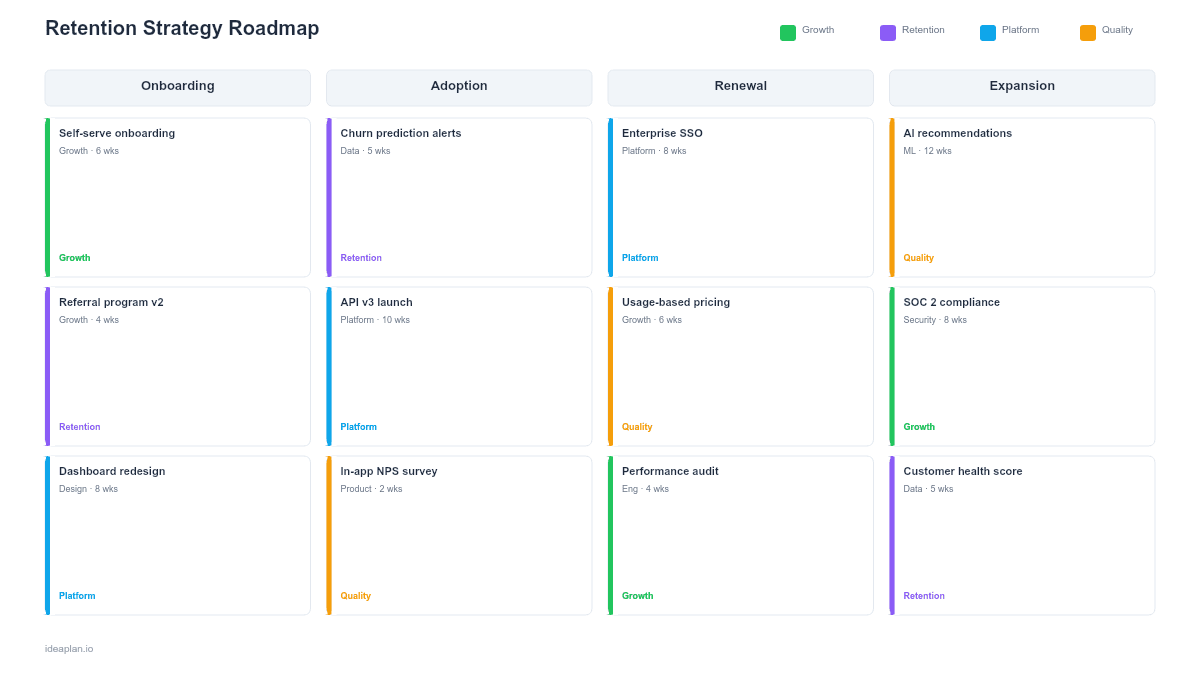
This free PowerPoint template structures your retention efforts across five workstreams. Early lifecycle, engagement depth, at-risk intervention, win-back campaigns, and measurement. Planned on a quarterly timeline. It gives growth and product teams a coordinated view of every initiative aimed at keeping users active and reducing churn. Download the .pptx, map your retention gaps to the workstreams, and present a concrete plan for improving net revenue retention.
What This Template Includes
- Cover slide. Product name, current retention rate and churn rate, target metrics, and the timeframe for achieving them.
- Instructions slide. How to diagnose retention problems, segment users by risk, and prioritize interventions. Remove before presenting.
- Blank template slide. Four quarterly columns with five workstream rows. Placeholder cards for each retention initiative, including expected impact and measurement approach.
- Filled example slide. A B2B SaaS retention roadmap showing 20 initiatives across four quarters, moving from quick wins (improved onboarding emails, health score alerts) to structural changes (product value expansion, community building), with churn reduction targets per quarter.
Why Retention Deserves a Strategic Roadmap
Acquiring a new customer costs 5-7x more than retaining an existing one. Despite this, most product teams spend 80% of their roadmap on acquisition-oriented features and 20% on retention. The math does not add up.
Retention is also deceptive in its complexity. Churn is not a single problem. It is dozens of different problems wearing the same metric. A user who leaves because they never activated is a completely different problem from a user who leaves after 18 months because a competitor shipped a feature they need. A single "reduce churn" initiative cannot address both.
A retention roadmap decomposes the problem into addressable workstreams:
- Where in the lifecycle do users leave?. New users churning in the first 30 days is an activation problem. Mature users churning after a year is a value or competitive problem.
- What signals predict churn before it happens?. Building a customer health score gives your team time to intervene.
- Which interventions have the highest expected impact per cohort?. Not every churning user is worth the same investment to save.
Template Structure
Quarterly Columns
Four columns represent calendar quarters. Retention work benefits from calendar-based planning because results take time to measure. A Q1 initiative's impact on monthly retention rate may not be visible until Q2.
Quarter 1 should focus on quick wins and instrumentation (you cannot fix what you do not measure). Quarters 2-3 should tackle the highest-impact retention levers. Quarter 4 should address longer-term structural improvements.
Workstream Rows
Five rows cover the full retention lifecycle:
- Early Lifecycle (0-30 days). Activation improvements, onboarding optimization, first-value acceleration. These initiatives reduce the "never activated" churn that inflates your overall churn number. See the activation rate metric for measurement approaches.
- Engagement Depth (30-180 days). Feature adoption campaigns, habit-forming loops, usage expansion beyond the initial use case. The goal is moving users from casual to committed.
- At-Risk Intervention (any stage). Health score monitoring, proactive outreach triggers, automated save campaigns. These target users showing disengagement signals before they cancel.
- Win-Back (post-churn). Re-engagement emails, return offers, product update announcements to churned users. Lower conversion rate than retention but still worth systematic effort.
- Measurement & Infrastructure. Health score development, churn prediction models, retention dashboards, cohort analysis setup. The data foundation that makes every other workstream effective.
Impact Sizing
Each card includes an estimated churn reduction impact: High (> 1 percentage point reduction), Medium (0.3-1 pp), Low (< 0.3 pp). Impact estimates are inherently uncertain, but sizing forces the team to think about expected value before committing engineering time.
How to Use This Template
1. Segment your churn by lifecycle stage
Pull your churn data and bucket it: what percentage of churned users left in the first 30 days? 31-90 days? 91-180 days? Beyond 180 days? This distribution tells you which workstream rows need the most attention. If 60% of churn happens in the first 30 days, the Early Lifecycle row should dominate Q1. Use cohort retention curves to visualize where users drop off.
2. Identify leading indicators for each segment
For each lifecycle stage, find the behavioral signals that predict churn. Users who do not complete onboarding within 7 days churn at 3x the rate. Users whose login frequency drops below once per week churn within 60 days. These signals become the triggers for At-Risk Intervention initiatives.
3. Prioritize by expected impact and effort
Score each initiative using the RICE framework or a similar model. A health score alert system (medium effort) that prevents 50 churns per month beats a full product redesign (massive effort) that might prevent 60. Start with the initiatives that have the best ratio of impact to engineering investment.
4. Build measurement before interventions
Place instrumentation and dashboard work in Q1, even if it delays some intervention launches. Running retention campaigns without measurement means you cannot tell what works. You need baseline retention by cohort data and a working health score before the At-Risk Intervention row can function effectively.
5. Review monthly with cross-functional retention team
Retention work spans product, customer success, marketing, and data teams. Monthly reviews keep everyone aligned on what is working, what is not, and where to reallocate effort. Track the overall customer churn rate as the north star, but use workstream-specific metrics to diagnose which initiatives drive the change.
When to Use This Template
The retention strategy roadmap fits when:
- Churn is a material business problem. Your gross revenue retention is below your industry benchmark and leadership has made retention a priority
- Multiple teams contribute to retention (product, customer success, growth, data) and need a shared plan rather than independent efforts
- You have enough data to segment churn by lifecycle stage and identify leading indicators. If you are pre-data, start with the Measurement & Infrastructure row only.
- Quick fixes have been exhausted. You have already patched the obvious issues and need a structured, multi-quarter approach to sustained retention improvement
- Investors or the board are tracking retention metrics and you need to show a credible plan for improvement, not just a target number
If your retention problem is concentrated in the first 30 days, the User Onboarding Roadmap PowerPoint template provides a more focused format for that specific workstream. For a broader view that includes acquisition and expansion alongside retention, the Revenue Growth Roadmap template covers the full growth picture.
Featured in
This template is featured in Customer Success and Retention Roadmap Templates, a curated collection of roadmap templates for this use case.
Key Takeaways
- Churn is not one problem. It is dozens of problems at different lifecycle stages. Segment before you intervene.
- Five workstreams (Early Lifecycle, Engagement Depth, At-Risk Intervention, Win-Back, Measurement) ensure no retention lever is ignored.
- Build measurement and health scoring infrastructure in Q1. You cannot improve what you do not track.
- Prevention delivers 3-5x higher ROI than win-back. Weight your roadmap toward keeping users, not recovering them.
- Monthly cross-functional reviews keep product, customer success, and growth teams aligned on what is working and where to shift effort.
- Compatible with Google Slides, Keynote, and LibreOffice Impress. Upload the
.pptxto Google Drive to edit collaboratively in your browser.