Quick Answer (TL;DR)
This free PowerPoint template structures your response after a service failure. From immediate customer acknowledgment through compensation, root cause resolution, and long-term prevention. It coordinates support, engineering, and customer success on a shared timeline so affected customers experience a deliberate recovery rather than scattered damage control. Download the .pptx, customize the compensation tiers and communication cadence, and turn your next service failure into a trust-building moment.
What This Template Includes
- Cover slide. Service name, failure date, affected customer count, and designated recovery lead.
- Instructions slide. How to classify service failures by severity, choose compensation tiers, and measure recovery success. Remove before sharing externally.
- Impact and segmentation slide. A grid segmenting affected customers by impact severity (full outage, degraded service, minor disruption) and account tier (enterprise, mid-market, self-serve), with compensation recommendations for each cell.
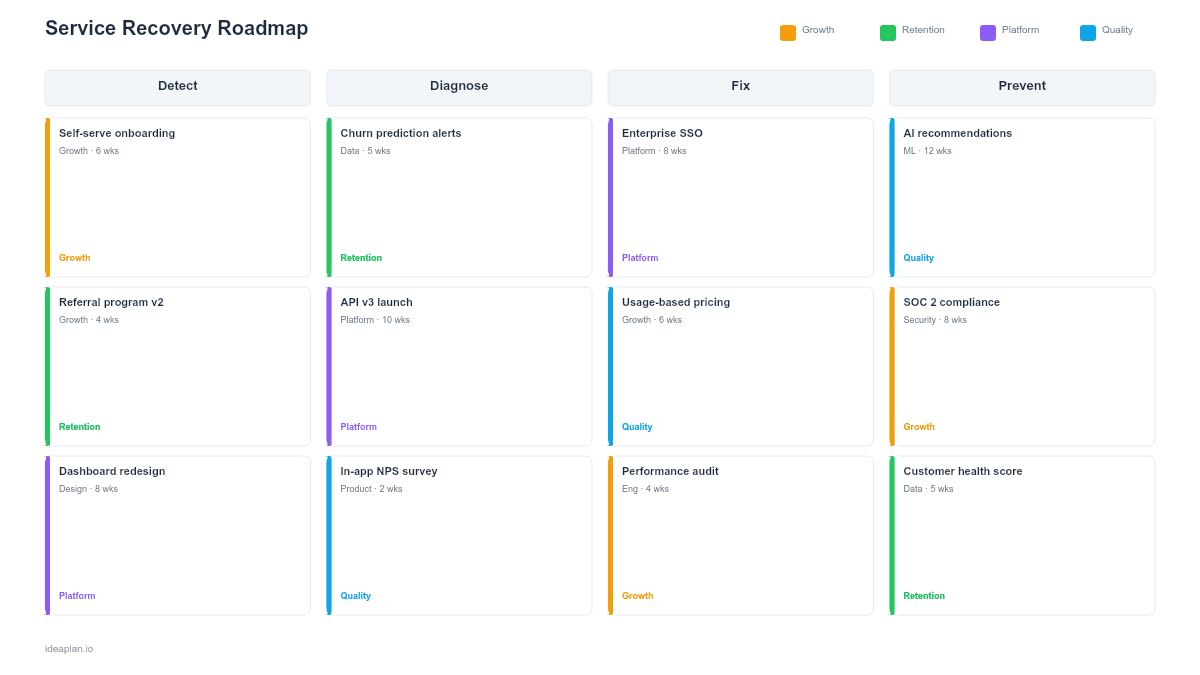
- Recovery timeline slide. Five phases (Acknowledge, Stabilize, Compensate, Fix, Prevent) with parallel tracks for Customer Communication, Engineering, and Customer Success. Each task card includes owner, deadline, and success metric.
- Filled example slide. A SaaS product recovering from an 8-hour API outage: status page updated within 5 minutes, enterprise accounts called within 1 hour, service credits issued within 48 hours, root cause fix shipped within 1 week, and monitoring improvements deployed within 2 weeks.
Why Service Recovery Deserves Its Own Plan
Research on the "service recovery paradox" shows that customers who experience a well-handled failure often become more loyal than customers who never had a problem. The key word is "well-handled." Most teams handle the technical fix but fumble the customer experience of the recovery.
The gap happens because recovery spans multiple teams with different priorities. Engineering focuses on the fix. Support focuses on ticket volume. Customer success focuses on at-risk renewals. Nobody owns the end-to-end customer experience of going from "something is broken" to "we fixed it, here is what we are doing to prevent it, and here is something for your trouble."
This template creates that ownership. It assigns every recovery action to a specific person, ties it to a timeline, and measures whether the recovery actually restored customer confidence. The customer experience roadmap template covers ongoing CX improvement; this template handles the acute recovery phase.
Template Structure
Customer Segmentation Matrix
Not every affected customer gets the same recovery treatment. The matrix crosses impact severity with account value to produce nine cells, each with a recommended response:
- High impact + Enterprise. Personal call from executive sponsor, service credits, and a private post-mortem briefing.
- High impact + Self-serve. In-app notification, email with service credits, and a published post-mortem.
- Low impact + Enterprise. Proactive email from CSM acknowledging the issue.
- Low impact + Self-serve. Status page update and email summary.
This segmentation prevents the two most common mistakes: over-communicating to minimally affected users (who did not even notice) and under-communicating to badly affected enterprise accounts (who are evaluating competitors).
Five Recovery Phases
- Acknowledge (0-1 hour). Confirm the issue to all affected customers through appropriate channels. Do not wait for root cause.
- Stabilize (1-8 hours). Restore service to an acceptable state, even if the root cause is not yet fixed. A workaround that gets customers unblocked is more valuable than a perfect fix that takes days.
- Compensate (24-72 hours). Issue credits, extend trials, or provide other tangible acknowledgment based on the segmentation matrix.
- Fix (1-2 weeks). Ship the root cause fix and verify it resolves the underlying issue. Communicate the fix to affected customers.
- Prevent (2-4 weeks). Implement monitoring, testing, and process changes that reduce the likelihood of recurrence. Measure customer satisfaction to confirm trust recovery.
How to Use This Template
1. Segment affected customers within the first hour
Pull affected account data from your product analytics. Cross-reference with account tier and contract value. The segmentation determines the entire recovery plan. Who gets called, who gets emailed, and who gets credits. Do not treat all affected customers identically.
2. Acknowledge before you diagnose
Send the first customer communication within 30 minutes. It does not need to explain the root cause. It needs to confirm three things: we know about the issue, we are working on it, and here is when we will update you next. This follows the principles outlined in the stakeholder management guide.
3. Match compensation to impact and expectations
Enterprise customers with SLAs expect credits calculated against their SLA terms. Self-serve customers respond better to extended trial days or feature access. The compensation tier matrix in the template provides defaults you should adjust based on your pricing model and contractual obligations.
4. Close the loop with every affected customer
After the fix ships, send a resolution email that includes: what happened, what you fixed, and what you changed to prevent recurrence. This final communication is the one most teams skip, and it is the one that determines whether customers feel the recovery was complete. Track net promoter score for affected accounts in the following quarter to measure trust recovery.
When to Use This Template
The service recovery roadmap fits when:
- A service failure affects customers for more than 1 hour and simple status page updates are not sufficient
- Enterprise accounts are impacted and require personalized outreach and potential SLA credit calculations
- Customer churn risk is elevated because the failure affected a core workflow or happened during a critical business period
- Multiple teams need coordination. Support handling inbound tickets, CS doing proactive outreach, engineering deploying fixes
- You want to measure recovery effectiveness beyond just "is the service back up"
For incidents that are primarily technical with minimal customer-facing impact, the incident response roadmap covers the engineering response. For ongoing support process improvements, the support escalation roadmap is more appropriate.
Featured in
This template is featured in Customer Success and Retention Roadmap Templates, a curated collection of roadmap templates for this use case.
Key Takeaways
- Well-handled service recovery can increase customer loyalty beyond pre-failure levels, but only if the recovery experience is deliberate and complete.
- Segment affected customers by impact severity and account tier. Different segments need different communication channels, timing, and compensation.
- Acknowledge within 30 minutes, stabilize within hours, compensate within 48 hours, fix within 2 weeks, and prevent within 4 weeks.
- The resolution email is the most skipped and most important step. Tell customers what happened, what you fixed, and what changed.
- Measure recovery success through satisfaction scores and churn rates for affected accounts, not just uptime restoration.
- Compatible with Google Slides, Keynote, and LibreOffice Impress. Upload the
.pptxto Google Drive to edit collaboratively in your browser.