Quick Answer (TL;DR)
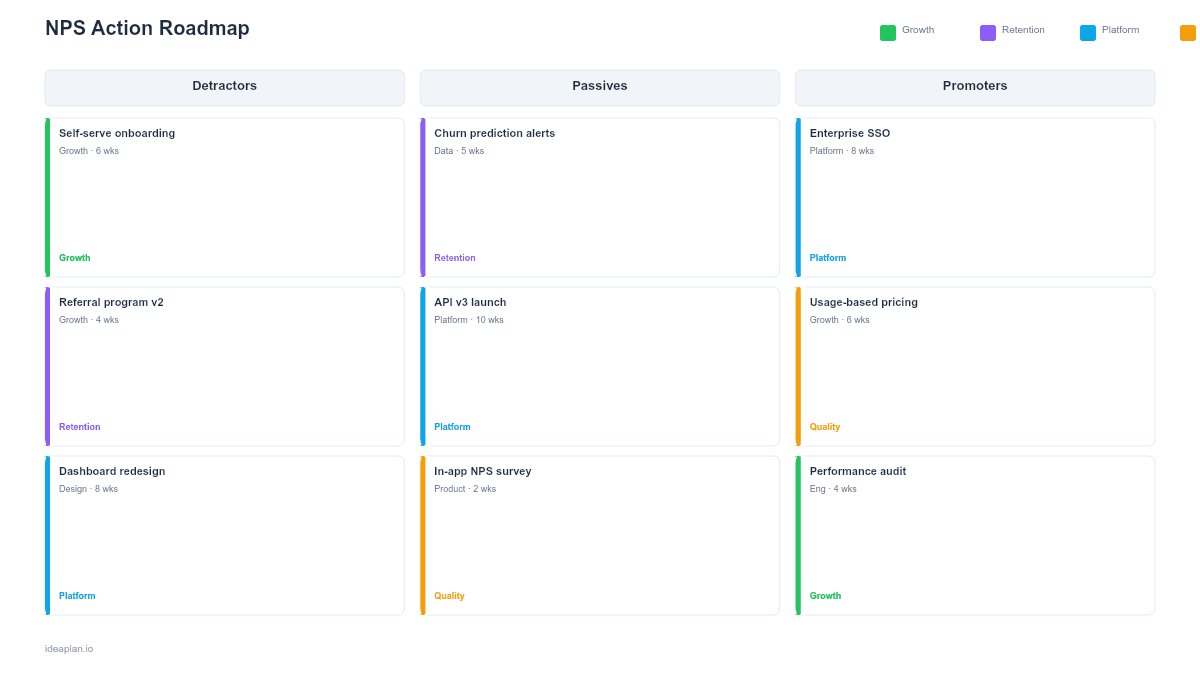
An NPS score without an action plan is a vanity metric. This free PowerPoint template turns NPS survey results into structured initiatives: recovering detractors, converting passives to promoters, activating promoters as advocates, and improving the survey program itself. Each slide maps a specific NPS segment to the interventions that move the score. Download the .pptx, plug in your latest NPS data, and present a plan that treats Net Promoter Score as an input to action rather than a number to report.
What This Template Includes
- NPS snapshot slide. Current score, response rate, and segment distribution (promoters, passives, detractors) with trend data from the past four survey cycles.
- Detractor recovery slide. Top detractor themes categorized by root cause, with intervention playbooks and ownership assignments for each theme.
- Passive conversion slide. Analysis of what separates passives from promoters, with targeted initiatives to close the gap.
- Promoter activation slide. Programs to turn high scores into business outcomes: referrals, case studies, reviews, and advocacy.
Why NPS Needs an Action Roadmap
The typical NPS program runs like this: send a survey, calculate the score, put it in a slide deck, present it at the leadership meeting, move on. The score fluctuates between quarters and nobody can explain why. Detractors complain, passives stay silent, and promoters are never asked to do anything with their enthusiasm.
The problem is not the metric. It is the absence of a response system. NPS becomes valuable when each score triggers a specific action. A detractor response triggers a root cause investigation and a recovery outreach. A passive response triggers an analysis of what would move them to promoter status. A promoter response triggers an advocacy request. Without these action loops, NPS is a temperature reading that does not treat the patient.
The roadmap also forces the team to address NPS program design: survey timing, question structure, response rates, and follow-up cadences. A program with a 15% response rate and no follow-up questions is generating incomplete data. Improving the program itself is as important as acting on the results.
Template Structure
NPS Snapshot Dashboard
The snapshot slide establishes the baseline:
- Overall NPS. The headline number, trending over the past 4-8 survey cycles.
- Segment distribution. Percentage of respondents in each bucket (0-6 detractors, 7-8 passives, 9-10 promoters) with count and ARR per segment.
- Response rate. Percentage of surveyed customers who responded. Low response rates (below 25%) indicate survey fatigue or poor timing.
- Top themes by segment. The 3-5 most common open-text themes from each segment. This qualitative data is more actionable than the score itself.
Detractor Recovery Program
Detractors (scores 0-6) are actively dissatisfied. The recovery program has three components:
- Immediate follow-up. Every detractor gets a personal outreach within 48 hours of responding. Not a form email. A human message from someone who can help. The goal is to understand the specific issue and demonstrate that the feedback was heard.
- Theme-based intervention. Group detractor feedback into root cause categories (product gaps, support failures, pricing frustration, onboarding problems). Assign each category to the team that owns the fix. Product gaps go to the PM. Support failures go to the support manager. This is where NPS connects to your product roadmap.
- Recovery tracking. Follow up with detractors 60 days after intervention to ask for an updated score. Track the detractor-to-passive and detractor-to-promoter conversion rates. These rates measure whether recovery efforts actually work.
Passive Conversion Strategy
Passives (scores 7-8) are satisfied but unenthusiastic. They are the easiest segment to move, because the gap between passive and promoter is often a single unresolved friction point. The conversion strategy involves:
- Gap analysis. Compare feature usage, support interactions, and onboarding completion between passives and promoters. The differences reveal what promoters experience that passives do not.
- Targeted nudges. If promoters use feature X at 3x the rate of passives, build adoption campaigns for feature X targeted at the passive segment.
- Friction removal. If passives cite specific complaints (slow performance, missing integration, confusing pricing), these become prioritized roadmap items.
Promoter Activation
Promoters (scores 9-10) are your most valuable asset, but only if you activate their enthusiasm. The activation slide covers:
- Referral program. Ask promoters to refer peers. Track referral rate and referral-to-customer conversion by promoter cohort.
- Case study pipeline. Invite promoters to participate in case studies and testimonials. A promoter who has agreed to a case study is 3x more likely to renew.
- Review campaigns. Request G2, Capterra, or app store reviews from recent promoters. Timing matters. Ask within 48 hours of the NPS response when sentiment is fresh.
- Advisory board recruitment. Invite top promoters to join a customer advisory board where they can influence the roadmap and deepen their investment in the product.
How to Use This Template
1. Pull and segment your NPS data
Export results from your latest survey cycle. Calculate overall NPS, segment distribution, and response rate. Extract open-text responses and categorize them by theme. If your current survey only captures a score without a follow-up question, add "What is the primary reason for your score?" to the next cycle. The qualitative data is essential for action planning.
2. Design the detractor recovery workflow
Build the outreach sequence: who contacts detractors, within what timeframe, using what channel, and with what message. Assign theme-based ownership for root causes. Set a 60-day follow-up cadence to measure recovery. If your customer health score flags detractors as at-risk, coordinate NPS follow-up with existing CS intervention workflows to avoid duplicate outreach.
3. Analyze the passive-promoter gap
Run a comparative analysis between your passive and promoter segments. Look at product usage patterns, onboarding completion, support interactions, account age, and plan tier. Identify the 2-3 factors with the strongest correlation to promoter status. These factors become your conversion targets.
4. Build promoter activation programs
Select 2-3 activation channels (referrals, reviews, case studies) and create the outreach templates and tracking. Time activation requests close to the NPS response. A promoter who scored you 9 yesterday is more receptive than one who scored you 9 three months ago. Track activation rate (percentage of promoters who take the requested action) as a program KPI.
5. Improve the survey program itself
Review response rates, survey timing, and question design. If response rates are below 25%, experiment with delivery timing (in-app vs. email), survey length (shorter converts better), and incentives. If you survey annually, consider moving to quarterly to capture trends. The customer satisfaction metric guide covers survey design best practices that apply to NPS programs.
When to Use This Template
An NPS action roadmap adds the most value when:
- NPS is measured but not acted on. The score is reported to leadership quarterly but no structured response system exists for any segment
- Detractor volume is high and the team suspects specific product or service issues are driving low scores but has not systematically investigated
- Passive segment is large (typically 40-60% of respondents) and represents a significant conversion opportunity with relatively low effort
- Promoters are untapped. High scores exist but the company does not have referral, review, or advocacy programs that channel promoter enthusiasm into business results
- Response rates are declining and the survey program needs design improvements to remain useful
For a broader customer feedback program that spans multiple channels beyond NPS, the Voice of Customer Roadmap covers the full program design. For general retention planning, the Retention Strategy Roadmap addresses retention across the full customer lifecycle.
Featured in
This template is featured in Customer Success and Retention Roadmap Templates, a curated collection of roadmap templates for this use case.
Key Takeaways
- NPS without action is a vanity metric. Every score segment (detractor, passive, promoter) needs a defined response workflow.
- Detractor recovery within 48 hours demonstrates that feedback matters. Group detractor themes by root cause and route them to the team that owns the fix.
- Passives are the easiest segment to move. Identify what differentiates promoters from passives in product usage and close the gap with targeted adoption campaigns.
- Promoters are a growth asset. Activate them through referral programs, case studies, and review campaigns timed close to their survey response.
- Improve the survey program alongside the action plan. Low response rates and missing follow-up questions limit the data you can act on.
- Compatible with Google Slides, Keynote, and LibreOffice Impress. Upload the
.pptxto Google Drive to edit collaboratively in your browser.