Quick Answer (TL;DR)
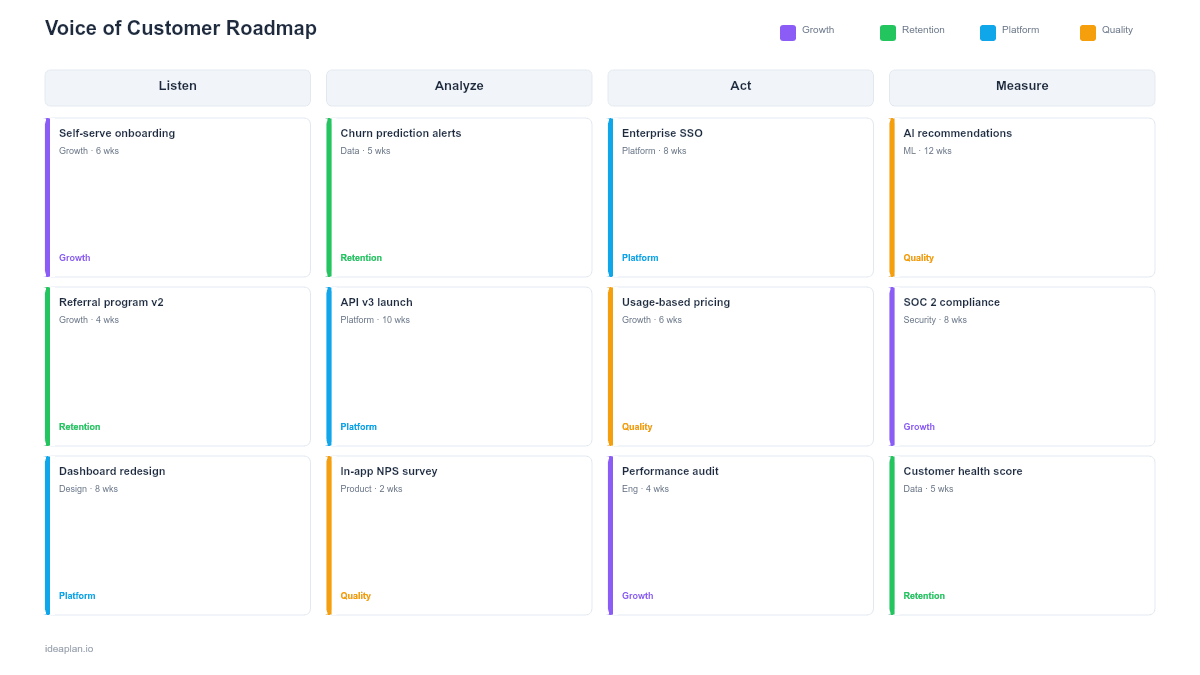
Collecting feedback is easy. Turning it into product decisions is hard. This free PowerPoint template structures a complete voice of customer program: which channels to deploy, how feedback gets analyzed and themed, where insights are distributed, and how the team tracks whether customer input actually changes the product. Download the .pptx, map your current VoC state, and present a phased plan for building a program that connects what customers say to what you ship.
What This Template Includes
- Channel map slide. All feedback channels (surveys, interviews, support, in-app, advisory board, social) mapped by type, owner, volume, and signal quality.
- Analysis workflow slide. The process from raw feedback to themed insights: tagging taxonomy, analysis cadence, and the cross-functional team responsible for synthesis.
- Insight distribution slide. How insights reach decision-makers: dashboards, weekly digests, quarterly reports, and embedded metrics in product planning documents.
- Action tracking slide. A closed-loop system showing which product changes originated from VoC insights, with impact measurement and customer communication.
Why VoC Programs Need a Roadmap
Most companies collect customer feedback. Few do anything useful with it. The typical failure mode: multiple teams run surveys, collect support tickets, and conduct interviews independently. Each team sees a fragment of the picture. Nobody synthesizes the fragments into themes. Nobody tracks whether themes turn into product changes. Customers fill out surveys, hear nothing back, and stop responding.
A VoC roadmap prevents this by treating the feedback program as a product itself. With defined inputs, processing steps, outputs, and success metrics. Phase 1 audits and consolidates existing channels. Phase 2 builds the analysis layer that turns raw feedback into themed insights. Phase 3 distributes insights to the teams that make product decisions. Phase 4 closes the loop by tracking which decisions were influenced by VoC data and communicating changes back to customers.
The phased approach matters because building everything at once overwhelms the team and produces a program that is broad but shallow. Starting with channel consolidation, then adding analysis, then distribution, then closed-loop tracking builds capability progressively and shows results at each stage.
Template Structure
Channel Map
The channel map is a grid showing every feedback input:
| Channel | Type | Owner | Frequency | Volume | Signal Quality |
|---|---|---|---|---|---|
| NPS survey | Quantitative | CX | Quarterly | 200 responses | Medium |
| Support tickets | Qualitative | Support | Continuous | 500/month | High |
| Customer interviews | Qualitative | Product | Monthly | 8/month | Very High |
| In-app feedback | Mixed | Product | Continuous | 100/month | Medium |
| Advisory board | Qualitative | CS | Quarterly | 10 accounts | Very High |
| App store reviews | Qualitative | Marketing | Continuous | 30/month | Low |
The goal is not to maximize channels but to ensure coverage across quantitative and qualitative research methods, across customer segments, and across lifecycle stages. Gaps in the map become roadmap items.
Analysis Workflow
Raw feedback is noise until it is themed, prioritized, and connected to product decisions. The analysis workflow has three cadences:
- Weekly. Support tickets and in-app feedback tagged by theme. Auto-tagging handles volume; manual review catches nuance. Output: weekly theme frequency report.
- Monthly. Cross-channel synthesis session. Product, CX, and support teams review the top themes from all channels, compare against the current roadmap, and flag themes that warrant investigation. Output: monthly insight brief.
- Quarterly. Deep analysis combining quantitative trends (NPS, CSAT, theme frequency) with qualitative insights (interview highlights, advisory board feedback). Output: quarterly VoC report presented to leadership.
Insight Distribution
Insights trapped in a report that nobody reads are wasted. The distribution plan ensures insights reach the right people in the right format:
- Product planning. Top VoC themes embedded in PRDs and sprint planning documents. Every feature proposal includes the VoC data that supports or contradicts it.
- Leadership dashboards. Monthly VoC health metrics: response rates, top themes, sentiment trends, and feedback-to-feature conversion rate.
- CS and sales enablement. Real-time theme alerts for customer-facing teams so they can address emerging concerns proactively.
How to Use This Template
1. Audit existing feedback channels
Map every way customers provide feedback today. For each channel, document: who owns it, what volume it generates, how the data is stored, and whether anyone reviews it systematically. The user research methods guide can help identify channel types you may be missing. Common gaps: no structured way to capture sales call feedback, no mechanism for customer-initiated feature requests, or no feedback channel for churned customers.
2. Consolidate and tag
Choose a central repository for feedback. A dedicated tool, a shared database, or even a well-structured spreadsheet. Import data from all channels. Build a tagging taxonomy with 15-20 theme categories (e.g., onboarding friction, missing integration, pricing confusion, performance issues). Keep the taxonomy narrow enough to be useful; too many tags dilutes analysis.
3. Establish analysis cadences
Assign a weekly owner for tagging incoming feedback. Schedule a monthly synthesis session with representatives from product, CX, and support. Book the quarterly deep dive with leadership. These cadences are the engine of the VoC program. Without them, feedback accumulates but never becomes insight.
4. Connect insights to product decisions
The most important and most frequently skipped step. After each monthly synthesis, identify the top 3 themes and route them to the product team as potential roadmap candidates. Run them through your prioritization framework alongside other inputs. Track which themes make it onto the roadmap and which are deprioritized with documented reasons.
5. Close the loop with customers
When a product change ships that was influenced by VoC feedback, communicate it back to the customers who raised the issue. Targeted emails, changelog entries, and follow-up survey questions ("We shipped X based on your feedback. Is it solving the problem?") all close the loop. This step increases future feedback quality and participation rates.
When to Use This Template
A VoC roadmap is the right investment when:
- Customer feedback is collected but not acted on. Teams run surveys and interviews but cannot point to product decisions that resulted from the data
- Multiple teams collect feedback independently and there is no shared view of what customers are saying across channels
- Response rates are declining because customers do not see evidence that their input matters
- Product decisions rely on internal opinions rather than structured customer data, and leadership wants to change that
- The company is scaling and the informal feedback loops that worked with 50 customers break at 500 or 5,000
If your feedback program is already mature and you need to focus specifically on acting on NPS data, the NPS Action Roadmap provides a more focused template. For general customer feedback loop design, the Customer Feedback Roadmap covers the collection-to-action pipeline.
Featured in
This template is featured in Customer Success and Retention Roadmap Templates, a curated collection of roadmap templates for this use case.
Key Takeaways
- A VoC program is a system, not a survey. It requires channels, analysis, distribution, and closed-loop tracking to produce value.
- Map all existing feedback channels before adding new ones. Most companies collect more feedback than they analyze. The bottleneck is synthesis, not volume.
- Three analysis cadences (weekly tagging, monthly synthesis, quarterly deep dive) turn raw feedback into actionable insights on a predictable schedule.
- Connect insights directly to product planning by embedding VoC themes in PRDs and sprint planning. Insights that do not reach decision-makers are wasted.
- Close the loop by telling customers when their feedback drives product changes. This one step improves response rates, satisfaction, and feedback quality simultaneously.
- Compatible with Google Slides, Keynote, and LibreOffice Impress. Upload the
.pptxto Google Drive to edit collaboratively in your browser.