Quick Answer (TL;DR)
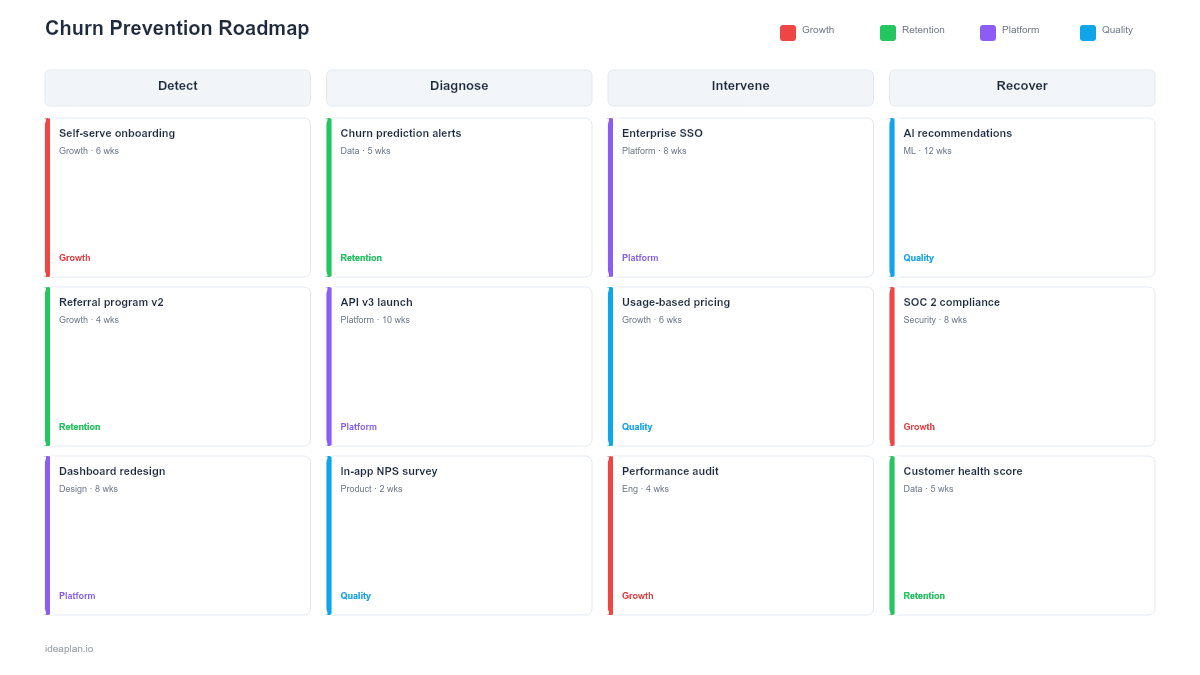
Preventing churn starts long before a customer submits a cancellation request. This free PowerPoint template structures your churn prevention efforts into four layers: early warning detection, intervention workflows, save offers for customers actively leaving, and root cause analysis that feeds product improvements. Download the .pptx, map your churn signals and intervention capacity, and present a plan that moves your team from reactive fire-fighting to systematic churn rate reduction.
What This Template Includes
- Early warning dashboard slide. The signals that predict churn 30-90 days before cancellation, with detection thresholds and alert routing rules.
- Intervention workflow slide. Step-by-step playbooks for CSM outreach, automated nudges, and executive escalation based on warning severity.
- Save offer framework slide. A decision tree for selecting the right retention offer (discount, plan adjustment, feature access, extended support) based on churn reason and account value.
- Root cause analysis slide. A categorization framework for tracking why customers leave, with quarterly trend data that feeds product and pricing decisions.
Why Churn Prevention Requires a Structured Approach
Ad hoc churn prevention. Where a CSM notices a problem and improvises a response. Works when you have 50 accounts. It breaks at 500. At scale, you need systems: automated detection, standardized workflows, pre-approved save offers, and feedback loops that close the gap between churn causes and product changes.
The cost of getting this wrong compounds. Every churned account represents lost revenue, wasted acquisition cost, and a customer who may share negative experiences with peers. For SaaS companies, reducing monthly churn by even one percentage point can mean millions in preserved ARR over a year. The investment in a structured prevention program pays back quickly.
Most importantly, churn prevention generates product intelligence. When you systematically track why customers leave and which interventions work, you build a dataset that makes your product, pricing, and onboarding better over time. Reactive churn management produces saves; systematic prevention produces a better business.
Template Structure
Early Warning Signals
The early warning slide catalogs the behavioral signals that precede churn:
- Engagement decline. Login frequency drops below the account's historical average. Feature usage narrows to fewer core actions. DAU/MAU ratio falls below the product benchmark.
- Support escalation. Ticket volume spikes, tone shifts negative, or the customer requests an executive call. Support interactions are often the first visible sign of dissatisfaction.
- Billing friction. Failed payment retries, downgrade page visits, cancellation page views without completing. These signals have high specificity for imminent churn.
- Stakeholder changes. The product champion leaves the company, a new decision-maker joins who favors a competitor, or the team reorganizes and the product loses its internal sponsor.
Each signal has a detection threshold (e.g., "login frequency drops 40% from the 90-day average") and a routing rule (e.g., "alert assigned CSM via Slack, create task in CS platform").
Intervention Workflows
Three intervention tiers based on warning severity:
- Low severity (single signal). Automated in-app message acknowledging reduced usage, educational content about underused features, or a product tip email. No CSM involvement unless the customer responds.
- Medium severity (two signals). CSM outreach within 5 business days. The call follows a structured format: acknowledge the usage change, ask about barriers, offer specific help (training, configuration review, stakeholder re-onboarding).
- High severity (three+ signals or billing signal). Escalation to CS leadership within 48 hours. Custom success plan created. If the account is in the top revenue tier, executive sponsor engagement.
Save Offer Decision Tree
When a customer reaches the cancellation flow, the save offer is the last chance. The template includes a decision tree:
- What is the stated churn reason?. Price, product gap, competitive switch, internal change, low usage.
- What is the account's ARR and health history?. High-value accounts with historically good health get more generous offers.
- Which offer matches the reason?. Price complaints get a discount or plan adjustment. Product gap gets early access to an upcoming feature. Low usage gets an extended trial with dedicated onboarding support.
Pre-approving save offers by category and account value lets CSMs respond quickly without waiting for management approval during the critical cancellation moment.
How to Use This Template
1. Map your churn signals to available data
Audit which signals you can detect today versus which require new instrumentation. Login frequency is usually available immediately. Stakeholder changes may require CRM enrichment or LinkedIn monitoring. Build a prioritized list: start with the signals you have, add others to the roadmap. The product analytics setup guide covers common instrumentation patterns.
2. Build detection thresholds from historical data
Pull data from accounts that churned in the past 12 months. For each signal, identify the pattern that appeared before churn. What was the median time between engagement decline and cancellation? What percentage of churned accounts showed billing friction first? These patterns set your detection thresholds and give the early warning system a baseline.
3. Design and staff intervention workflows
Match intervention capacity to expected alert volume. If your model generates 50 medium-severity alerts per month and each CSM can handle 10, you need five CSMs in the intervention rotation. Understaffing interventions is worse than not having the alerts. It creates a backlog of at-risk accounts that nobody contacts.
4. Pre-approve save offers by tier
Work with finance and leadership to pre-approve save offer parameters: maximum discount percentage by account tier, feature access extensions, plan adjustment options. Document these in the decision tree so CSMs can execute during the cancellation conversation without escalating for approval. Speed matters. The longer it takes to present an offer, the more likely the customer completes the cancellation.
5. Track root causes and feed product decisions
After every churn event (saved or lost), record the root cause in a standardized taxonomy: product gap, price sensitivity, competitive loss, champion departure, poor onboarding, low engagement, other. Review the distribution quarterly with the product team. The three most common causes should each have a corresponding product initiative on the product roadmap. This feedback loop turns churn data into product improvement.
When to Use This Template
A churn prevention roadmap delivers value when:
- Churn is above your industry benchmark and the team has moved past denial into action mode
- Prevention efforts are inconsistent. Some CSMs prevent churn effectively while others do not, because there is no shared process
- You have enough data to detect signals but no system to turn signals into timely interventions
- Save offers are improvised per-account leading to inconsistent discounting and missed opportunities
- The product team does not receive structured churn feedback and keeps building features that do not address the reasons customers leave
If your primary challenge is building the health scoring system that feeds early warnings, start with the Customer Health Roadmap. For winning back customers who have already churned, the Win-Back Roadmap covers that phase.
Featured in
This template is featured in Customer Success and Retention Roadmap Templates, a curated collection of roadmap templates for this use case.
Key Takeaways
- Churn signals appear 30-90 days before cancellation. Building detection systems for engagement decline, support escalation, and billing friction gives your team time to act.
- Three intervention tiers (automated, CSM outreach, executive escalation) match response intensity to warning severity.
- Pre-approved save offers by account tier and churn reason let CSMs respond quickly during the cancellation moment without waiting for approvals.
- Root cause tracking turns every churn event into product intelligence. The top three churn reasons should each map to a product initiative.
- Measure prevention ROI by tracking ARR saved through interventions against program costs. Most programs deliver 5-10x returns.
- Compatible with Google Slides, Keynote, and LibreOffice Impress. Upload the
.pptxto Google Drive to edit collaboratively in your browser.