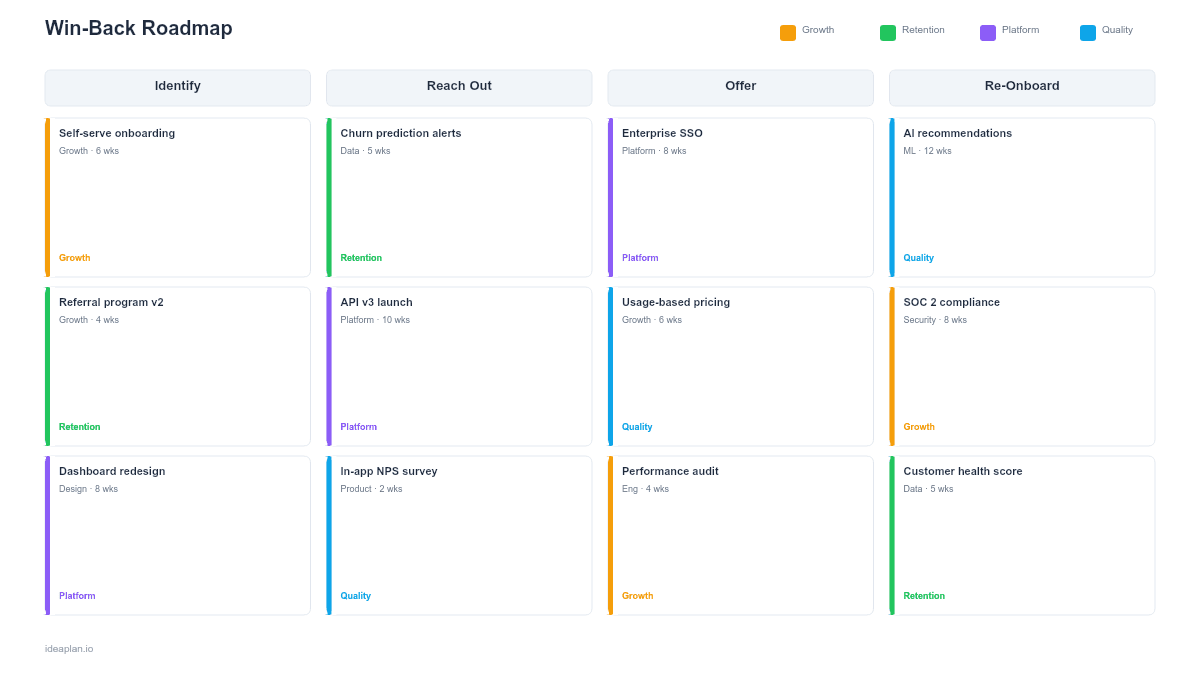
Quick Answer (TL;DR)
Not every churned customer is gone for good. This free PowerPoint template helps you build a systematic win-back program: segmenting churned customers by reason and recoverability, designing outreach campaigns timed to product milestones, creating re-onboarding flows for returners, and structuring offers that make coming back easy. Download the .pptx, populate it with your churn data, and present a plan that turns your churned customer list from a write-off into a reactivation pipeline.
What This Template Includes
- Churn segmentation slide. Churned customers categorized by reason (product gap, price, competitive switch, internal change), recency (30/60/90/180+ days), and account value (ARR at time of churn).
- Outreach campaign timeline slide. Multi-touch campaign sequences mapped to product updates, pricing changes, and seasonal triggers across four quarters.
- Re-onboarding flow slide. The streamlined return experience: account reactivation, data restoration, what-changed walkthrough, and personalized setup based on the customer's previous usage.
- Offer framework slide. A matrix of return offers by churn reason and account value, with approval levels and expected conversion rates.
Why Win-Back Deserves Dedicated Planning
Churned customers are the most underused growth lever in most SaaS businesses. These are people who already know your product, already went through onboarding, and already demonstrated willingness to pay. Reacquiring a churned customer typically costs 50-70% less than acquiring a net-new one, because the awareness, evaluation, and trust-building phases are partially complete.
Yet most teams treat churn as final. The customer cancels, the account goes cold, and nobody follows up unless the customer reaches out on their own. Even companies with retention programs rarely have a structured approach to winning back customers after they leave.
The timing of win-back matters as much as the offer. A customer who left because of a missing feature is most reachable the week you ship that feature. A customer who left due to pricing is most reachable when you introduce a new tier or discount. A customer whose champion left is most reachable when a new stakeholder arrives. Without a roadmap that connects outreach timing to these triggers, win-back campaigns default to generic emails that convert at 1-2% instead of the 8-15% that targeted campaigns achieve.
Template Structure
Churn Segmentation Matrix
Effective win-back starts with knowing who left and why. The segmentation matrix cross-references two dimensions:
- Churn reason. Product gap (missing feature or capability), price sensitivity (budget cuts, competitor undercuts), competitive switch (chose an alternative), internal change (champion left, company restructured, use case eliminated), and low engagement (never fully adopted).
- Recoverability tier. High (the churn reason is now addressed), Medium (the churn reason is partially addressed or circumstances may have changed), Low (the churn reason remains or the customer explicitly said they would not return).
High-recoverability customers get priority outreach. Low-recoverability customers go into a passive nurture track. This segmentation prevents wasting effort on accounts with near-zero return probability.
Campaign Timeline
Win-back campaigns are event-triggered, not calendar-triggered. The timeline maps outreach to specific events:
- Product update campaigns. When a feature ships that addresses a common churn reason, notify all customers who cited that reason. Include a specific "here's what changed" message, not a generic newsletter.
- Pricing change campaigns. When new tiers, discounts, or packaging launch, reach out to price-sensitive churned customers with the new options.
- Milestone campaigns. At 30, 90, and 180 days post-churn, send tailored messages. The 30-day message acknowledges the departure and offers to help. The 90-day message shares product updates. The 180-day message offers a return incentive.
- Industry event campaigns. Coincide outreach with budget cycles, fiscal year starts, or industry events when buying decisions are being made.
Re-onboarding Flow
Returning customers are not new customers. The re-onboarding flow skips the basics and focuses on what changed since they left: new features, improved workflows, resolved issues. It also restores their historical data and settings when possible, reducing the friction of returning. The flow includes a dedicated CSM check-in at day 7 to catch problems early and prevent re-churn.
How to Use This Template
1. Build your churn database
Export all churned accounts from the past 12-18 months. For each account, record: cancellation date, ARR at churn, stated reason (from exit survey, CSM notes, or cancellation flow), and any competitive intelligence. If you lack exit data, categorize based on usage patterns before churn using the signals from your customer health score.
2. Segment and score recoverability
Apply the segmentation matrix. Customers who churned due to a product gap that you have since fixed are high-recoverability. Customers who churned because they went out of business are low-recoverability. Score every account and sort the list. The top quartile by recoverability and account value becomes your active win-back target list.
3. Design triggered campaigns
Map your product roadmap and pricing plans to the campaign timeline. When a feature ships that addresses "product gap" churn reasons, that is a campaign trigger. Write the outreach sequence: email 1 announces the change with specific before/after detail, email 2 offers a return trial or demo, email 3 includes a time-limited return offer. Personalize each sequence to the churn reason.
4. Build the re-onboarding experience
Work with product and engineering to create a returning customer flow. Account reactivation should take less than 5 minutes. Historical data should restore automatically if still available. A "what's new since you left" walkthrough should highlight the specific improvements relevant to why they left. The user onboarding roadmap covers onboarding design patterns that apply to re-onboarding.
5. Measure and iterate
Track four metrics for your win-back program: outreach response rate, trial/demo conversion rate, reactivation rate (full return to paid), and re-churn rate (customers who return but leave again within 90 days). A high re-churn rate means the underlying issue was not actually resolved. Review these metrics monthly and adjust targeting and messaging based on what the data shows.
When to Use This Template
A win-back roadmap is worth building when:
- Your churned customer base is large enough to represent meaningful revenue. If recovering 10% of churned accounts would materially impact ARR, the program justifies investment
- Product improvements have addressed common churn reasons and former customers do not know about the changes
- Customer acquisition costs are rising and reactivating former customers offers a more efficient growth path
- You have sufficient churn data (reasons, recency, account value) to segment and target effectively
- Competitive dynamics have shifted. A competitor has stumbled, raised prices, or degraded their product, creating an opening for return
If your priority is preventing churn before it happens, start with the Churn Prevention Roadmap. For the full retention lifecycle from activation through win-back, the Retention Strategy Roadmap covers all phases.
Featured in
This template is featured in Customer Success and Retention Roadmap Templates, a curated collection of roadmap templates for this use case.
Key Takeaways
- Churned customers cost 50-70% less to reacquire than net-new customers. A structured win-back program turns a write-off into a growth channel.
- Segment churned customers by reason and recoverability before designing outreach. High-recoverability accounts (where the churn reason is now addressed) get priority.
- Trigger campaigns based on product updates and pricing changes, not arbitrary calendar dates. Specificity in messaging drives 5-7x higher conversion than generic re-engagement.
- Build a dedicated re-onboarding flow that restores data, highlights what changed, and connects returning customers to a CSM within the first week.
- Track reactivation rate and re-churn rate together. Winning a customer back only counts if they stay.
- Compatible with Google Slides, Keynote, and LibreOffice Impress. Upload the
.pptxto Google Drive to edit collaboratively in your browser.