These twelve free AI and ML roadmap templates cover AI product planning, data pipeline setup, LLM fine-tuning, ML model lifecycle, prompt engineering, AI ops, and governance/ethics/safety. All are free PowerPoint downloads compatible with Google Slides.
AI products have planning requirements that standard roadmap templates miss. Model training cycles do not fit neatly into sprints. Evaluation metrics are probabilistic, not binary. Safety and ethics reviews add stages that traditional product development skips entirely. And the pace of foundation model improvement means your build-vs-buy calculus can change every quarter. The AI PM Handbook covers the strategic thinking behind AI product management. These templates give you the planning artifacts.
What templates help with AI product planning?
These templates help you plan what AI features to build, how to integrate them into existing products, and how to structure the overall AI product roadmap.
AI Feature Roadmap
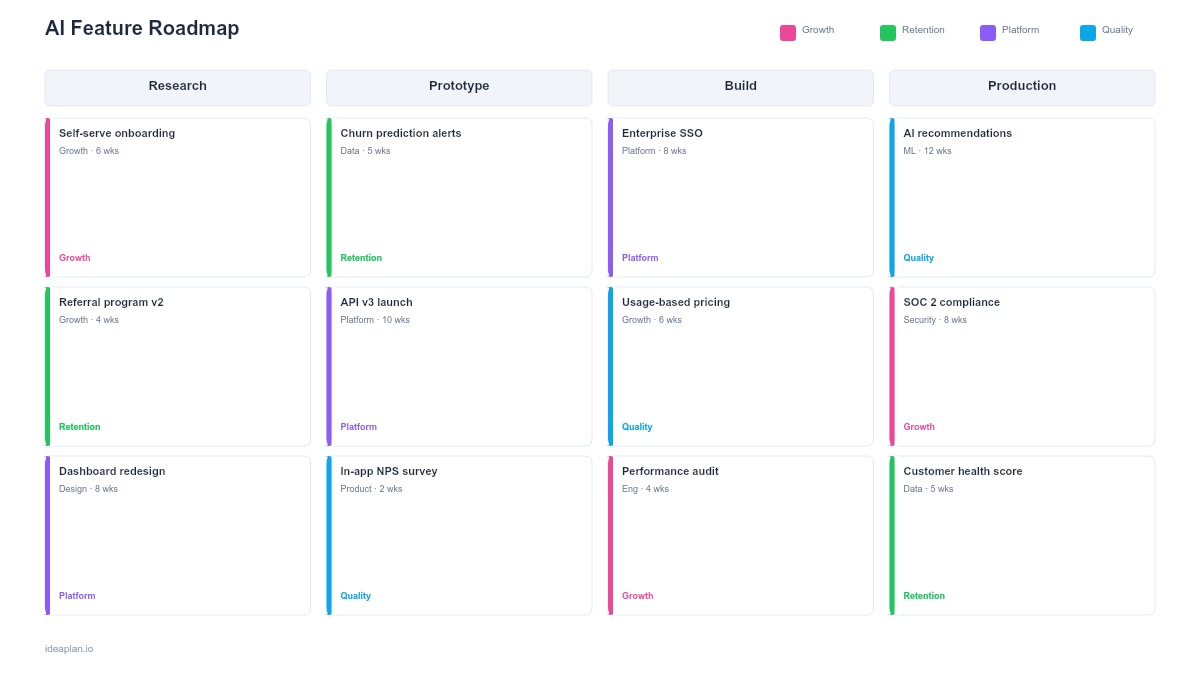
The AI feature roadmap organizes planned AI capabilities by feature area with model requirements, data dependencies, and evaluation criteria for each. Unlike a standard feature roadmap, it includes columns for model type (fine-tuned, prompt-engineered, RAG-based), confidence threshold, and fallback behavior when the model produces low-quality output. Use this when you are planning which AI features to build and need to communicate the plan to engineering and leadership.
AI Feature Integration Roadmap
An AI feature integration roadmap is for teams adding AI capabilities to an existing product rather than building an AI-first product from scratch. It structures the integration into phases (feasibility assessment, architecture planning, phased rollout, and optimization) with A/B testing checkpoints and fallback plans at every stage. The key difference from a greenfield AI roadmap is that you already have users, existing workflows, and established expectations. The AI Build vs Buy tool helps decide which AI capabilities to build internally versus integrate from vendors.
AI Product Roadmap
A general-purpose AI product roadmap for teams whose entire product is AI-powered. It covers model development, data acquisition, evaluation infrastructure, user experience design, and go-to-market. All the workstreams that need to coordinate for an AI product to ship. This template works for both startups building an AI-native product and established companies launching an AI product line. Check your team's readiness with the AI Readiness Assessment before committing to the plan.
What do you need for AI data and infrastructure planning?
AI products are only as good as their data and infrastructure. These templates plan the foundational work that makes AI features possible.
AI Data Pipeline Roadmap
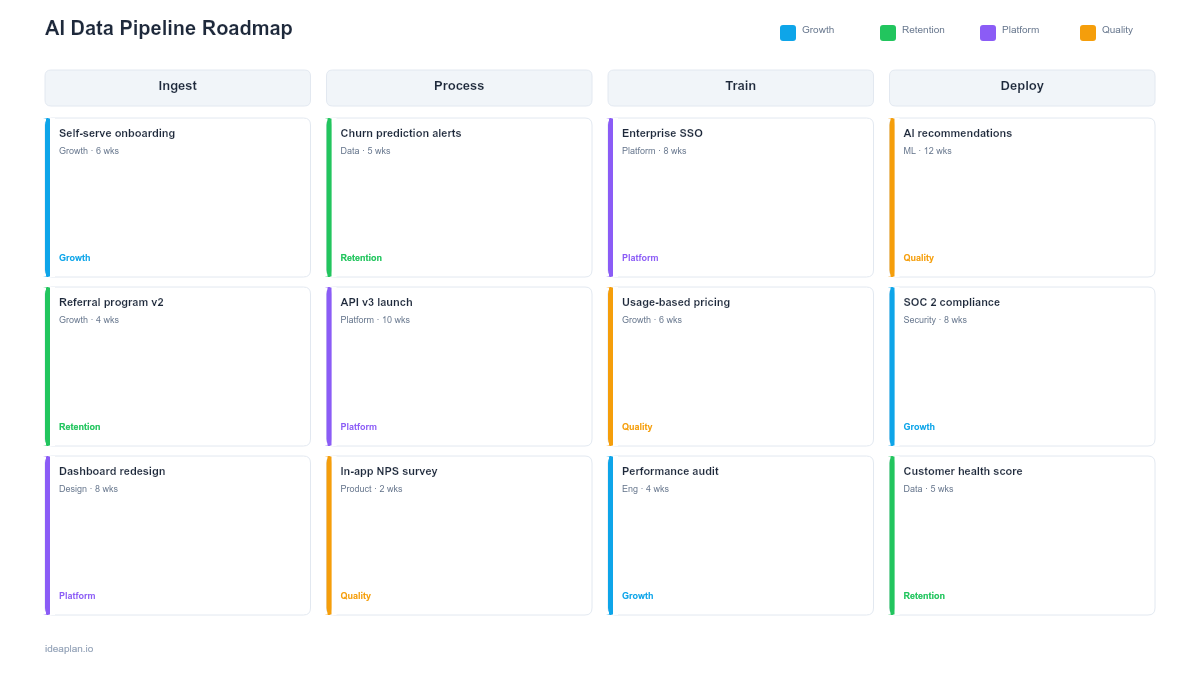
The AI data pipeline roadmap plans the end-to-end data infrastructure needed to train, evaluate, and serve AI models. It covers data collection, cleaning, labeling, storage, versioning, and the pipelines that feed production models. Most AI projects fail at the data layer, not the model layer. This template forces you to plan the unglamorous data work before jumping to model development.
AI Ops Roadmap
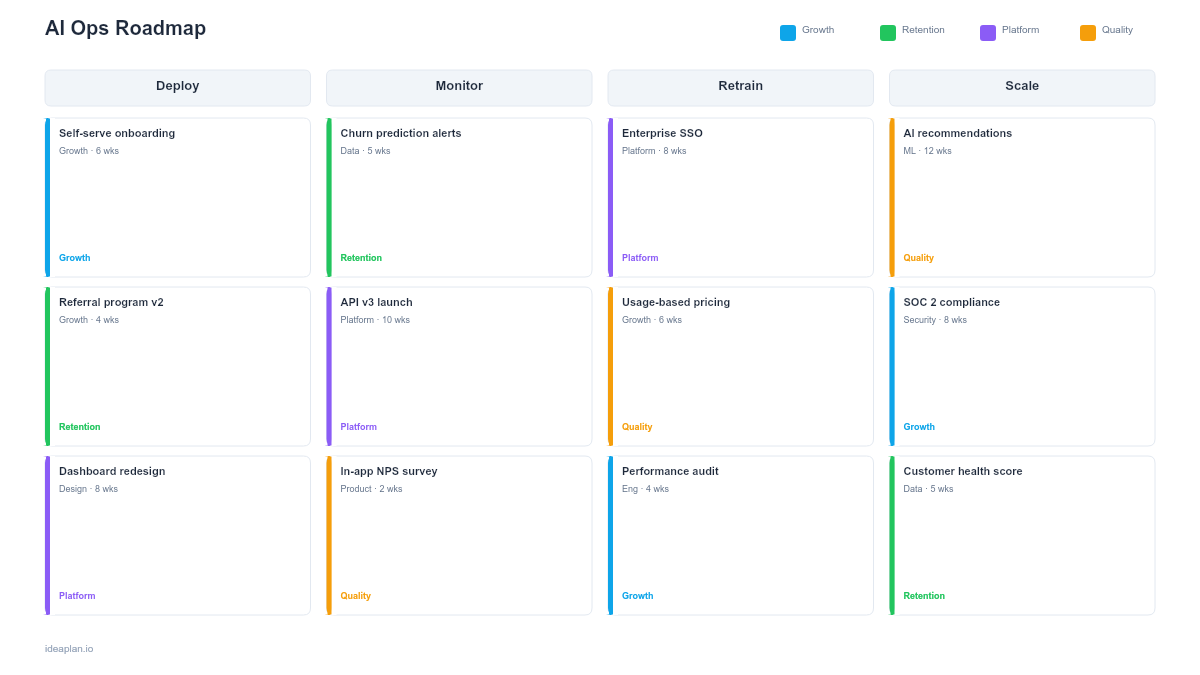
AI Ops (MLOps) is the discipline of deploying, monitoring, and maintaining AI models in production. This roadmap plans the operational infrastructure: model serving, monitoring dashboards, drift detection, automated retraining triggers, A/B testing infrastructure, and incident response for model failures. If you have shipped an AI feature but do not have a plan for keeping it healthy in production, this is the template to start with.
Which templates cover model development and optimization?
These templates plan the model-specific work: training, fine-tuning, evaluation, and prompt engineering.
LLM Fine-Tuning Roadmap
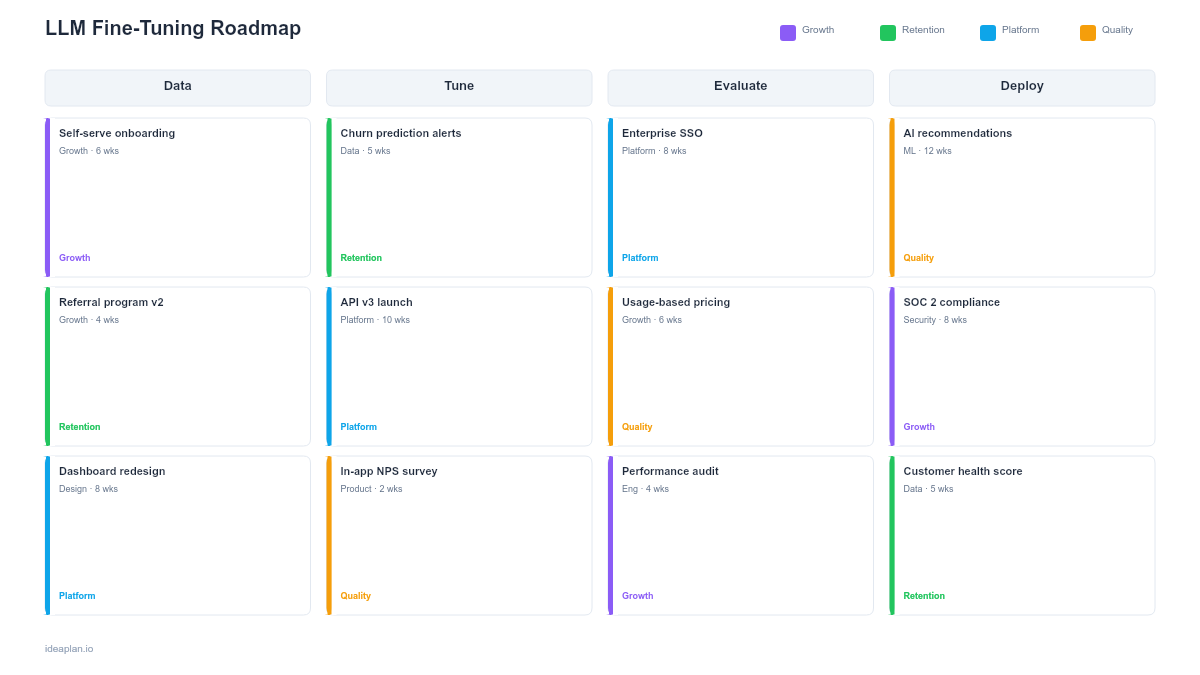
The LLM fine-tuning roadmap plans the process of adapting a foundation model to your specific domain or use case. It covers dataset preparation, training configuration, evaluation methodology, and deployment. Each fine-tuning run is treated as an experiment with a hypothesis, success criteria, and comparison against the baseline model. The template tracks multiple fine-tuning iterations so you can see the progression from base model to production-ready model.
Machine Learning Roadmap
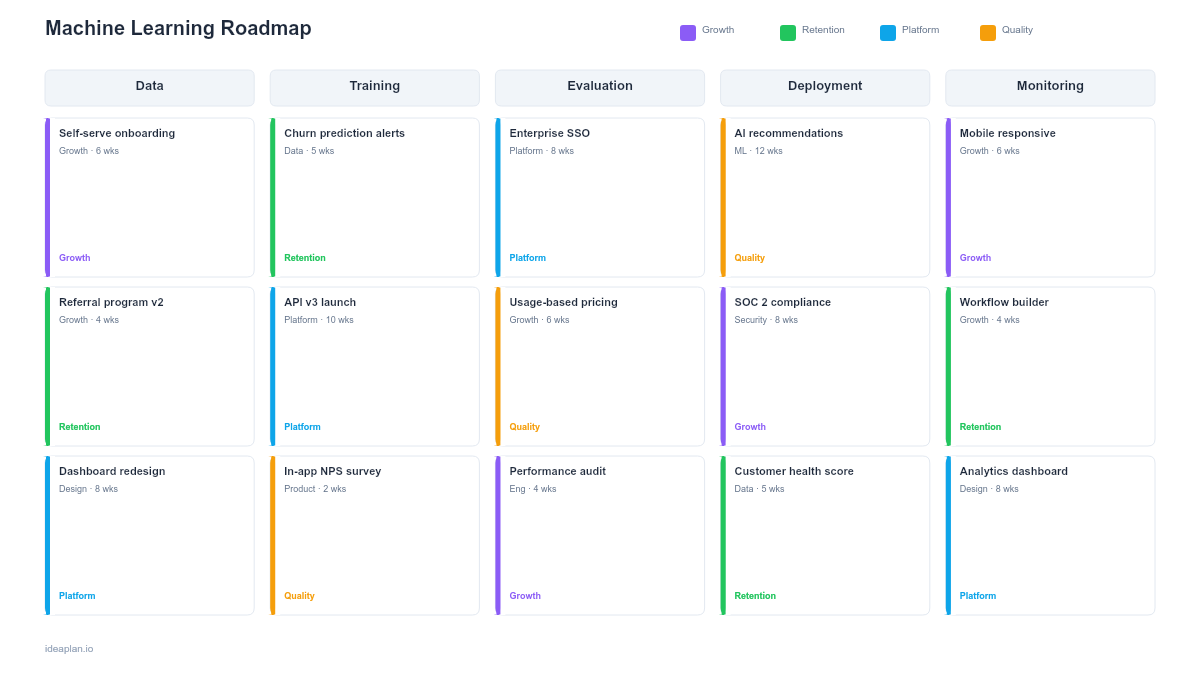
The ML roadmap covers the full model development lifecycle: problem definition, data collection, feature engineering, model selection, training, evaluation, and deployment. It is broader than the LLM fine-tuning template and applies to any ML approach: classical ML, deep learning, or LLMs. Use this template when your AI work involves multiple model types or when you are planning the ML capability across an entire product.
ML Model Lifecycle Roadmap
The ML model lifecycle roadmap focuses on the ongoing management of models after initial deployment. It plans version management, retraining schedules, performance monitoring, and deprecation of old model versions. Most teams plan the first model deployment carefully and then neglect the lifecycle management that keeps the model accurate over time. This template ensures you plan for model maintenance, not just model creation.
Prompt Engineering Roadmap
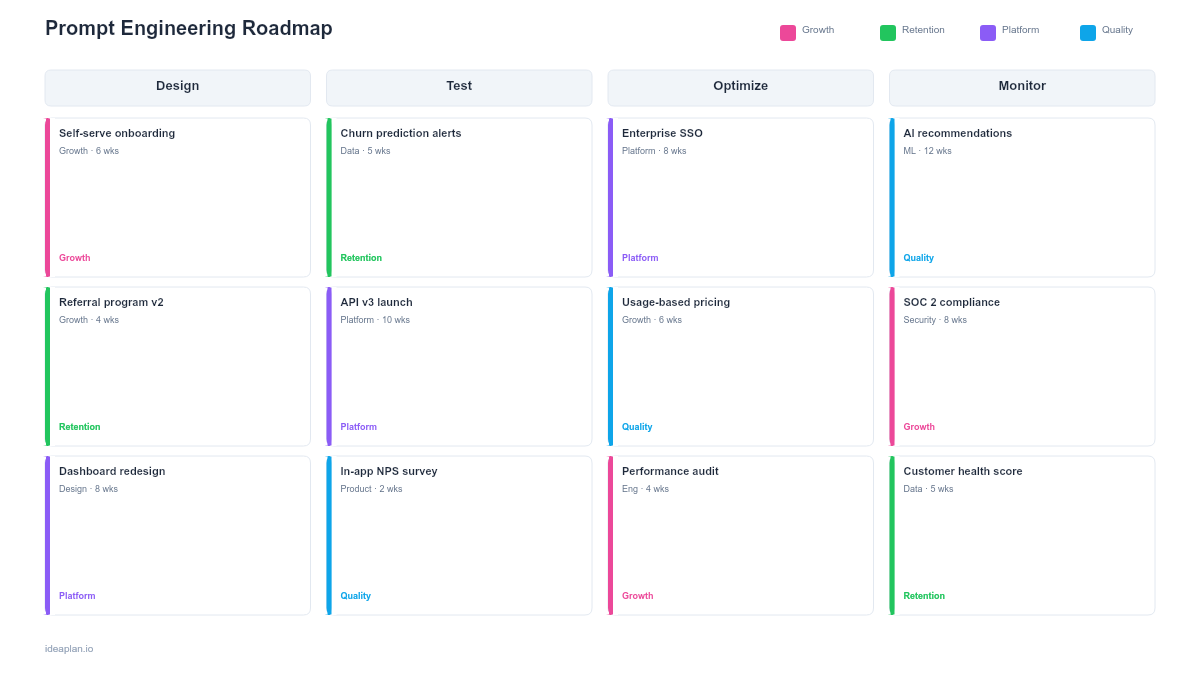
For teams using LLMs via API (not fine-tuning), prompt engineering is the primary lever for improving output quality. This roadmap plans the systematic improvement of prompts: baseline measurement, prompt variation testing, evaluation against ground truth, and deployment of winning prompts. It treats prompt engineering as an iterative discipline rather than a one-time setup task.
How do you plan for AI governance, ethics, and safety?
AI products carry risks that traditional software does not. These templates plan the guardrails.
AI Ethics Roadmap
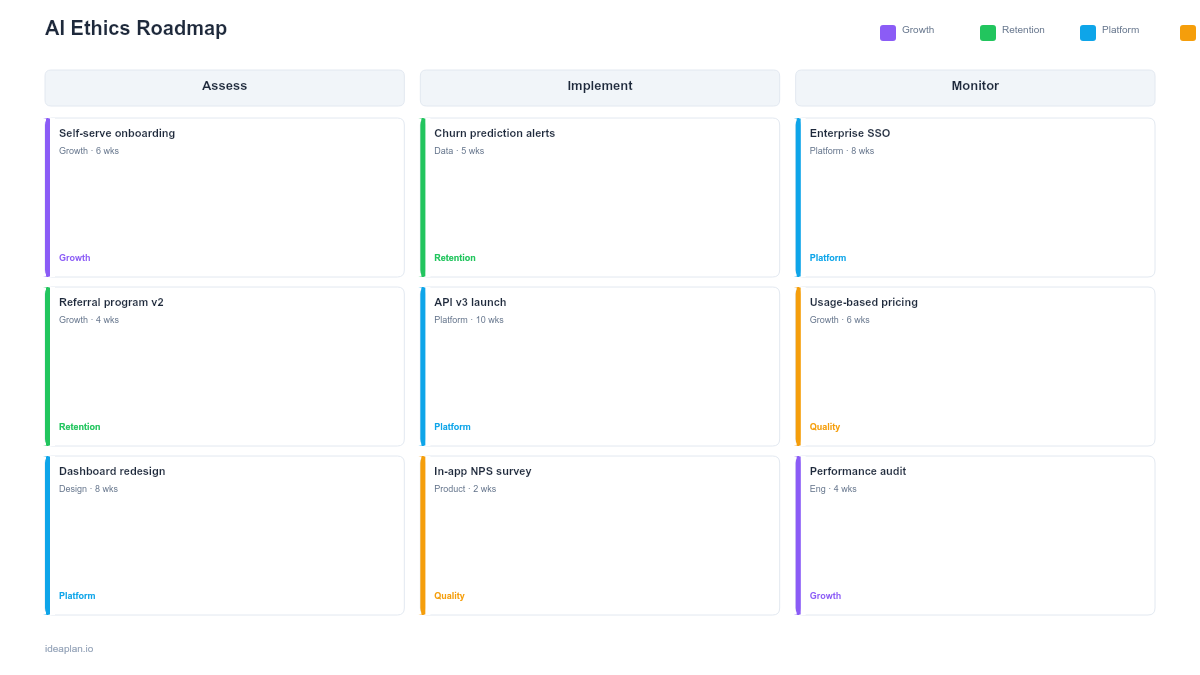
The AI ethics roadmap plans the responsible development practices your team will follow: bias auditing, fairness testing, transparency documentation, and user consent mechanisms. It is not a compliance checkbox. It is a plan for building AI products that users and regulators will trust. The template includes a review cadence so ethics considerations are evaluated at every stage, not just before launch.
AI Governance Roadmap
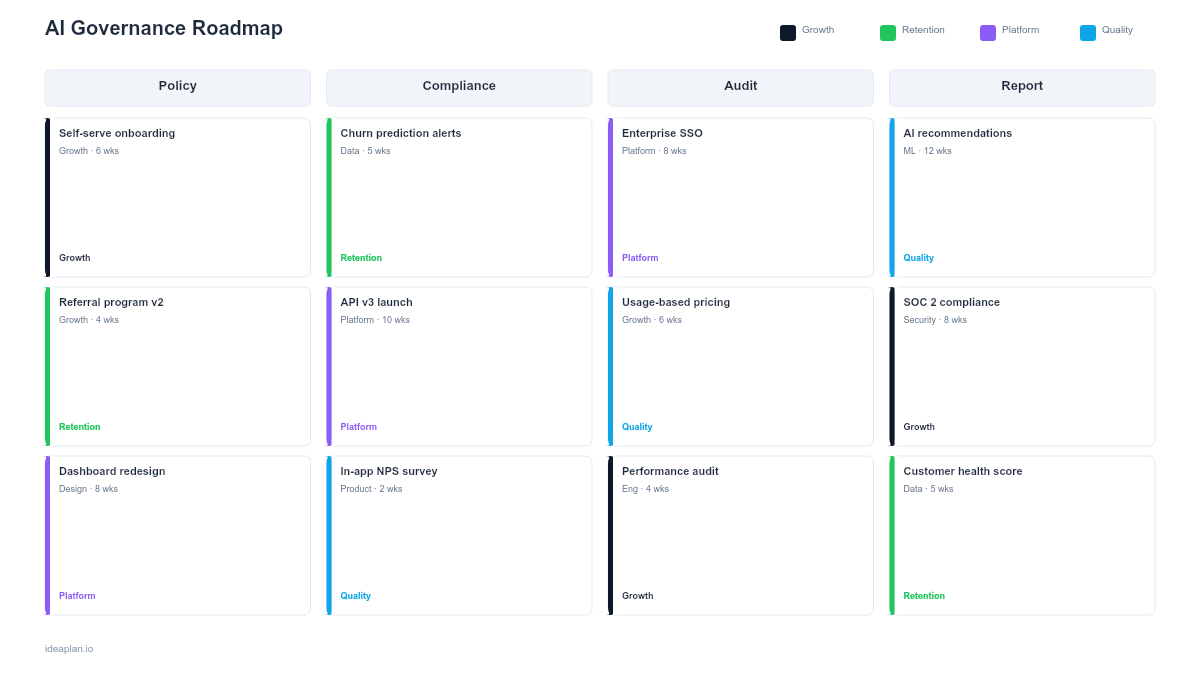
AI governance goes beyond ethics to cover organizational policies, access controls, audit trails, and regulatory compliance. This roadmap plans the governance infrastructure: who can deploy models, what approvals are needed, how decisions are documented, and how the organization responds to AI incidents. For companies in regulated industries (healthcare, finance, insurance), this template is not optional. It is a prerequisite for shipping AI products.
AI Safety Roadmap
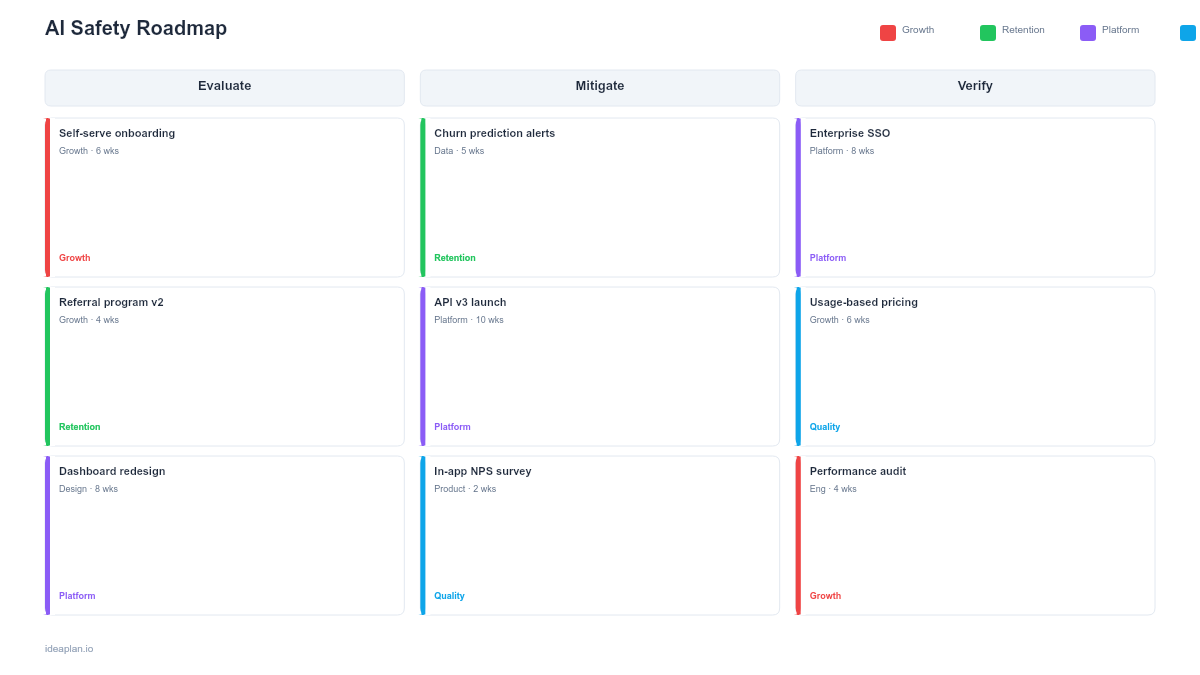
The AI safety roadmap plans the specific technical and procedural safeguards that prevent AI systems from causing harm. It covers red-teaming schedules, adversarial testing, output filtering, hallucination monitoring, and escalation procedures for safety incidents. Use this template when your AI product interacts directly with users (chatbots, content generation, recommendation systems) and a bad output could damage trust, cause financial harm, or violate regulations.
How do you choose the right AI roadmap template?
Start with where you are in the AI product lifecycle:
- Exploring AI → AI Feature Roadmap to plan what to build, AI Feature Integration Roadmap if adding to an existing product
- Building the foundation → AI Data Pipeline Roadmap first, then Machine Learning or LLM Fine-Tuning Roadmap
- Shipping to production → AI Ops Roadmap for operational readiness, Prompt Engineering Roadmap if using LLMs via API
- Scaling responsibly → AI Ethics, Governance, and Safety roadmaps based on your regulatory environment and risk tolerance
Most AI teams need three templates simultaneously: one for feature planning, one for model development, and one for governance. Download all three and keep them aligned. The feature roadmap should not promise capabilities the model roadmap cannot deliver.
Explore More
- Product Management in AI/ML Products - How PMs work in AI and machine learning, what metrics matter, and how to ship AI products users trust.
- Best PM Tools for AI/ML (2026) - Top product management tools for AI and ML PMs.
- Top 10 AI Tools for Product Managers (2026) - 10 AI-powered tools that save product managers hours every week.
- Product Management in Robotics - How PMs build robotics products: managing autonomy levels, safety certification, and the hardware-AI-software stack.