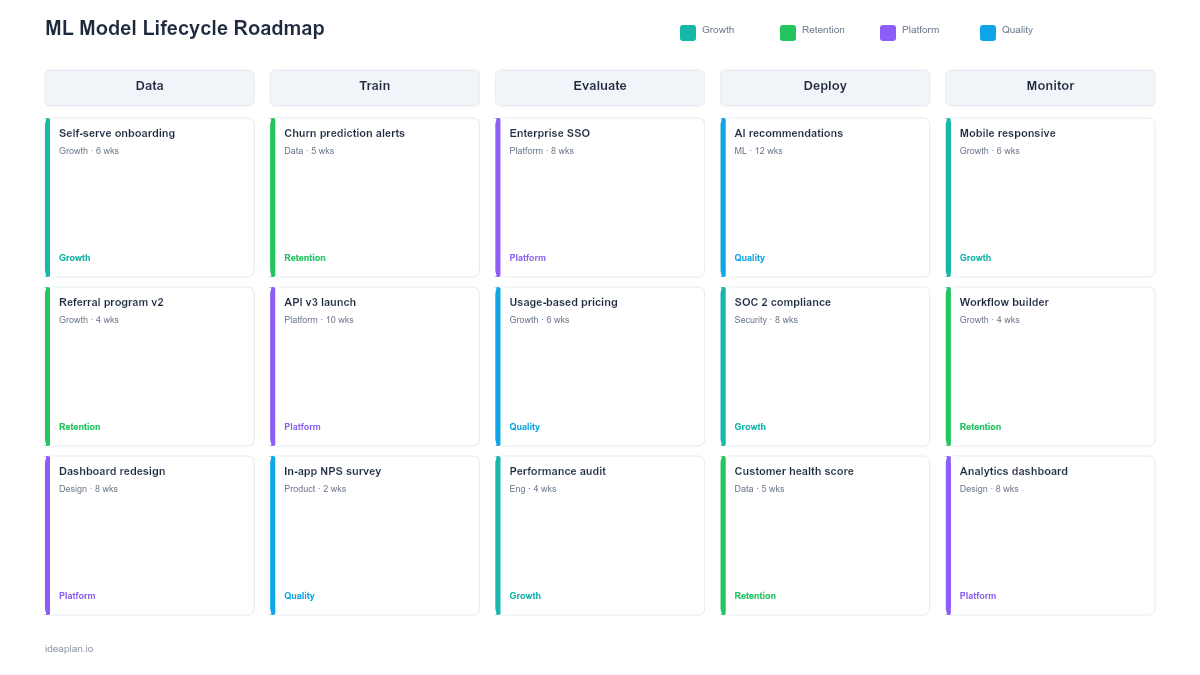
Quick Answer (TL;DR)
An ML model lifecycle roadmap traces the complete journey of a machine learning model from initial data collection through production deployment and ongoing retraining. Most ML projects fail not because the model architecture is wrong but because teams lack a structured plan for the stages between "we have an idea" and "the model is reliably serving users in production." This template breaks the lifecycle into six discrete phases. Data collection, feature engineering, training, evaluation, deployment, and monitoring. With clear deliverables, decision gates, and handoff points at each transition.
What This Template Includes
- Data readiness scorecard that evaluates whether your training data meets volume, quality, diversity, and labeling accuracy requirements before committing to model training.
- Feature engineering tracker for documenting feature hypotheses, transformations, validation results, and feature importance rankings across iterations.
- Training experiment log with structured fields for architecture choices, hyperparameters, dataset versions, compute resources used, and results against baseline metrics.
- Evaluation rubric covering accuracy, precision, recall, latency, fairness, robustness, and safety. With configurable thresholds for each deployment stage.
- Deployment checklist spanning model packaging, serving infrastructure, A/B test configuration, canary rollout steps, and rollback procedures.
- Monitoring and retraining dashboard template with metrics for data drift, prediction drift, latency degradation, and automated retraining triggers.
Template Structure
Phase 1: Data Collection and Preparation
The lifecycle begins with data, and this phase determines the ceiling of everything that follows. This section plans the data acquisition strategy: what data sources to tap, what volume is needed for statistical significance, what labeling methodology to use, and what quality benchmarks must be met before data is considered training-ready. It also covers data versioning. Every training run should be reproducible by referencing an exact dataset snapshot.
Data preparation is where most ML projects quietly lose months. Cleaning, deduplication, handling missing values, resolving labeling disagreements, and ensuring representative class distributions are all work that must be planned and tracked. This phase includes a data readiness scorecard with explicit pass/fail criteria so the team knows when data is genuinely ready for training versus when it merely looks ready.
Phase 2: Feature Engineering
Feature engineering transforms raw data into the signals that models actually learn from. This section tracks feature hypotheses. Each proposed feature gets a brief rationale explaining why it should be predictive, along with the transformation logic and validation approach. Features are evaluated individually and in combination, and the results are logged so the team builds institutional knowledge about what works for this problem domain.
This phase also addresses feature pipelines. The infrastructure that computes features in real time for production inference. A feature that works beautifully in a batch training context but cannot be computed within latency constraints at serving time is useless. Planning the production feature pipeline alongside the experimental feature work prevents late-stage surprises.
Phase 3: Model Training
Training is the phase most people picture when they think of machine learning, but it represents a fraction of the total lifecycle effort. This section organizes training into structured experiments. Each experiment has a hypothesis, a configuration (architecture, hyperparameters, dataset version, augmentation strategy), and success criteria. Experiments are time-boxed to prevent unbounded exploration.
The training phase also plans compute resource allocation. GPU hours are expensive and often contested. Estimating compute needs upfront and reserving capacity prevents training queues from becoming a bottleneck. The template includes a compute budget tracker that maps planned experiments to estimated resource requirements.
Phase 4: Model Evaluation
Evaluation is where the team decides whether a model is good enough to deploy. This phase goes well beyond aggregate accuracy. The evaluation rubric in this template covers performance across data slices (does the model work equally well for all user segments?), robustness to input perturbations (does it degrade gracefully on noisy or adversarial inputs?), latency under production load, and [fairness across protected demographic attributes](https://ai.google/responsibilities/responsible-ai-practices/).
The template defines three evaluation tiers: offline evaluation against held-out test sets, shadow evaluation running alongside the production system without affecting users, and online evaluation via A/B testing with live traffic. Each tier has its own metrics and thresholds, and models must pass each tier sequentially before advancing.
Phase 5: Deployment and Serving
Deploying an ML model requires infrastructure that most software engineering teams do not have in place. This section covers model serialization and packaging, serving infrastructure selection (batch vs. real-time, self-hosted vs. managed), API design, load testing, and integration testing with downstream systems. It also plans the rollout strategy: what percentage of traffic the model serves initially, how long the observation period lasts, and what metrics trigger expansion or rollback.
The deployment checklist ensures nothing is skipped in the rush to launch. It covers versioned model artifacts, feature pipeline parity between training and serving, monitoring instrumentation, alerting configuration, and documented rollback procedures. Teams that treat deployment as a one-step "push to production" action consistently encounter issues that a structured checklist would have caught.
Phase 6: Monitoring and Retraining
Production ML models are not static assets. They degrade as the world changes around them. This section establishes the monitoring infrastructure: what metrics to track (prediction distribution, feature distribution, latency percentiles, error rates by segment), how to detect drift, and what thresholds trigger investigation versus automated retraining.
The retraining plan defines the cadence (scheduled weekly? triggered by drift detection?), the data window (retrain on the last 90 days? expanding window?), the evaluation pipeline that validates retrained models before they replace the current production model, and the canary rollout process for the updated model. This phase closes the loop, feeding production data back into Phase 1 and starting the next iteration of the lifecycle.
How to Use This Template
Step 1: Audit Your Data Assets
What to do: Catalog all available data sources, assess their quality using the data readiness scorecard, and identify gaps that must be filled before training can begin. Document data access permissions and any privacy or compliance constraints.
Why it matters: Data gaps discovered mid-training are the leading cause of ML project delays. A thorough audit upfront surfaces problems when they are cheapest to fix.
Step 2: Define Your Feature Strategy
What to do: Generate feature hypotheses based on domain knowledge, document the transformation logic for each, and plan the infrastructure that will compute these features in production. Prioritize features that are both predictive and feasible to serve in real time.
Why it matters: Features that cannot be reproduced at serving time are wasted effort. Aligning the experimental and production feature pipelines early prevents a painful refactoring phase later.
Step 3: Plan Training Experiments
What to do: Design a sequence of time-boxed experiments, each with a clear hypothesis and success criteria. Start with a simple baseline model before exploring complex architectures. Estimate compute requirements and reserve capacity.
Why it matters: Structured experimentation prevents the team from wandering through model architecture space without a clear direction. A simple baseline also provides a reference point for measuring the value of additional complexity.
Step 4: Build the Evaluation Pipeline
What to do: Implement the three-tier evaluation framework. Offline, shadow, and online. Before the first model is ready for testing. Define metrics and thresholds for each tier, and automate as much of the evaluation as possible.
Why it matters: Building evaluation infrastructure in advance ensures that model quality is assessed rigorously and consistently, rather than through ad hoc manual checks under time pressure.
Step 5: Prepare Deployment Infrastructure
What to do: Set up model serving, load testing, A/B testing framework, monitoring dashboards, and alerting. Run through the deployment checklist with a dummy model to validate the pipeline end to end.
Why it matters: Infrastructure issues discovered during a real deployment create pressure to skip steps or cut corners. Validating the pipeline with a dummy model eliminates this pressure.
Step 6: Implement Monitoring and Retraining Automation
What to do: Deploy drift detection, set up automated retraining triggers, and validate that the retraining pipeline produces models that pass the evaluation pipeline before reaching production.
Why it matters: Without automated monitoring and retraining, model degradation goes unnoticed until users complain. At which point trust is already damaged.
When to Use This Template
This template is designed for teams managing the full lifecycle of one or more ML models in production. As a specialized technology roadmap, it applies structured phase-gate planning to the unique challenges of ML systems. For a broader view of roadmap planning fundamentals, see the guide to building a product roadmap. It is most valuable when the model is a critical component of the product. Not a nice-to-have experiment but a system that users depend on and that must perform reliably over time. The AI PM Handbook provides deeper coverage of the product management practices that complement this lifecycle framework.
Teams deploying their first production ML model will find this template essential for understanding the scope of work beyond model training. The lifecycle phases from deployment through monitoring and retraining often represent more total effort than the training phase itself, and teams that plan only for training are consistently surprised by the operational burden that follows.
Organizations running multiple models in production can use this template as a standardized lifecycle framework, ensuring that every model follows the same rigorous process for data preparation, evaluation, deployment, and monitoring. This standardization is particularly valuable for ML platform teams that support multiple product teams, as it creates a common language and shared expectations around model readiness.
Data science teams transitioning from notebook-based experimentation to production ML will find the deployment, monitoring, and retraining phases especially valuable. These phases bridge the gap between "the model works on my laptop" and "the model works reliably at scale for real users."
Common Mistakes to Avoid
- Jumping straight to model training without validating data quality. Garbage in, garbage out applies with particular force to ML. Invest the time to run the data readiness scorecard before starting any training.
- Ignoring the gap between training features and serving features. A feature that requires a 30-second database query cannot be used for real-time inference. Design your feature pipeline for production constraints from the start.
- Evaluating only on aggregate metrics. A model with 95 percent overall accuracy may have 60 percent accuracy for a critical user segment. Always evaluate on meaningful data slices, not just global averages.
- Treating deployment as a one-time event. Models require ongoing monitoring, retraining, and redeployment. Budget operational effort for the life of the model, not just the initial launch.
- Skipping shadow evaluation. Running a new model alongside the existing system without affecting users catches integration issues, latency problems, and edge cases that offline evaluation misses.
Featured in
This template is featured in AI and Machine Learning Roadmap Templates, a curated collection of roadmap templates for this use case.