Quick Answer (TL;DR)
This free PowerPoint template plans prompt engineering work across four tracks: Prompt Library, Testing & Evaluation, Version Control & Governance, and Optimization. Each track has initiative cards with measurable quality targets and cost impact estimates. Download the .pptx, inventory your current prompts, and build a roadmap that moves prompt engineering from ad-hoc string editing to a disciplined, measurable practice with clear ownership and quality gates.
What This Template Includes
- Cover slide. Product name, number of AI features using prompts, and the PM or ML lead responsible for prompt quality.
- Instructions slide. How to catalog existing prompts, set evaluation baselines, and implement version control. Remove before presenting.
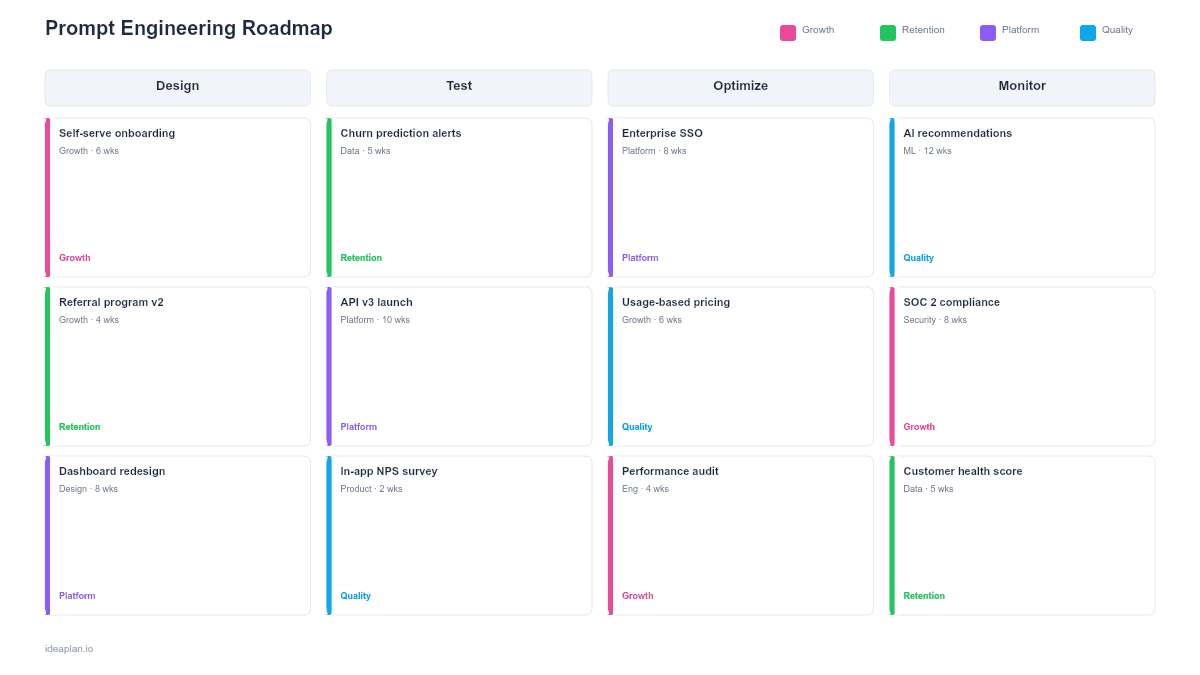
- Blank prompt engineering roadmap slide. Four tracks (Prompt Library, Testing & Evaluation, Version Control, Optimization) with initiative cards on a quarterly timeline. Each card shows the affected feature, quality metric target, and cost implication.
- Filled example slide. A SaaS product's prompt engineering roadmap showing centralized prompt repository migration, automated eval suite for customer support prompts, Git-based prompt versioning, and chain-of-thought optimization that cut token cost per interaction by 40%.
Why Prompt Engineering Needs a Roadmap
In most organizations, prompts are treated like configuration strings. Edited in place, tested manually, and owned by whoever wrote them last. This works when one engineer manages one AI feature. It falls apart when ten features depend on prompts written by different people at different times, with no shared standards, no evaluation baselines, and no way to tell whether a prompt change improved or degraded quality.
Prompt engineering is a development discipline, not a one-time task. Prompts degrade when models are updated (a prompt tuned for GPT-4 may behave differently on GPT-4o). Prompts interact with each other in multi-step chains where one change cascades. Prompts have direct cost implications. A verbose prompt that adds 500 tokens per call at 10M calls/month is a material line item.
The prompt engineering for PMs guide covers techniques and best practices. This template turns those practices into a sequenced plan with deadlines, owners, and measurable outcomes.
Template Structure
Four Engineering Tracks
Columns represent the prompt engineering capability areas:
- Prompt Library. Centralizing all production prompts in a shared repository with metadata: feature name, model provider, creation date, author, last evaluation date, and performance baseline. This replaces scattered prompts in code, config files, and database records.
- Testing & Evaluation. Building automated evaluation suites that run on every prompt change. Each prompt gets a test set of inputs and expected outputs. The eval pass rate metric measures whether a prompt change improves or degrades quality. Evaluation runs before any prompt reaches production.
- Version Control & Governance. Git-based prompt versioning with branching, pull reviews, and change history. Governance rules define who can modify production prompts, what review process is required, and how rollbacks work. This prevents unauthorized or untested prompt changes from affecting users.
- Optimization. Reducing cost and latency without sacrificing quality. Techniques include prompt compression, chain-of-thought refinement, few-shot example pruning, and model routing (sending simple queries to cheaper models). Track prompt-to-value ratio to measure output quality relative to cost.
Initiative Cards
Each card contains:
- Initiative name. Specific work item (e.g., "Build eval suite for document summarization prompts").
- Affected feature. Which AI feature this prompt work supports.
- Quality target. Measurable outcome (e.g., "Eval pass rate > 92% on 200-case test set").
- Cost impact. Expected change in token cost per interaction after optimization.
- Owner. Engineer or PM responsible for delivery.
Quality Dashboard Strip
A bottom strip shows the aggregate prompt health across the product: total prompts in library, percentage with evaluation coverage, average eval pass rate, and monthly prompt-related inference cost. This gives leadership a single view of prompt engineering maturity.
How to Use This Template
1. Inventory all production prompts
Find every prompt in your codebase, configuration systems, and databases. Most teams discover prompts they forgot existed. A prompt for an edge case feature written six months ago by someone who left the company. Document each prompt's purpose, owning feature, and current model target.
2. Establish evaluation baselines
For each prompt, create a baseline evaluation: a set of test inputs and expected outputs that define acceptable quality. Run the current prompt against this set and record the pass rate. This baseline is essential. Without it, you cannot tell whether future changes improve or break the prompt.
3. Migrate to a centralized library
Move all prompts into a shared repository with consistent metadata. This does not require specialized tooling initially. A Git repository with structured directories per feature works. The key is that every production prompt has a single source of truth with ownership and last-evaluated dates.
4. Implement evaluation-gated deployments
No prompt change ships to production without passing its evaluation suite. Integrate evaluation runs into your CI/CD pipeline or deployment workflow. A prompt that passes evaluation can deploy automatically. A prompt that fails evaluation triggers a review. The LLM evaluation framework provides structured approaches for building these evaluation suites.
5. Optimize for cost and latency
Once evaluation coverage is in place, start optimizing. Shorten system prompts that include unnecessary context. Reduce few-shot examples from ten to three if evaluation scores hold. Route simple queries to smaller, cheaper models. Each optimization should be measured against the evaluation suite to verify quality is preserved.
When to Use This Template
A prompt engineering roadmap is the right format when:
- Five or more AI features depend on prompts and no centralized management exists
- Prompt quality is inconsistent across features, with some well-tuned and others untouched since initial development
- Model provider updates (new API versions, model swaps) create risk of prompt degradation
- Token costs are growing and optimization requires a structured effort across multiple features
- Multiple engineers modify prompts with no review process or change tracking
For a single AI feature's full development lifecycle, the AI feature roadmap template covers the broader scope. For the ML infrastructure that supports prompt serving and evaluation, the AI ops roadmap template addresses the platform layer.
Featured in
This template is featured in AI and Machine Learning Roadmap Templates, a curated collection of roadmap templates for this use case.
Key Takeaways
- Prompt engineering spans four tracks: Prompt Library, Testing & Evaluation, Version Control, and Optimization.
- Every production prompt needs a centralized home with ownership, metadata, and an evaluation baseline.
- Evaluation-gated deployments prevent untested prompt changes from reaching users.
- Prompt optimization (compression, few-shot pruning, model routing) reduces cost without sacrificing quality when measured against evaluation suites.
- Aggregate prompt health metrics give leadership visibility into prompt engineering maturity and cost trends.
- Compatible with Google Slides, Keynote, and LibreOffice Impress. Upload the
.pptxto Google Drive to edit collaboratively in your browser.