Quick Answer (TL;DR)
This free PowerPoint template organizes AI ethics work across four domains: Bias Detection & Mitigation, Fairness Metrics, Transparency & Explainability, and Human Oversight. Each initiative card maps to specific AI systems, affected user populations, and measurable outcomes. Download the .pptx, audit your AI systems against these four domains, and build a sequenced plan that moves ethics from aspiration to implementation with defined milestones and accountable owners.
What This Template Includes
- Cover slide. Product name, AI ethics program scope, and the ethics lead responsible for the initiative portfolio.
- Instructions slide. How to assess AI systems for ethical risk, set fairness thresholds, and design review workflows. Remove before presenting.
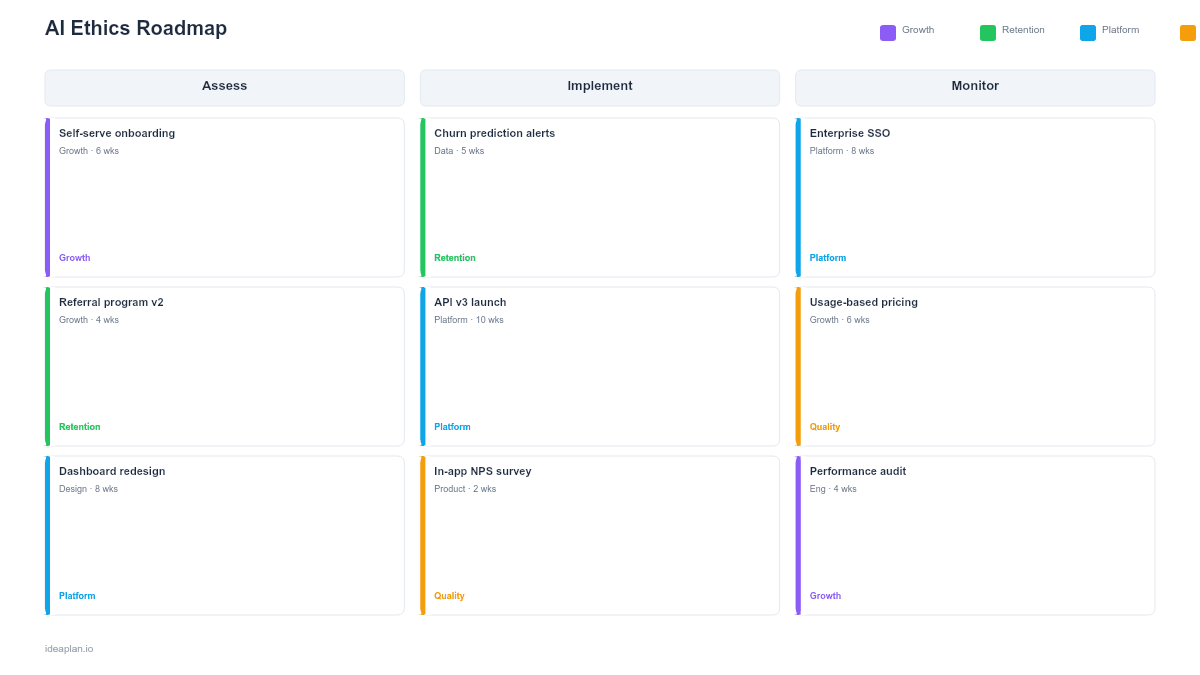
- Blank ethics roadmap slide. Four domain rows (Bias Detection, Fairness Metrics, Transparency, Human Oversight) with initiative cards on a quarterly timeline. Each card includes affected AI systems, user populations at risk, and success criteria.
- Filled example slide. A B2B SaaS product's ethics roadmap showing demographic bias audit for search ranking, fairness metric dashboards for recommendation algorithms, model card publishing, and escalation path implementation for AI-generated content.
Why AI Ethics Requires a Structured Roadmap
Ethics work in AI product teams tends to follow one of two failure modes: it either stays at the level of principles (a values statement on the website that never touches production code) or it becomes purely reactive (fixing bias after a public incident). Both approaches fail because they lack the infrastructure that connects ethical commitments to engineering practices.
Bias in AI systems is not a single bug to fix. It is a property that emerges from training data composition, model architecture choices, feature selection, and evaluation methodology. Addressing it requires coordinated work across data engineering, ML engineering, product design, and QA. The same kind of cross-functional coordination that any product initiative needs.
The responsible AI framework defines the principles. This template turns those principles into time-bound, measurable initiatives with clear ownership. For quantifying model behavior against fairness targets, the eval pass rate metric provides a standardized measurement approach.
Template Structure
Four Ethics Domains
Rows represent the core areas of AI ethics work:
- Bias Detection & Mitigation. Auditing training data for demographic imbalances, testing model outputs across protected groups, implementing debiasing techniques, and scheduling recurring audits. The goal is to surface and reduce bias before it reaches users.
- Fairness Metrics. Defining quantitative fairness criteria (demographic parity, equalized odds, calibration across groups), instrumenting production systems to measure them, setting thresholds, and building alerting when metrics drift outside acceptable ranges.
- Transparency & Explainability. Model cards documenting training data, intended use, and known limitations. User-facing explanations for AI-driven decisions. API documentation for downstream consumers. Internal documentation for auditors and regulators.
- Human Oversight. Escalation paths for AI decisions that cross risk thresholds. Human-in-the-loop review for high-stakes outputs. Override mechanisms for users who want to contest AI decisions. Monitoring dashboards for human escalation rate.
Initiative Cards
Each card contains:
- Initiative name. Specific action (e.g., "Implement demographic parity monitoring for loan scoring model").
- Affected AI systems. Which models or features this initiative covers.
- User populations. Which user groups are most affected by potential bias in these systems.
- Success criteria. Measurable outcome (e.g., "Fairness gap < 5% across all demographic groups").
- Owner and timeline. Accountable team and target completion quarter.
Ethical Risk Heat Map
A sidebar panel summarizes the ethical risk profile across all AI systems: how many are audited, how many meet fairness thresholds, and how many lack human oversight mechanisms. This gives leadership a portfolio-level view of ethical exposure.
How to Use This Template
1. Audit existing AI systems for ethical risk
Map every AI system to the user populations it affects and the decisions it influences. A content recommendation system affects what information users see. A search ranking model determines which products get visibility. Identify where unfair outcomes would cause the most harm and start there.
2. Define measurable fairness criteria
Vague commitments to "fairness" are unenforceable. Pick a quantitative definition for each system. Demographic parity (equal positive outcome rates across groups) works for some contexts. Equalized odds (equal false positive and false negative rates) works for others. The right metric depends on the domain and the specific harms you are trying to prevent.
3. Instrument monitoring
Fairness metrics that are not continuously monitored will degrade. Models retrained on new data may reintroduce bias that was previously corrected. Set up automated measurement and alerting using the same infrastructure you use for model accuracy scores.
4. Build transparency artifacts
For each AI system, create a model card documenting training data sources, intended use, known limitations, and evaluation results across demographic groups. The AI risk assessment framework provides a structured template for documenting risk factors. Publish model cards internally first, then selectively to customers and regulators.
5. Design human oversight mechanisms
For high-stakes AI decisions, implement escalation paths that route outputs above a risk threshold to human reviewers. Define what triggers escalation, who reviews, and what the SLA is. Monitor escalation volume to detect when models are producing more uncertain outputs than expected.
When to Use This Template
An AI ethics roadmap is the right format when:
- AI systems affect consequential decisions about users. Recommendations, scoring, content moderation, access, or pricing
- Regulatory requirements (EU AI Act, sector-specific rules) mandate bias testing and transparency documentation
- Customer or user trust depends on demonstrably fair AI behavior
- Multiple AI systems need coordinated ethics work rather than ad-hoc audits
- Cross-functional alignment between data science, engineering, product, legal, and policy teams is required
For broader AI governance including policy and compliance infrastructure, the AI governance roadmap covers the full program. For safety-focused work on guardrails and incident response, the AI safety roadmap is more appropriate.
Featured in
This template is featured in AI and Machine Learning Roadmap Templates, a curated collection of roadmap templates for this use case.
Key Takeaways
- AI ethics work spans four domains: Bias Detection, Fairness Metrics, Transparency, and Human Oversight.
- Measurable fairness criteria (not vague principles) are required to make ethics work enforceable.
- Continuous monitoring catches bias reintroduced by model retraining or data drift.
- Model cards and user-facing explanations build transparency for regulators, customers, and internal stakeholders.
- Human oversight mechanisms with defined escalation paths are essential for high-stakes AI decisions.
- Compatible with Google Slides, Keynote, and LibreOffice Impress. Upload the
.pptxto Google Drive to edit collaboratively in your browser.