Quick Answer (TL;DR)
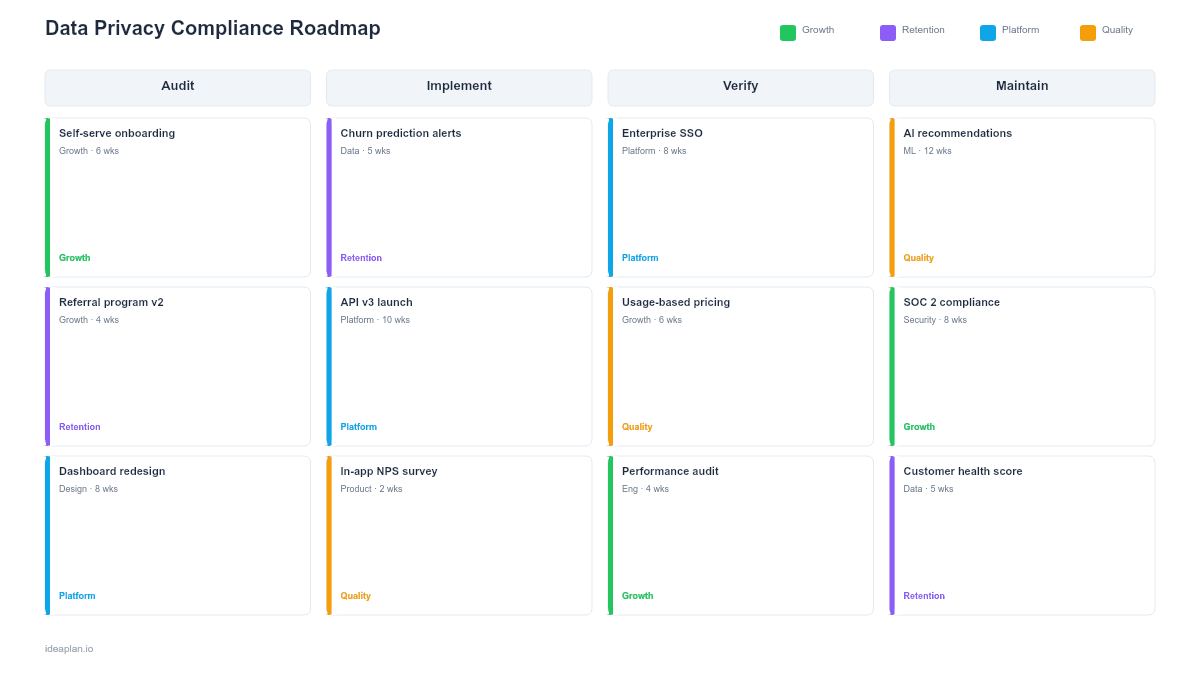
This free PowerPoint data privacy roadmap template maps your compliance journey across quarters, tracking data inventory audits, consent management rollouts, subject access request automation, and regulatory deadline alignment. It gives product, engineering, and legal teams a shared timeline showing which privacy requirements are being addressed when, who owns each workstream, and which external deadlines are non-negotiable. Download the .pptx, customize it for your regulatory environment, and use it to coordinate privacy work across technical and non-technical teams.
What This Template Includes
- Cover slide. Title slide with company name, applicable regulations (GDPR, CCPA, LGPD, etc.), privacy program owner, and compliance target date.
- Instructions slide. How to categorize privacy workstreams, map regulatory deadlines, and assign ownership between legal, engineering, and product. Remove before presenting.
- Blank privacy timeline slide. A quarterly roadmap with four swim lanes: data inventory and mapping, consent and preference management, data subject rights automation, and security and breach response. Each item shows the regulatory requirement it satisfies, the owning team, and the deadline.
- Filled example slide. A realistic 12-month GDPR compliance roadmap for a Series B SaaS company, showing data mapping in Q1, consent management platform deployment in Q2, automated DSR handling in Q3, and audit readiness in Q4.
Why PowerPoint for Data Privacy Roadmaps
Privacy compliance is inherently cross-functional. Engineering builds the technical controls. Legal interprets the regulations. Product decides how consent flows affect the user experience. Marketing needs to understand what data they can and cannot collect. None of these teams share a project management tool, and few share a common vocabulary.
A PowerPoint roadmap creates a single artifact that all four teams can read and reference. It translates legal requirements into engineering deliverables with dates, and it shows product managers how privacy work intersects with their feature roadmap. When a regulator asks "what is your compliance timeline," this slide is the answer.
Template Structure
Data Inventory Lane
The first lane covers knowing what data you have: where personal data lives, how it flows between systems, what the legal basis is for each data type, and where gaps exist. Cards in this lane include data mapping exercises, third-party vendor audits, and data classification projects. This work must come first because every other privacy initiative depends on understanding your data inventory.
Consent Management Lane
The second lane tracks consent infrastructure: cookie consent banners, email preference centers, in-app consent flows, and consent records storage. Each card specifies which regulation drives the requirement and the user-facing impact. Product managers need visibility into this lane because consent UI directly affects conversion rates and onboarding flows.
Data Subject Rights Lane
The third lane covers automation for handling data subject requests: access requests (right to know), deletion requests (right to erasure), portability requests, and opt-out mechanisms. Cards show the current process (manual vs. automated), target response time, and regulatory deadline (GDPR requires response within 30 days). This lane is where most engineering investment goes.
Security and Breach Response Lane
The fourth lane addresses the security controls that privacy regulations require: encryption standards, access controls, breach detection, and incident response procedures. Cards link to specific regulatory articles and show the current maturity level.
How to Use This Template
1. Identify your regulatory obligations
List every privacy regulation that applies to your business based on where your users are located, not where your company is headquartered. GDPR applies to EU residents' data regardless of your location. CCPA/CPRA applies to California consumers. Map each regulation to its specific requirements and deadlines. If you are subject to multiple regulations, start with the strictest (typically GDPR) and layer additional requirements on top.
2. Run a data inventory assessment
Before building privacy controls, understand what personal data you collect, where it is stored, how long you retain it, and who has access. This assessment reveals gaps that must be closed before compliance is achievable. The output feeds directly into the data inventory lane of the roadmap.
3. Prioritize by regulatory deadline and risk
Some privacy requirements have hard deadlines (regulation effective dates, contractual commitments). Others are ongoing obligations. Place deadline-driven items first. For items without external deadlines, prioritize by risk: what is the financial and reputational exposure if this gap is exploited? The risk assessment template can help quantify exposure.
4. Coordinate with product and engineering roadmaps
Privacy work competes with feature work for engineering capacity. Present the privacy roadmap alongside the product roadmap in planning meetings so trade-off decisions are explicit. Frame privacy items in terms leadership understands: "Delaying consent management by one quarter increases our GDPR fine exposure by X and blocks our EU expansion by Y months."
When to Use This Template
Data privacy roadmaps are essential when:
- Entering a new market with data protection regulations (EU, California, Brazil, etc.)
- Enterprise customers require compliance certifications as a condition of purchase
- Your product collects sensitive personal data (health, financial, biometric, children's data)
- You have received data subject requests and lack automated processes to handle them
- A privacy incident or near-miss has exposed gaps in your current controls
- Multiple teams need coordination on privacy work across engineering, legal, product, and marketing
If your product does not collect personal data and operates in unregulated markets, this template is unnecessary. For most SaaS companies serving international customers, privacy compliance is unavoidable and benefits from structured planning.
Key Takeaways
- Start every privacy roadmap with a data inventory. You cannot protect what you do not know you have.
- Organize by workstream (data mapping, consent, subject rights, security) rather than by regulation to avoid duplicate effort.
- Prioritize items with hard regulatory deadlines or high financial exposure first.
- Present the privacy roadmap alongside the product roadmap so capacity trade-offs are explicit and visible to leadership.
- Track DSR response time as the leading indicator of overall privacy program maturity.
- Compatible with Google Slides, Keynote, and LibreOffice Impress. Upload the
.pptxto Google Drive to edit collaboratively in your browser.