Quick Answer (TL;DR)
This free PowerPoint template helps product and security teams plan vulnerability remediation, compliance certification timelines, and security feature rollouts on a shared quarterly view. Initiatives are organized by security domain. Application security, infrastructure, data protection, and compliance. With severity and compliance impact tags on every item. Download the .pptx, populate it from your latest security assessment, and use it to coordinate security investments across engineering, DevOps, and compliance teams.
What This Template Includes
- Cover slide. Title slide with product name, security review period, and security lead or CISO name.
- Instructions slide. How to assign severity levels, map initiatives to compliance frameworks, and track remediation status. Remove before presenting to external audiences.
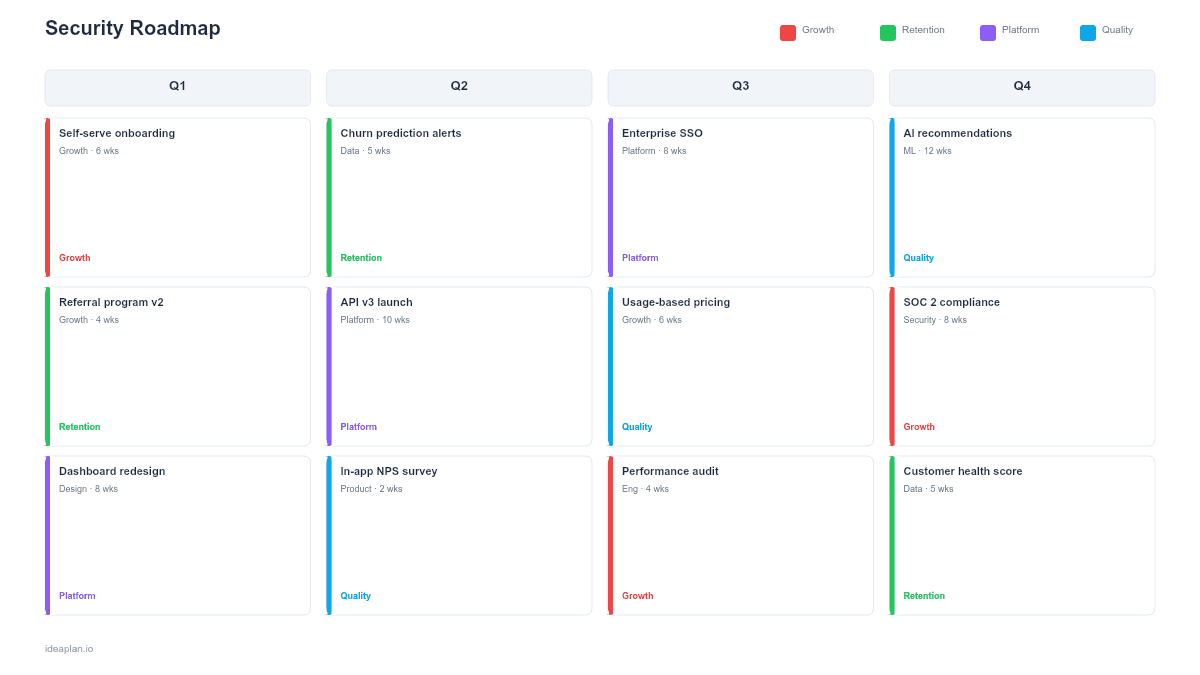
- Blank security timeline slide. A four-quarter grid with rows for each security domain (application security, infrastructure and DevOps, data protection, compliance and certification). Each card shows severity rating, compliance framework mapping (SOC 2, ISO 27001, GDPR, HIPAA), effort estimate, and owning team.
- Filled example slide. A realistic security roadmap for a growth-stage SaaS company showing OWASP Top 10 remediation, SOC 2 Type II audit preparation, encryption-at-rest implementation, and SSO/RBAC feature rollout, with certification audit dates marked as milestones.
Why PowerPoint for Security Roadmaps
Security work lives in a tension between urgency and planning. Critical vulnerabilities need immediate patches, but compliance certifications and security feature builds require sustained multi-quarter investment. A PowerPoint timeline surfaces both tracks side by side. The reactive remediation work and the proactive security capability builds. So leadership can see the full picture without digging through Jira filters.
The slide format is also essential for board-level and customer-facing communication. When a prospect's security questionnaire asks about your SOC 2 timeline, or a board member asks about your security posture, a single roadmap slide answers the question in seconds.
Template Structure
Security Domain Rows
Four rows cover the security surface: application security (code vulnerabilities, dependency scanning, penetration testing), infrastructure and DevOps (network security, container hardening, CI/CD pipeline security), data protection (encryption, access controls, data classification, backup and recovery), and compliance and certification (SOC 2, ISO 27001, GDPR, HIPAA, vendor security reviews).
Severity and Compliance Tags
Every initiative card carries a severity tag (critical, high, medium, low) and one or more compliance framework tags showing which certifications the work supports. A single initiative often maps to multiple frameworks. Implementing encryption at rest satisfies requirements in SOC 2, ISO 27001, and HIPAA simultaneously. This dual-tagging helps teams prioritize work that delivers the most compliance coverage per engineering hour.
Certification Milestone Markers
Vertical milestone lines mark key compliance dates: audit start, auditor on-site, certification issuance. These are hard deadlines that cannot slip without real business consequences. Delayed SOC 2 certification means delayed enterprise deals. Placing them on the same timeline as engineering work makes the connection between shipping code and hitting audit dates explicit.
How to Use This Template
1. Inventory security findings and compliance gaps
Gather inputs from your latest penetration test, vulnerability scans, compliance gap analysis, and customer security questionnaire responses. Categorize each item by security domain. If you have not run a formal security assessment recently, start there. A roadmap built on assumptions rather than findings will miss the highest-risk items.
2. Score severity and map to compliance frameworks
Assign severity using CVSS scores for vulnerabilities and business impact for compliance gaps. Map each item to the compliance frameworks it addresses. A risk assessment can help quantify business impact for items that do not have a CVSS score, such as missing access controls or incomplete audit logging.
3. Sequence by severity and certification deadlines
Critical and high-severity vulnerabilities go first, regardless of compliance impact. An actively exploitable vulnerability is more urgent than a SOC 2 gap. After critical items, sequence remaining work backward from certification audit dates. If your SOC 2 Type II audit starts in Q3, all required controls must be implemented and operating by early Q2 to build the required evidence trail.
4. Review with security, engineering, and business leadership
Security leads validate severity and completeness. Engineering leads confirm effort estimates and team availability. Business leadership (CEO, CRO, Head of Sales) validates that certification timelines align with deal pipeline requirements. The stakeholder management guide is useful for navigating these conversations when security and feature priorities conflict.
When to Use This Template
A security roadmap is essential when:
- Compliance certifications (SOC 2, ISO 27001, HIPAA) require multi-quarter preparation with hard audit deadlines
- A penetration test or security audit reveals dozens of findings that cannot be fixed in a single sprint
- Enterprise customers require security roadmap visibility as part of vendor evaluation
- Security and feature work compete for the same engineering teams and need explicit sequencing
- Board or investor reporting requires a structured view of security posture and investment
If your security work is limited to dependency updates and a few configuration fixes, a sprint plan handles it. This template is for when security is a multi-quarter program with compliance deadlines, cross-team dependencies, and leadership visibility requirements.
Featured in
This template is featured in Technical and Engineering Roadmap Templates, a curated collection of roadmap templates for this use case.
Key Takeaways
- Security roadmaps organize work by domain (app security, infrastructure, data protection, compliance) with severity and compliance framework tags on every initiative.
- Sequence critical vulnerabilities first, then work backward from certification audit deadlines for compliance items.
- Map initiatives to multiple compliance frameworks to identify work that delivers the most coverage per engineering hour.
- Reserve 10-15% unplanned buffer for zero-day patches and emergency remediation so planned work stays on track.
- Frame security investment in business terms. Risk reduction, compliance-enabled revenue, and customer trust.
- Compatible with Google Slides, Keynote, and LibreOffice Impress. Upload the
.pptxto Google Drive to edit collaboratively in your browser.