Quick Answer (TL;DR)
This free PowerPoint template plans your technical documentation program across four categories: API reference docs, architecture decision records (ADRs), operational runbooks, and developer guides. Each doc type tracks coverage percentage, staleness risk, and ownership. Download the .pptx, audit your current documentation gaps, and use it to turn "we should document that" into a scheduled plan with coverage targets and assigned owners.
What This Template Includes
- Cover slide. Organization or platform name, documentation program owner, and current overall coverage percentage.
- Instructions slide. How to audit documentation gaps, assign ownership, set quality standards, and track coverage over time. Remove before presenting.
- Blank documentation coverage matrix slide. A grid with documentation categories on rows (API reference, ADRs, runbooks, developer guides) and coverage states on columns (complete, draft, outdated, missing). Each cell shows document count and staleness indicator.
- Blank documentation timeline slide. A four-quarter timeline with rows per documentation category. Cards show the specific document, assigned owner, target completion date, and review cycle.
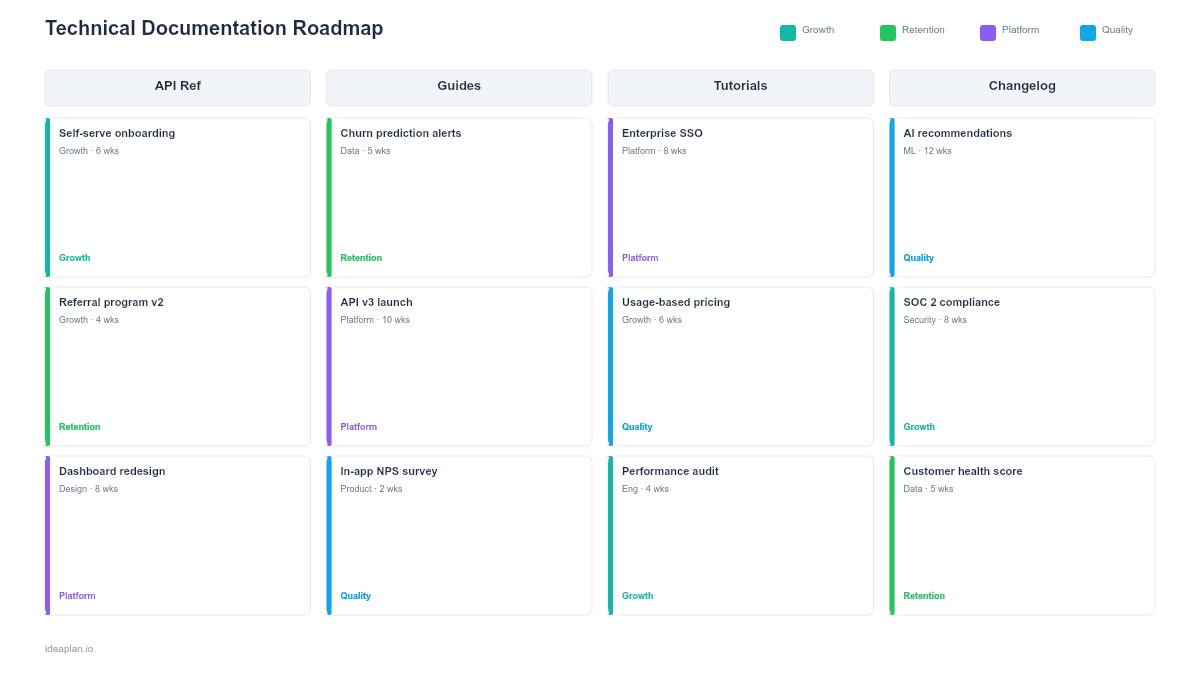
- Filled example slide. A realistic documentation roadmap for a SaaS engineering team showing 40% API reference coverage improving to 90%, 12 new ADRs, runbook creation for 8 critical services, and a developer onboarding guide rewrite.
Why Technical Documentation Needs a Roadmap
Every engineering team agrees documentation matters. Almost none treat it as planned work. Docs get written when someone is frustrated enough to spend a weekend on it, then decay because no one owns the review cycle. The result is documentation that is simultaneously too much (hundreds of outdated pages) and too little (the thing you actually need to know is not written down).
A roadmap changes documentation from reactive to planned. It treats docs like any other product deliverable. Scoped, scheduled, assigned, and reviewed. This is especially critical for API documentation, where gaps directly affect developer experience and external adoption, and for runbooks, where missing procedures during incidents cost real money.
Template Structure
API Reference Documentation Row
Tracks auto-generated and hand-written API reference docs. Cards show endpoint coverage (percentage of endpoints with complete documentation), schema accuracy (do the docs match the actual API contract?), and example quality (do code samples actually work?). The goal is 100% endpoint coverage with working examples in at least two languages. Link this to your API roadmap. Every new endpoint should ship with documentation.
Architecture Decision Records Row
ADRs document the "why" behind technical decisions. Database choices, framework selections, service boundaries, and protocol decisions. Cards show which decisions are documented, which are pending, and which need revision because the context has changed. A good target is one ADR per significant architectural decision. Track technical debt items that originate from undocumented decisions.
Operational Runbooks Row
Runbooks document how to respond to incidents, perform deployments, and execute maintenance procedures. Cards show service coverage (which services have runbooks), last-tested date (a runbook that has never been tested during a real incident is a guess, not a procedure), and mean time to recovery improvement targets. Prioritize runbooks for services with the highest incident frequency.
Developer Guides Row
Covers onboarding guides, setup instructions, contribution guidelines, and internal how-to documents. Cards show audience (new hires, external contributors, cross-team engineers), completion status, and time-to-productivity improvement targets. Measure effectiveness by tracking how long it takes a new engineer to make their first meaningful contribution after joining.
How to Use This Template
1. Audit current documentation state
Inventory every piece of technical documentation that exists. For each document, record: topic, last updated date, owner (if any), and accuracy rating (verified, probably correct, likely outdated, definitely wrong). Most teams discover that 30-50% of their existing documentation is outdated enough to be misleading. Misleading docs are worse than no docs.
2. Identify the highest-cost gaps
Focus on gaps that cost the team measurable time. If engineers spend 2 hours per week answering the same onboarding questions, that is 100+ hours per year a setup guide would save. If incident response takes 30 minutes longer than it should because there is no runbook, multiply that by incident frequency. Use these cost estimates to prioritize which documents to create first.
3. Assign ownership and review cycles
Every document needs an owner. The person responsible for keeping it accurate, not necessarily the person who writes it initially. Set review cycles based on change frequency: API docs should be reviewed every sprint if the API changes frequently, while ADRs only need review when the decision context changes. Put review dates on the roadmap so they are scheduled work, not afterthoughts.
4. Set coverage targets by quarter
Define measurable coverage targets: "API reference coverage from 40% to 75% by Q2" or "Runbooks for all Tier-1 services by Q3." Track coverage percentage monthly and report it alongside other engineering metrics. Documentation coverage that is visible to leadership gets investment; coverage that is invisible stays at zero.
When to Use This Template
A technical documentation roadmap is the right tool when:
- Onboarding new engineers takes weeks because tribal knowledge is not written down
- Incident response is slower than it should be due to missing or outdated runbooks
- API adoption is stalling because developers cannot find accurate documentation
- Architecture decisions keep getting relitigated because the original reasoning was never recorded
- Engineering teams are scaling and cannot rely on hallway conversations to transfer knowledge
If your documentation needs are limited to a single project or product launch, a section in your release plan is sufficient. This template is for teams that need to build documentation as an ongoing program with coverage tracking across multiple categories.
Featured in
This template is featured in Technical and Engineering Roadmap Templates, a curated collection of roadmap templates for this use case.
Key Takeaways
- Technical documentation roadmaps treat docs as planned work across four categories: API reference, ADRs, runbooks, and developer guides.
- Audit existing docs for staleness before writing new ones. Misleading documentation is more expensive than missing documentation.
- Assign every document an owner and a review cycle, and put review dates on the roadmap as scheduled work.
- Prioritize documentation gaps by measurable cost: hours lost to repeated questions, incident response delays, and onboarding time.
- Set quarterly coverage targets and report them alongside engineering metrics to make documentation investment visible to leadership.
- Compatible with Google Slides, Keynote, and LibreOffice Impress. Upload the
.pptxto Google Drive to edit collaboratively in your browser.