Quick Answer (TL;DR)
This free PowerPoint template structures your knowledge management strategy into four workstreams: capture, organize, discover, and maintain. Each slide maps initiatives to the problems they solve. Repeated questions in Slack, onboarding delays caused by missing documentation, and critical knowledge trapped in the heads of two engineers who have been here since the beginning. Download the .pptx, audit your current knowledge gaps, and present a plan that turns scattered tribal knowledge into a searchable, maintained system.
What This Template Includes
- Cover slide. Organization or team name, knowledge maturity level (ad hoc, emerging, structured, optimized), and the planning horizon.
- Instructions slide. How to audit existing knowledge sources, identify high-value gaps, and assign documentation owners. Remove before presenting.
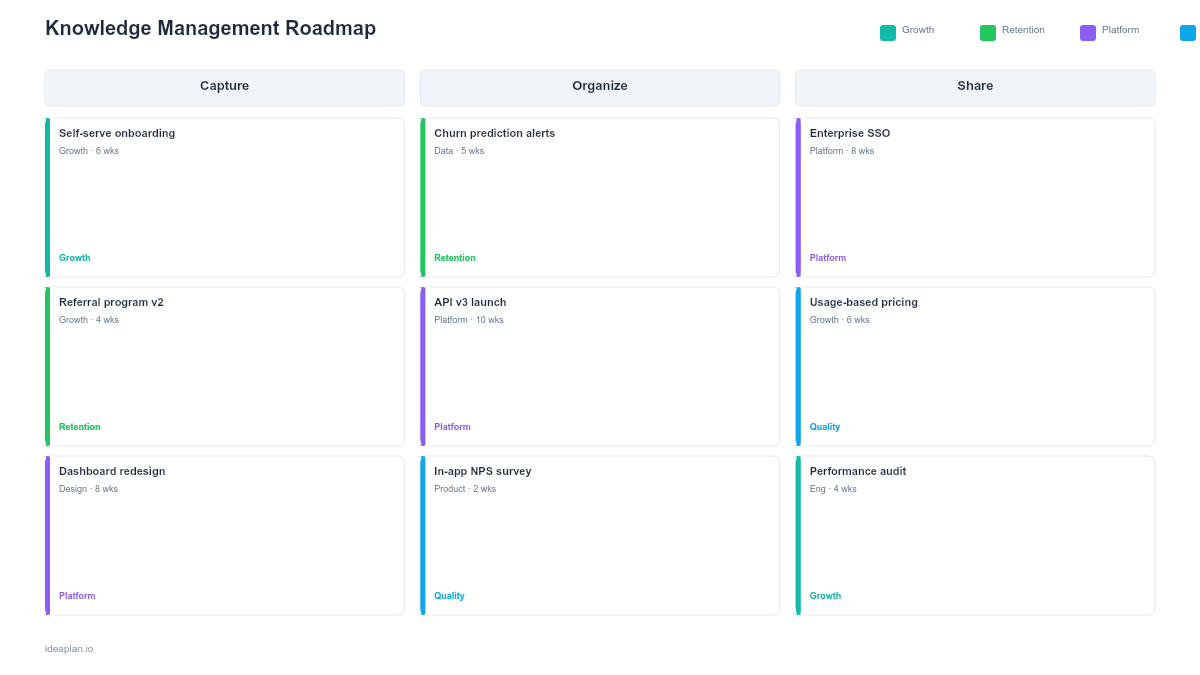
- Blank template slide. Four-workstream layout (Capture, Organize, Discover, Maintain) across quarterly columns with initiative cards, owner assignments, and success metrics.
- Filled example slide. A 50-person engineering organization building a knowledge management system over four quarters. Shows a documentation audit in Q1, wiki migration and taxonomy design in Q2, search implementation and templates in Q3, and a freshness review program in Q4 with ownership rotation.
Why Knowledge Management Needs a Roadmap
Every growing organization hits the same wall. When the team was 10 people, everyone knew everything. Decisions lived in Slack threads, architecture choices existed in the heads of the founding engineers, and new hires learned by sitting next to someone for a week. At 30 people, this breaks. At 100, it is a crisis.
The symptoms are predictable: engineers spend hours searching for how a system works, new hires take months to become productive because there is no written onboarding material, and the same questions get answered in Slack every week. These are not documentation problems. They are knowledge management problems. And they require a structured plan, not a mandate to "write more docs."
A knowledge management roadmap treats documentation as a product. It has users (your team), features (search, templates, freshness tracking), and metrics (time to find answers, documentation coverage, content freshness). Without this product thinking, documentation efforts start strong and decay within months.
Template Structure
Four Workstreams
The roadmap covers the full knowledge lifecycle:
- Capture. Getting knowledge out of people's heads and into a system. Includes documentation sprints, decision record templates, runbook creation, and post-mortem documentation. The goal is reducing the bus factor for critical systems.
- Organize. Structuring captured knowledge so it can be found. Taxonomy design, folder structures, tagging systems, and naming conventions. Bad organization makes good documentation invisible.
- Discover. Making knowledge findable at the moment someone needs it. Search indexing, contextual links, onboarding trails, and integration with tools people already use (Slack, IDE, ticketing systems).
- Maintain. Keeping knowledge accurate over time. Freshness review cycles, ownership assignments, deprecation workflows, and automated staleness alerts. Stale documentation is worse than no documentation because it misleads.
Knowledge Audit Matrix
The filled example includes a matrix mapping critical knowledge areas (architecture, deployment, business logic, operational procedures) against documentation status (documented and current, documented but stale, undocumented). This matrix drives prioritization. Undocumented areas with high access frequency get documented first.
Ownership Model
Each initiative card includes an owner, but the template also defines a broader ownership model: who is responsible for each knowledge area long-term, how ownership transfers when people leave, and how the review cadence works. This is the piece most documentation efforts skip, which is why docs decay.
How to Use This Template
1. Audit existing knowledge sources
List every place knowledge currently lives: wiki pages, Slack channels, Google Docs, README files, individual engineers' heads, recorded meetings. For each source, note whether it is searchable, maintained, and accessible to new hires. Most organizations discover their knowledge is scattered across 5-10 tools with no central index.
2. Identify the highest-cost knowledge gaps
Survey the team: "What question have you spent the most time trying to answer this month?" and "What knowledge would have saved you the most time when you started?" Rank gaps by frequency and impact. A missing architecture overview that blocks every new engineer for a week is higher priority than a missing style guide.
3. Choose a primary knowledge platform
Pick one system as the source of truth. Confluence, Notion, GitBook, or even a well-structured GitHub wiki. The specific tool matters less than the commitment to one primary location. Multiple wikis with partial information is worse than one wiki with gaps. For teams evaluating options, the PM tool picker can help compare documentation platforms.
4. Sequence by workstream dependencies
Capture comes before Organize. You cannot structure knowledge that does not exist yet. Organize comes before Discover. Search is useless without good taxonomy. Maintain runs continuously starting from Q2 once there is content worth maintaining. The template encodes this natural sequencing.
5. Assign documentation owners by knowledge area
Every major knowledge area (authentication system, payment flows, deployment procedures) gets one owner. The owner does not write every document but is responsible for ensuring the area is documented, current, and reviewed on schedule. Track documentation coverage as a metric and review it monthly.
When to Use This Template
Knowledge management roadmaps fit when:
- New hire onboarding takes longer than it should because critical knowledge is not written down or is scattered across tools
- The same questions keep appearing in Slack and the answers live only in chat history or individual memory
- Key people leaving would cause significant knowledge loss. The bus factor for critical systems is one or two people
- An existing wiki or documentation system has decayed and needs a structured revival with ownership and maintenance processes
- The organization is scaling past the point where informal knowledge sharing works
If your focus is specifically on customer-facing documentation rather than internal knowledge, the documentation roadmap template covers external docs and help centers.
Key Takeaways
- Knowledge management roadmaps cover four workstreams: capture, organize, discover, and maintain. In that dependency order.
- Start with a knowledge audit to identify the highest-cost gaps, not a mandate to "document everything."
- Assign named owners to knowledge areas, not just individual documents, to prevent decay over time.
- Track time-to-find-answers and documentation coverage as primary metrics for knowledge management effectiveness.
- PowerPoint format makes knowledge management investment visible to leadership and cross-functional stakeholders who may not see the daily cost of missing documentation.
- Compatible with Google Slides, Keynote, and LibreOffice Impress. Upload the
.pptxto Google Drive to edit collaboratively in your browser.