Quick Answer (TL;DR)
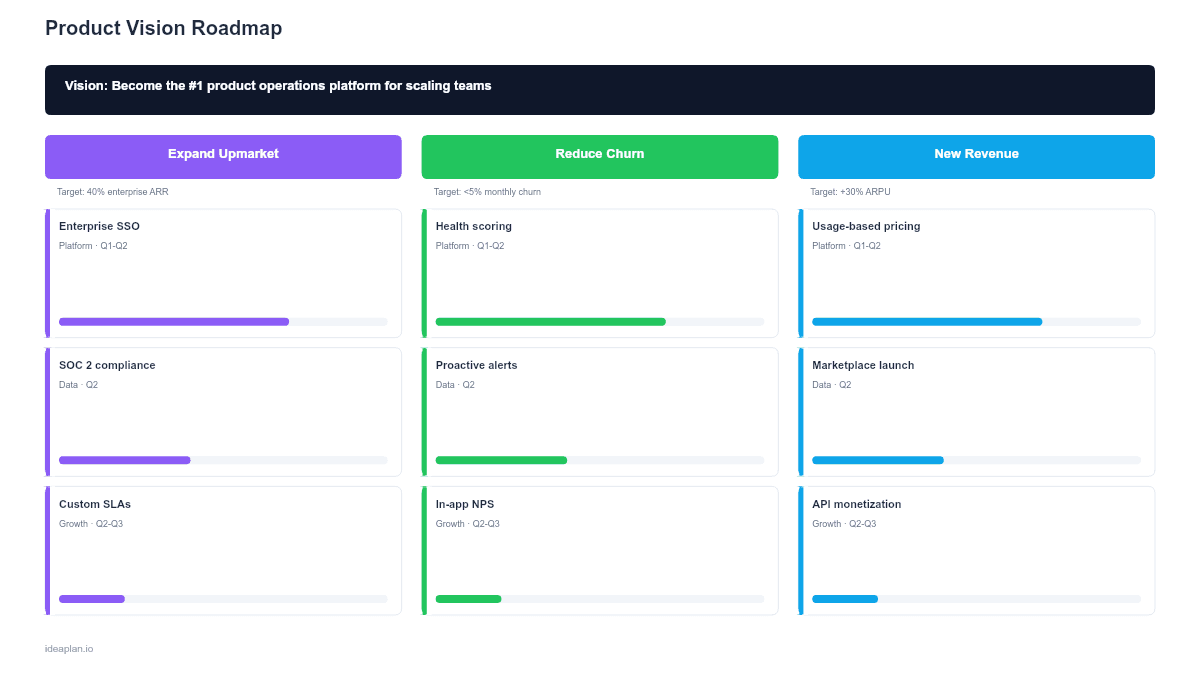
This free PowerPoint template connects a long-term product vision to quarterly execution through a cascading structure: vision statement at the top, north star metric below it, three strategic pillars across the middle, and milestone markers along a 4-8 quarter timeline. Download the .pptx, define your product's north star and pillars, and use it to show leadership, investors, and your team how daily work ladders up to a multi-year destination.
What This Template Includes
- Cover slide. Product name, vision headline, and the time horizon covered (typically 2-3 years).
- Instructions slide. Step-by-step guidance for defining your vision, selecting pillars, and placing milestones. Remove before presenting.
- Blank vision roadmap slide. Vision banner, north star metric card, three strategic pillar columns, and a timeline row with milestone markers across 4-8 quarters.
- Filled example slide. A developer tools company vision roadmap showing three pillars (Developer Experience, Enterprise Readiness, Ecosystem Growth) with milestones mapped across six quarters and a north star of weekly active developers.
Why a Vision Roadmap Needs Its Own Format
Standard roadmaps answer "what are we building this quarter?" A vision roadmap answers "where are we going over the next 2-3 years and why?" These are different questions that require different slide structures.
The most common failure in product planning is a gap between the vision document that sits in a Google Doc and the quarterly roadmap that drives daily work. Teams build features without understanding which strategic pillar the work supports. Leadership reviews quarterly plans without evaluating whether they advance the multi-year direction.
This template bridges that gap. The vertical hierarchy. Vision, north star, pillars, milestones. Creates a direct line from the company's aspirational future to the next quarter's deliverables. For guidance on writing a vision statement that actually guides decisions, see the product vision guide.
Template Structure
Vision Banner
A full-width banner at the top holds the product vision in a single sentence. This statement should be aspirational but specific. "Make every developer 10x more productive" is better than "Build the best developer tools." The vision should be stable for 3-5 years.
North Star Metric
Below the vision, a metric card displays the north star metric. The single number that best measures progress toward the vision. Include the current value and the target for the end of the roadmap horizon. Every pillar and milestone should plausibly move this number.
Strategic Pillars
Three columns represent the major investment themes that drive the vision forward. Each pillar has a name, a one-line description, and a supporting metric that tracks progress within that pillar. Pillars are stable for 12-18 months. If they change every quarter, they are initiatives, not pillars.
Good pillars answer: "What must we be excellent at to reach our vision?" They are not feature categories. "Notifications" is a feature category. "Proactive User Engagement" is a pillar.
Milestone Timeline
A horizontal track at the bottom shows 4-8 quarters with milestone markers. Each milestone is a tangible achievement that demonstrates progress toward the vision: "1,000 enterprise accounts," "Plugin marketplace launch," "50% self-serve onboarding rate." Milestones connect pillars to time, showing which quarters deliver the biggest inflection points.
How to Use This Template
1. Define or revisit the vision
If your team lacks a written product vision, start there. The vision roadmap template is not useful without a genuine vision. If a vision exists, evaluate whether it still holds. Markets change. A vision written two years ago may need refinement.
2. Select the north star metric
Pick the single metric that best represents value delivery to users. For a collaboration tool, this might be weekly active collaborators. For an analytics product, it could be queries run per account per week. The north star metric guide explains the selection process in detail.
3. Identify three strategic pillars
Brainstorm the 4-6 things the product must do well to reach its vision. Then force-rank them. The top three become pillars. The others become supporting themes that may get pillar status in a future cycle. This constraint is intentional. Three pillars keep the team focused.
4. Map milestones to quarters
Work backward from the vision. If the vision is "every developer uses our tool daily," what needs to be true in Year 2? Year 1? Next quarter? Place 1-2 milestones per quarter. Early quarters should have specific, measurable milestones. Later quarters can be directional.
5. Validate with leadership
Present the draft to your CPO, CEO, or founder. The vision roadmap is a commitment statement. If leadership disagrees with a pillar or milestone, resolve it now rather than discovering the misalignment mid-quarter. See the stakeholder management guide for alignment techniques.
6. Cascade to quarterly plans
Each quarter, the team should be able to point to the vision roadmap and say: "This quarter's work advances Pillar 2 toward Milestone X." If the quarterly roadmap does not connect to any pillar, either the quarterly plan is off-strategy or the pillars need updating.
When to Use This Template
A vision roadmap is the right artifact when:
- Annual or multi-year planning requires a document that outlasts any single quarter
- New product launches need a north star and directional pillars before detailed feature planning begins
- Leadership alignment across founders, C-suite, and board requires a shared view of where the product is heading
- Team onboarding where new PMs and engineers need to understand the strategic context behind their backlog
- Fundraising where investors want to see the 2-3 year product trajectory alongside the current traction
If you already have a clear vision and need to plan the next quarter in detail, use the quarterly roadmap template. For connecting goals to measurable key results, the OKR roadmap adds that layer of accountability.
Featured in
This template is featured in Roadmap Templates for Executive and Board Presentations, a curated collection of roadmap templates for this use case.
Key Takeaways
- Vision roadmaps bridge the gap between aspirational vision documents and tactical quarterly plans.
- The cascade structure. Vision, north star, pillars, milestones. Creates a direct line from multi-year direction to quarterly deliverables.
- Three strategic pillars force genuine prioritization of what the product must do well.
- Milestones give the vision a timeline, making abstract direction feel concrete and measurable.
- Review every six months; adjust later-quarter milestones while keeping the vision and pillars stable.
- Compatible with Google Slides, Keynote, and LibreOffice Impress. Upload the
.pptxto Google Drive to edit collaboratively in your browser.