Quick Answer (TL;DR)
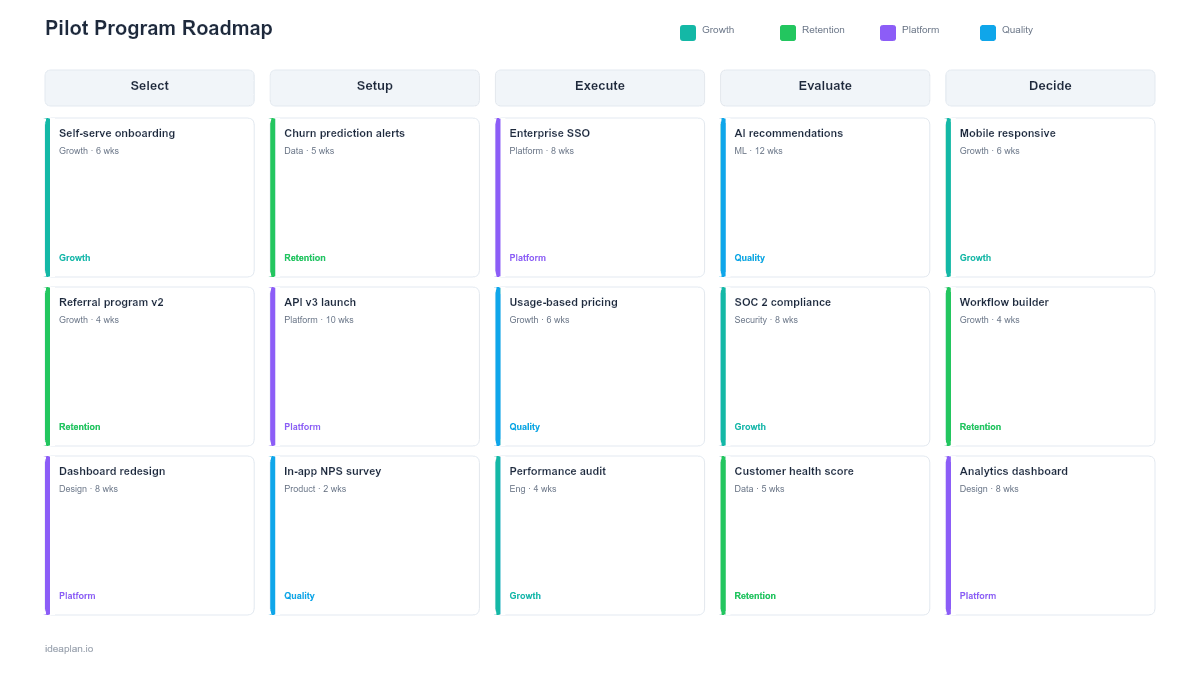
This free PowerPoint template helps you plan and manage structured product pilots from participant selection through a Go/No-Go rollout decision. It covers five phases: Select, Setup, Execute, Evaluate, and Decide. Download the .pptx, define your success criteria, and run a pilot that produces clear evidence for whether to expand to general availability.
What This Template Includes
- Cover slide. Feature or product name, pilot duration, target participant count, and program owner.
- Instructions slide. Step-by-step guidance for defining selection criteria, setting up feedback channels, running the execution phase, and making the final Go/No-Go decision. Remove before presenting.
- Blank template slide. Five-phase column layout (Select, Setup, Execute, Evaluate, Decide) with placeholder cards for tasks and milestones. Includes a success criteria metrics section at the bottom.
- Filled example slide. A 12-week enterprise analytics dashboard pilot with 8 accounts across 3 segments, showing real tasks per phase and success metrics (adoption rate, time to value, NPS, support tickets, Go/No-Go verdict).
When to Use This Template
A pilot program sits between a proof of concept and a full launch. Use this template when:
- You need real-world validation with actual customers before committing to a broad rollout. Internal testing and staging environments cannot replicate production conditions.
- The feature affects enterprise workflows and you need to prove value to multiple stakeholders (buyers, administrators, end users) before expanding.
- You want to limit blast radius. Pilots constrain the impact of bugs, performance issues, or poor UX to a small group while you iterate.
- Stakeholders require evidence before funding GA. A structured pilot with measurable outcomes gives leadership the data to approve headcount, marketing spend, and sales enablement.
- The product serves multiple segments and you need to verify that the feature works across different company sizes, industries, or use cases.
For features that need technical feasibility validation rather than market validation, start with a Proof of Concept Roadmap. For features that are already validated and need graduated percentage-based rollout, use the Feature Flag Rollout Roadmap instead.
Key Features
Five-Phase Column Layout
The roadmap divides the pilot into sequential phases, each with clear deliverables:
- Select. Define participant criteria, recruit accounts, sign pilot agreements. Target 5-15 participants across 2-4 segments for statistical variety without excessive support burden.
- Setup. Provision accounts, run kick-off calls, assign dedicated customer success contacts, and configure feedback channels.
- Execute. The pilot runs for a fixed window (typically 4-12 weeks). Track adoption metrics weekly. Conduct a mid-pilot review to surface and address blockers early.
- Evaluate. Score results against predefined success criteria. Document usage patterns, feature requests, and UX gaps. Identify what needs to change before GA.
- Decide. Present findings to stakeholders with a clear Go/No-Go recommendation. If Go, define the rollout timeline. If No-Go, specify what must change before a second pilot.
Success Criteria Dashboard
The bottom section tracks five metrics that directly inform the Go/No-Go decision:
- Adoption Rate. Percentage of pilot participants actively using the feature on a weekly basis.
- Time to Value. Days from account provisioning to first meaningful outcome (varies by product).
- NPS / CSAT. Net Promoter Score or customer satisfaction from pilot participants.
- Support Tickets. Average weekly support volume per pilot account. High ticket rates signal UX or stability issues.
- Go/No-Go. Binary verdict based on how many criteria met their targets.
Realistic Filled Example
The example slide shows an enterprise analytics dashboard pilot with 8 accounts across SaaS, fintech, and healthcare segments. It demonstrates how tasks flow across phases: recruitment with segment diversity, sandbox provisioning, a mid-pilot review at week 6, and a final Go decision with a phased rollout plan.
How to Customize
Step 1: Define success criteria first
Before recruiting a single participant, write down 4-6 measurable criteria that determine Go or No-Go. Each criterion needs a target threshold (e.g., adoption rate > 60%, time to value < 5 days). Without predefined criteria, the pilot produces opinions instead of evidence.
Step 2: Select participants deliberately
Recruit across 2-4 segments that represent your target market. Include at least one segment that will stress-test the feature (high-volume users, complex integrations) and one that represents your median customer. Avoid filling the pilot with friendly accounts who will give positive feedback regardless.
Step 3: Build a feedback cadence
Schedule structured touchpoints: a kick-off call, weekly async check-ins, a mid-pilot review (survey + interviews), and a final evaluation call. Use the Voice of Customer Roadmap template pattern to structure feedback collection. In-app analytics complement qualitative feedback.
Step 4: Run a mid-pilot review
At the midpoint, assess early signals. If adoption is below expectations, diagnose whether the issue is onboarding friction, feature gaps, or wrong-fit participants. Course-correct before the second half rather than discovering problems at evaluation time.
Step 5: Make the Go/No-Go decision explicit
Present the results in a structured format: criteria, targets, actuals, verdict. Avoid ambiguity. If 4 of 5 criteria pass and the gap is mitigable, recommend Go with conditions. If fundamental issues remain, recommend a second pilot with changes. Use the RICE framework to help prioritize which gaps to address first.
Best Practices for Pilot Program Roadmaps
- Set a hard end date. Pilots without deadlines become permanent soft launches. Even if you extend, set a new deadline and communicate it to all participants.
- Track leading indicators weekly. Do not wait until the evaluation phase to look at data. Weekly adoption trends reveal problems weeks before the formal assessment.
- Assign dedicated support. Pilot participants need faster response times than GA users. A shared Slack channel or dedicated CSM per 2-3 accounts keeps engagement high.
- Document everything. Feature requests, workarounds, support patterns, and participant quotes become invaluable during GA planning and sales enablement.
- Limit scope creep. Pilots are for validating what exists, not building new features mid-stream. Log feature requests for post-GA and keep the pilot focused on the current state.
- Communicate results back to participants. Send a summary of what you learned and what you are doing about it. Participants who feel heard become internal advocates.
Featured in
This template is featured in:
Key Takeaways
- Define 4-6 measurable success criteria before recruiting participants. Criteria without targets produce inconclusive pilots.
- Recruit across 2-4 customer segments. Homogeneous pilots produce biased results that do not predict GA performance.
- Run a mid-pilot review at the halfway point to catch and address issues before evaluation.
- Make the Go/No-Go decision binary and data-driven. Present criteria, targets, actuals, and a clear recommendation.
- Eight to twelve weeks is the standard pilot duration for enterprise features. Set a hard end date and communicate it upfront.
- Compatible with Google Slides, Keynote, and LibreOffice Impress. Upload the
.pptxto Google Drive to edit collaboratively in your browser.