Quick Answer (TL;DR)
This free PowerPoint template structures proof of concept projects around four phases: Define, Build, Evaluate, and Decide. Each POC gets explicit success criteria before a single line of code is written, a constrained build scope, and a decision gate that forces a clear go, pivot, or kill recommendation. Download the .pptx, scope your POC, and give stakeholders a timeline they can track without micromanaging the investigation.
What This Template Includes
- Cover slide. POC title, sponsoring team, target decision date, and executive sponsor.
- Instructions slide. How to set success criteria, scope the build, and run the evaluation review. Remove before presenting.
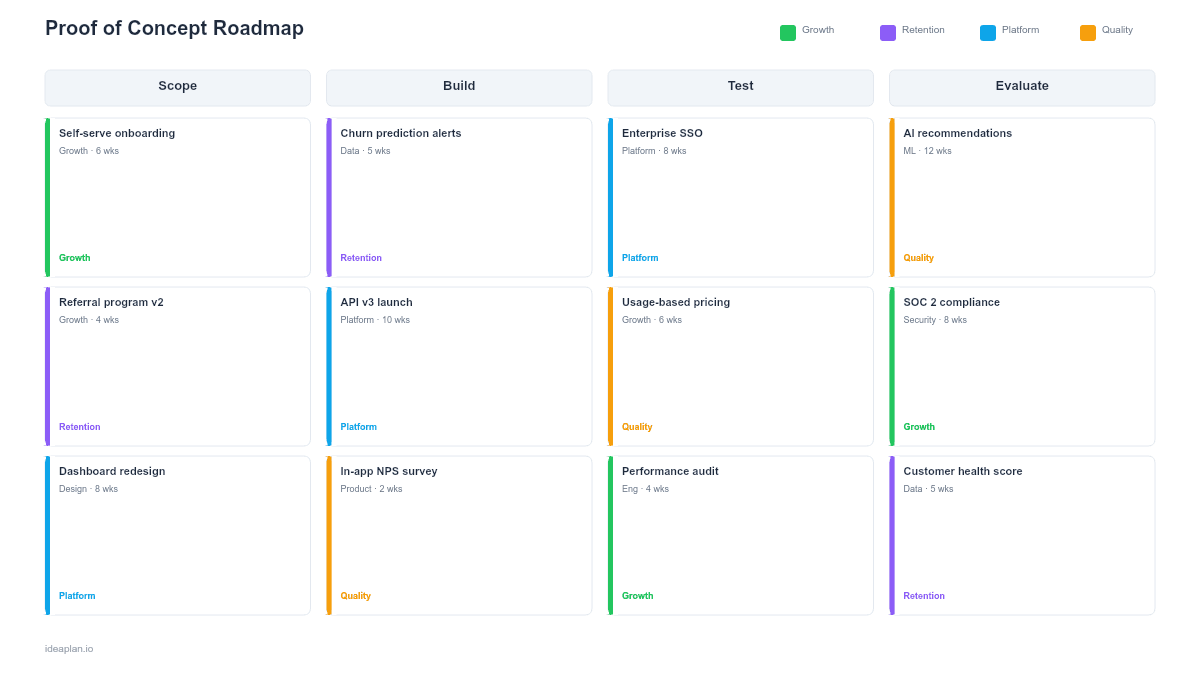
- Blank template slide. Four-phase timeline (Define, Build, Evaluate, Decide) with rows for Technical Work, Business Validation, and Stakeholder Touchpoints. Placeholder cards at each phase boundary.
- Filled example slide. A 6-week POC for an AI-powered recommendation engine, showing hypothesis, build milestones, evaluation metrics, and the final decision gate with stakeholder sign-off.
Why Proof of Concepts Fail
Most POCs fail not because the technology does not work, but because the team never defined what "works" means. The pattern looks like this: a team builds something interesting over four to six weeks, demos it, gets mixed reactions, and the project enters limbo. Not killed, not funded, just consuming attention.
The root cause is missing success criteria. Without measurable thresholds defined before the build, the evaluation becomes subjective. Enthusiastic stakeholders call it a success. Skeptical ones call it inconclusive. Nobody has the data to settle the argument.
A structured POC roadmap prevents this by separating the question from the investigation. You define what success looks like in Phase 1 (before building anything), build the minimum necessary to test it in Phase 2, evaluate against the predefined criteria in Phase 3, and make a binary decision in Phase 4. This is the same discipline that makes A/B testing effective. You set the hypothesis and success metric before running the experiment.
Template Structure
Four-Phase Timeline
The horizontal axis divides the POC into four phases with hard boundaries:
- Define (Week 1). Frame the hypothesis, set success criteria, identify risks, and get stakeholder alignment on what "good enough" looks like.
- Build (Weeks 2-4). Construct the minimum prototype that can be evaluated against the criteria. No feature polish, no edge cases, no production hardening.
- Evaluate (Week 5). Run the prototype against the success criteria. Collect quantitative data and qualitative feedback from the target audience.
- Decide (Week 6). Present findings to the decision-making group. Recommend Go (fund full development), Pivot (reframe the approach), or Kill (abandon the concept).
Three Workstream Rows
Each row tracks a different dimension of the POC:
- Technical Work. Architecture spikes, prototype code, integration stubs, performance benchmarks.
- Business Validation. Market sizing, customer interviews, competitive analysis, revenue model assumptions.
- Stakeholder Touchpoints. Kick-off meeting, mid-point check-in, evaluation review, decision gate presentation.
Success Criteria Card
A dedicated card on the Define phase slide captures:
- Primary metric. The one number that determines success (e.g., "Recommendation click-through rate above 8%").
- Secondary metrics. Supporting signals (e.g., "API response time under 500ms," "User satisfaction score above 3.5/5").
- Kill criteria. Conditions that trigger early termination (e.g., "Estimated production cost exceeds $50K/month").
How to Use This Template
1. Frame the hypothesis
Write one sentence: "We believe [approach] will [outcome] for [user segment], and we will know this works when [metric] reaches [target]." This prevents scope creep by anchoring every build decision to the original question. Align this with your product vision to ensure the POC is worth running.
2. Define success and kill criteria
Set measurable thresholds before building. The success criteria should be challenging but achievable. The kill criteria should flag obvious dead ends early. Both must be agreed on by the decision-making group so the evaluation is not relitigated after the fact.
3. Scope the minimum build
List only the components needed to evaluate the success criteria. If the success metric is click-through rate, you need a working recommendation UI. You do not need user accounts, analytics dashboards, or admin controls. Apply the same ruthlessness you would use in MoSCoW prioritization to strip the build to essentials.
4. Run the evaluation
Test the prototype with real users or realistic data. Collect the metrics defined in Phase 1. Document both quantitative results and qualitative observations. Note any surprises. Signals the team did not anticipate often matter as much as the predefined metrics.
5. Present and decide
Walk the decision group through the findings in a 30-minute review. Lead with the verdict, then show the evidence. If the primary metric cleared the threshold, recommend Go with a rough estimate for full development. If it fell short, explain why and whether a pivot could change the outcome. Avoid "let's run it for two more weeks". That usually means the criteria were wrong, not that the POC needs more time.
When to Use This Template
Proof of concept roadmaps are the right tool when the team faces significant uncertainty about feasibility or value. Use this template when:
- A proposed feature requires new technology and the team needs to validate that it works before committing to a full build
- Stakeholders disagree on whether an idea is viable and need evidence, not opinions, to settle the discussion
- The estimated build cost is high and a cheaper prototype can de-risk the investment before allocating a full squad
- You are evaluating third-party vendors or APIs and need hands-on testing beyond what a sales demo reveals
- Innovation projects need guardrails to prevent them from becoming indefinite explorations with no decision point
For smaller technical questions that can be answered in 1-3 days, use the Technical Spike Roadmap template instead. For validating market demand rather than technical feasibility, the Hypothesis Testing Roadmap template focuses on user experiments.
Featured in
This template is featured in Roadmap Templates for Startups and MVPs, a curated collection of roadmap templates for this use case.
Key Takeaways
- Define success criteria before building anything. Without predefined thresholds, POC evaluations become opinion contests.
- Scope the build to the minimum needed to evaluate those criteria. Every extra feature added to a POC delays the decision without improving it.
- Set explicit kill criteria so the team can exit early when evidence clearly shows the approach will not work.
- The decision gate forces a binary outcome: Go, Pivot, or Kill. "Let's keep exploring" is not a valid output.
- POC code is disposable. Its value is the knowledge it produces, not the code it contains.
- Compatible with Google Slides, Keynote, and LibreOffice Impress. Upload the
.pptxto Google Drive to edit collaboratively in your browser.