Eight free PowerPoint roadmap templates designed for early-stage products: Proof of Concept, MVP, Beta Launch, Early Access, General Availability, Product Launch, Experiment Pipeline, and Growth Experiment. Each covers a specific startup lifecycle phase and works in Google Slides, Keynote, or LibreOffice Impress. Start with the Proof of Concept Roadmap if you are validating an idea, or the MVP Roadmap if you are ready to build.
Most roadmap templates assume you have a mature product, established teams, and quarterly planning cycles. If you are building an MVP or running a startup, those templates create more overhead than value. You need formats built for speed, experimentation, and the reality that your plan will change every two weeks.
Looking for startup ideas to apply these roadmap templates to? Browse our SaaS Idea Lab with 71 validated product ideas, complete with market sizing, competitive analysis, MVP feature sets, tech stacks, and go-to-market strategies. Filter by build time, competition level, or market category. For broader market context on where the highest-growth opportunities exist, explore our SaaS Market Trends 2026 analysis covering 25 trends with growth trajectories and emerging segments.
How Do You Validate Your Startup Idea?
Before writing a line of code, you need a structured way to test whether your idea holds up. These templates help you plan the validation phase without over-committing resources.
Proof of Concept Roadmap
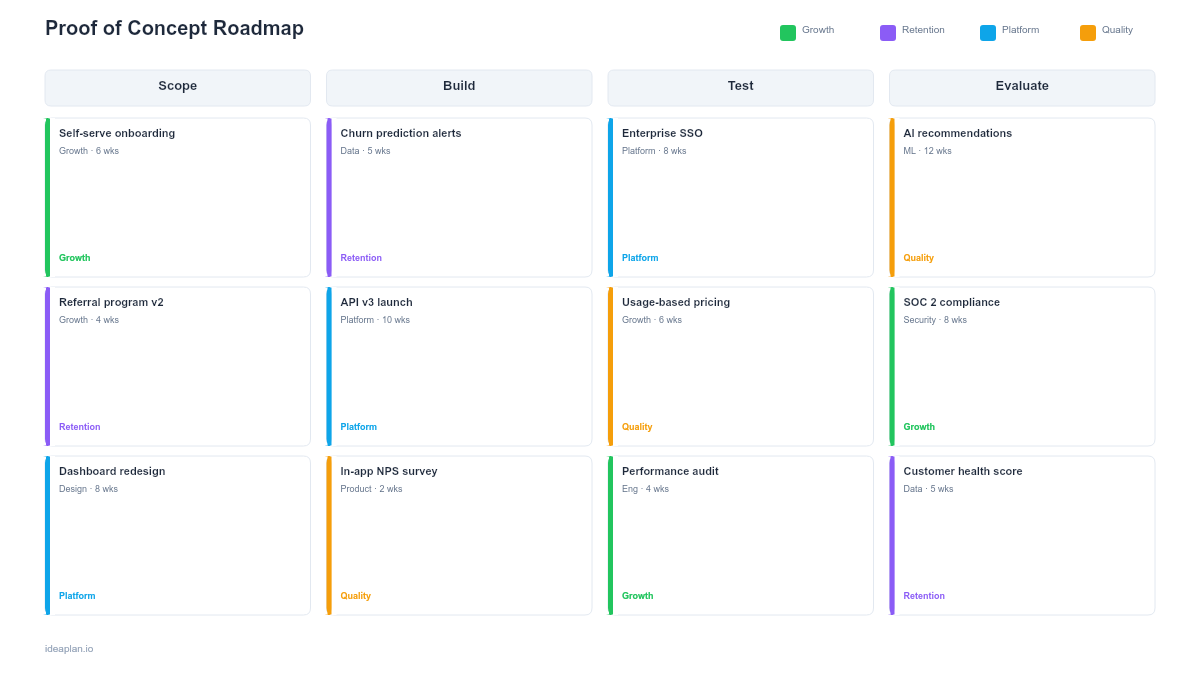
A proof of concept roadmap focuses on the minimum work needed to answer one question: does this idea work? It structures the validation into phases: hypothesis definition, technical feasibility, user testing, and a go/no-go decision point. Unlike a full product roadmap, it is designed to end. Either you validate the concept and move to MVP, or you kill it early and save months of wasted effort. Use the RICE framework to decide which concepts are worth proving first.
MVP Roadmap
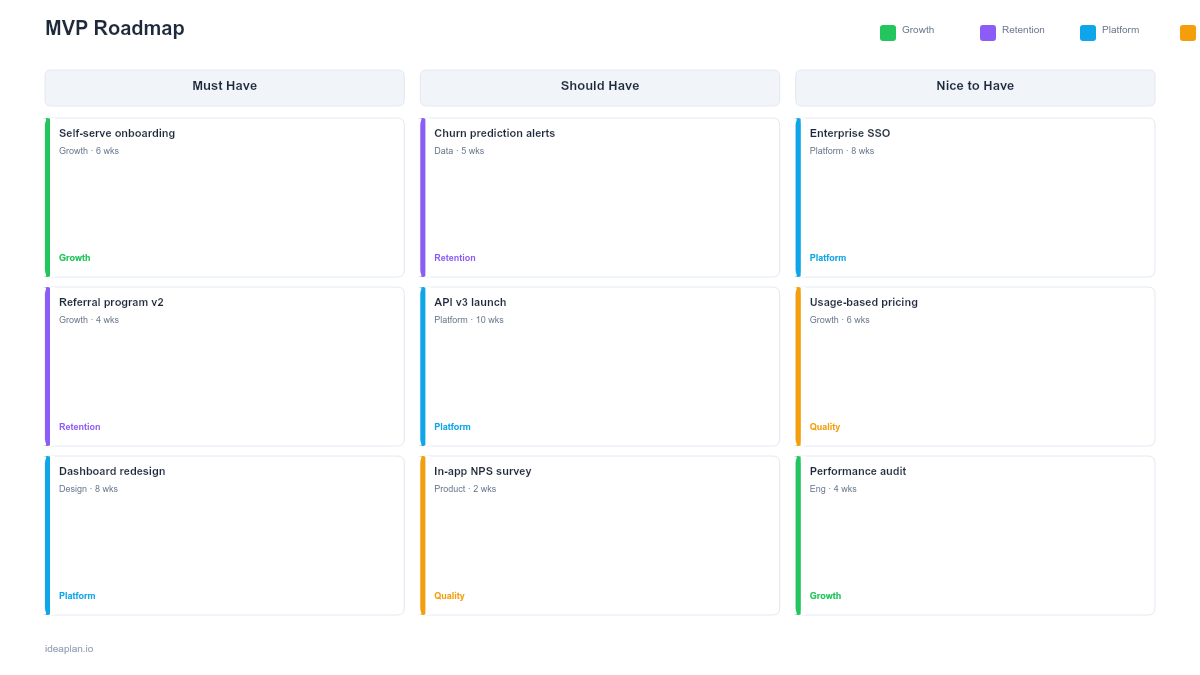
The MVP roadmap strips planning down to what matters: the smallest set of features that delivers value to your first users. It organizes work into a single build cycle with clear scope boundaries, launch criteria, and a feedback collection plan for after release. The template forces you to define what is out of scope, which, for most startups, is the harder and more important exercise. If you are deciding whether to build your MVP in-house or use existing tools, the AI Build vs Buy assessment can help frame that decision.
What Templates Help with Launching and Iterating?
Once you have something to ship, these templates structure the messy middle between "it works" and "it is ready for everyone."
Beta Launch Roadmap
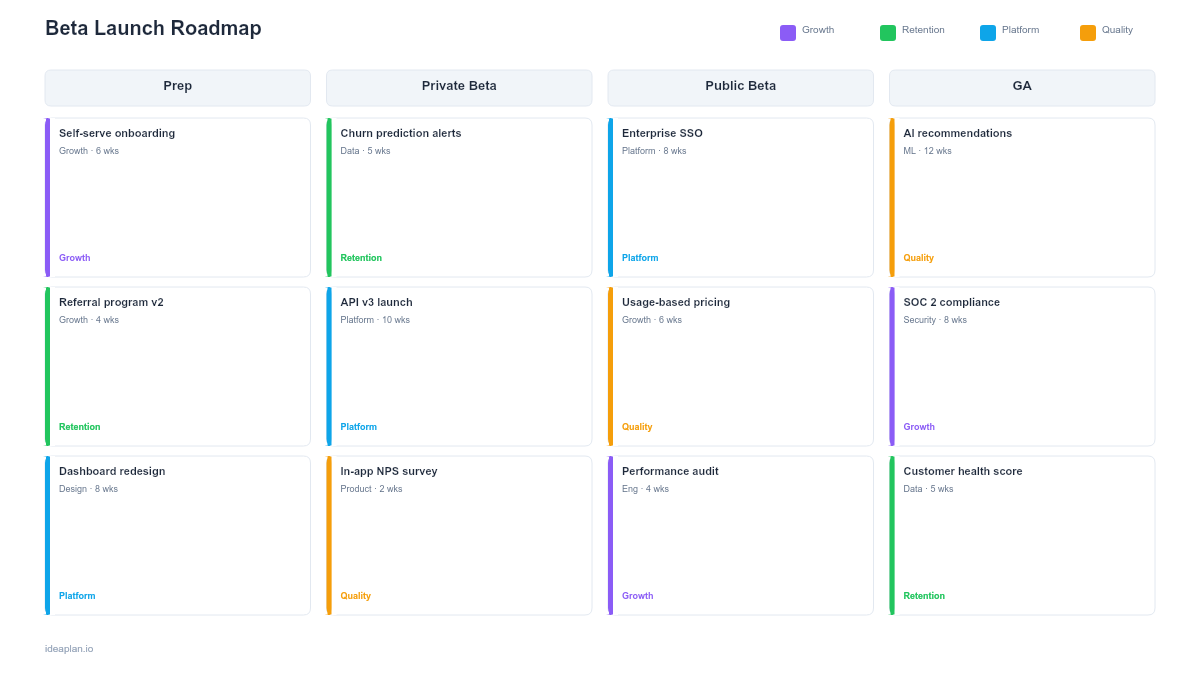
A beta launch roadmap plans the controlled release of your product to a limited audience. It covers beta recruitment, onboarding, feedback loops, bug triage, and the criteria for moving from beta to general availability. The template includes a feedback tracking section so you can systematically capture what beta users love, what frustrates them, and what they expected but did not find. Most failed betas suffer from poor feedback loops, not poor products.
Early Access Roadmap
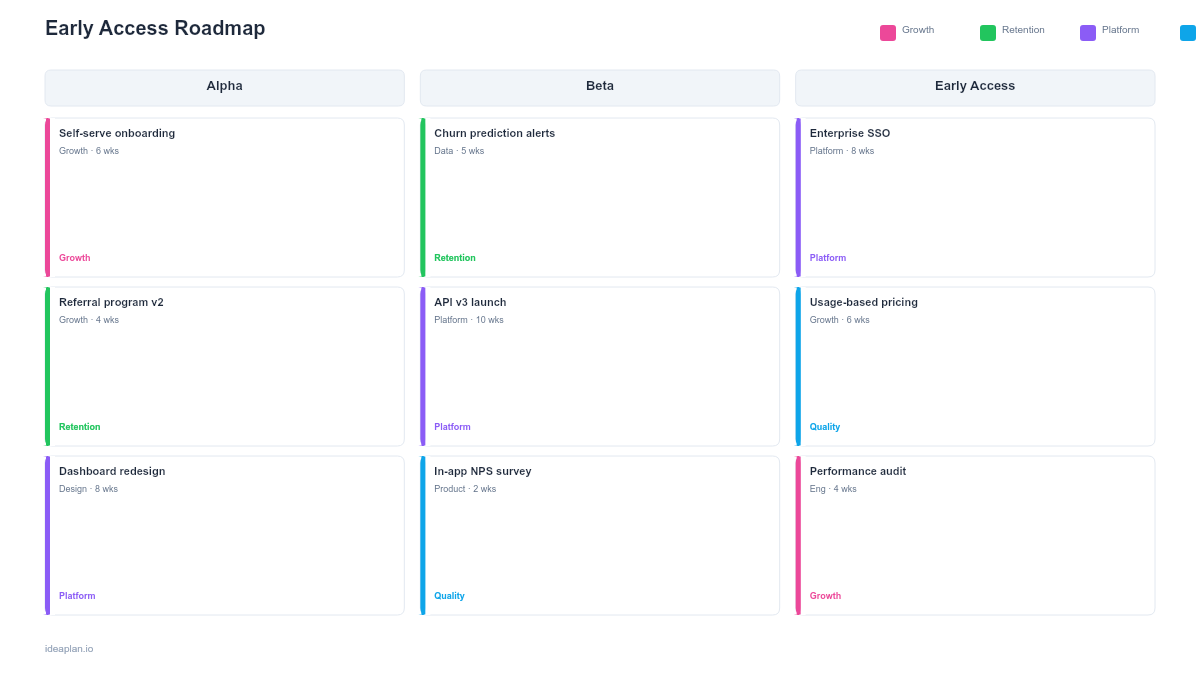
Early access programs differ from betas in one key way: users know they are getting an incomplete product and they are choosing to participate anyway, often in exchange for discounted pricing or influence over the product direction. This template structures the early access program timeline, participant management, feature rollout cadence, and the transition plan for converting early access users to paying customers. It is particularly useful for B2B startups where early access participants become your first case studies.
General Availability Roadmap
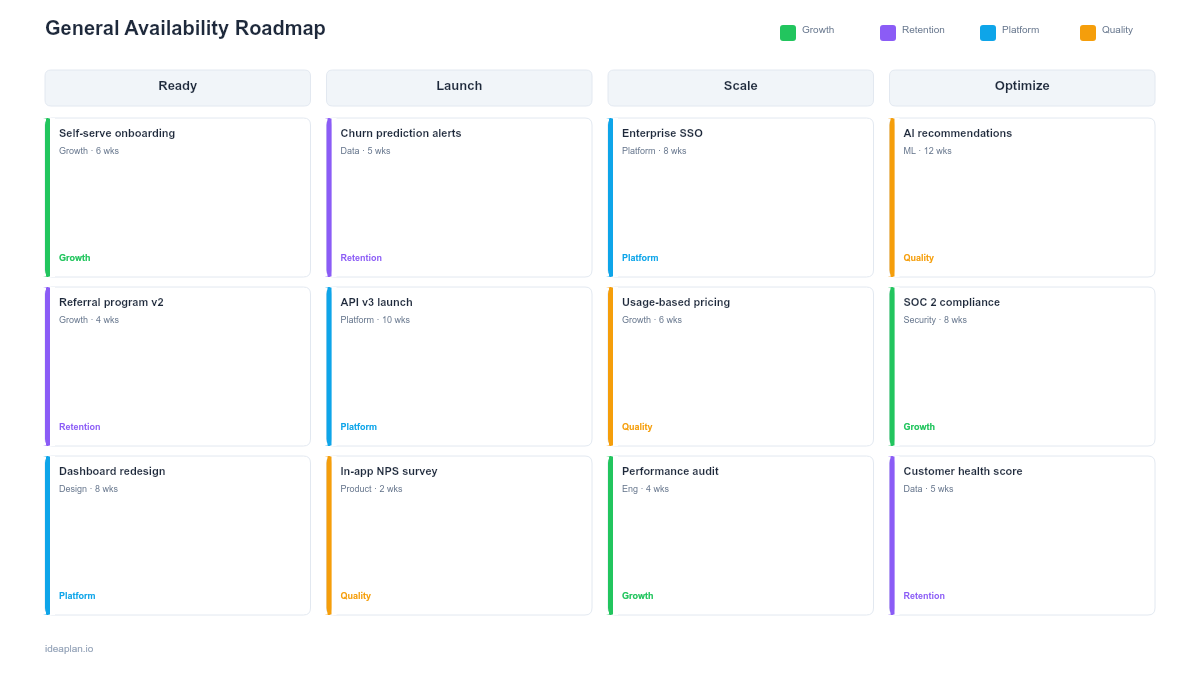
The GA roadmap plans the transition from limited release to open availability. It covers the final hardening work (performance, security, scalability), documentation, support readiness, and the marketing launch sequence. This is the template you need when your product works but is not yet ready for anyone to sign up without hand-holding. The product launch playbook covers the full go-to-market strategy in detail.
Product Launch Roadmap
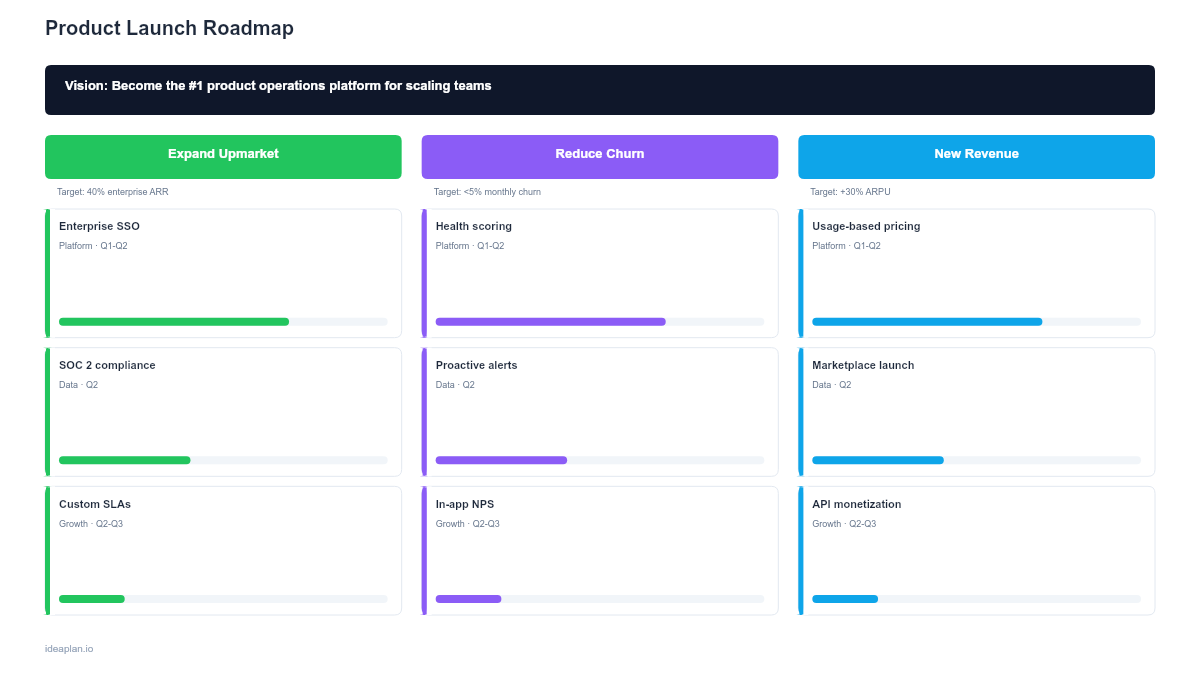
A product launch roadmap coordinates the cross-functional work required to put a product in front of customers. It goes beyond engineering delivery to include marketing campaigns, sales enablement, support training, and success metrics. For startups, this is often the first time you need to coordinate across functions, and the first time a missed handoff between engineering and marketing costs you real momentum.
How Do You Plan for Growth After Launch?
Once you have users, the roadmap shifts from "build it" to "grow it." These templates structure experimentation and growth planning.
Experiment Pipeline Roadmap
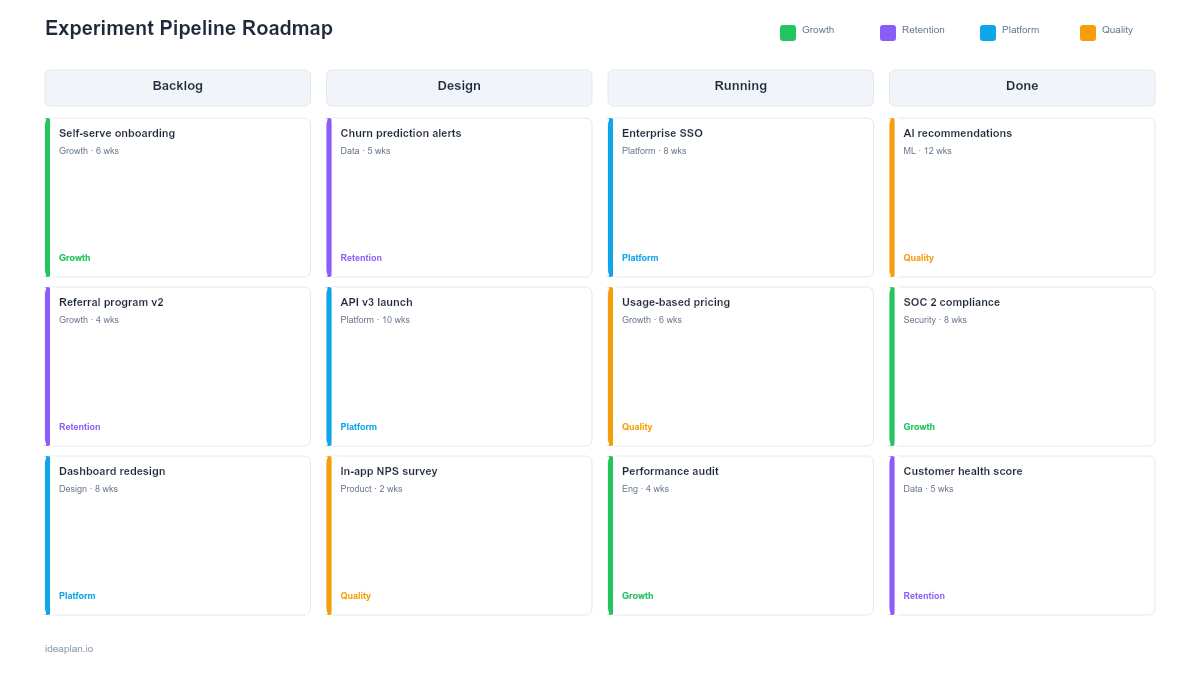
An experiment pipeline roadmap treats your product backlog as a series of hypotheses to test rather than features to build. Each experiment has a hypothesis, success metric, minimum sample size, and duration. The pipeline view shows which experiments are in design, running, or completed, and what you learned from each. This is the right format when you do not yet know what works and need to learn fast. It pairs well with the hypothesis testing roadmap for teams running structured A/B tests.
Growth Experiment Roadmap
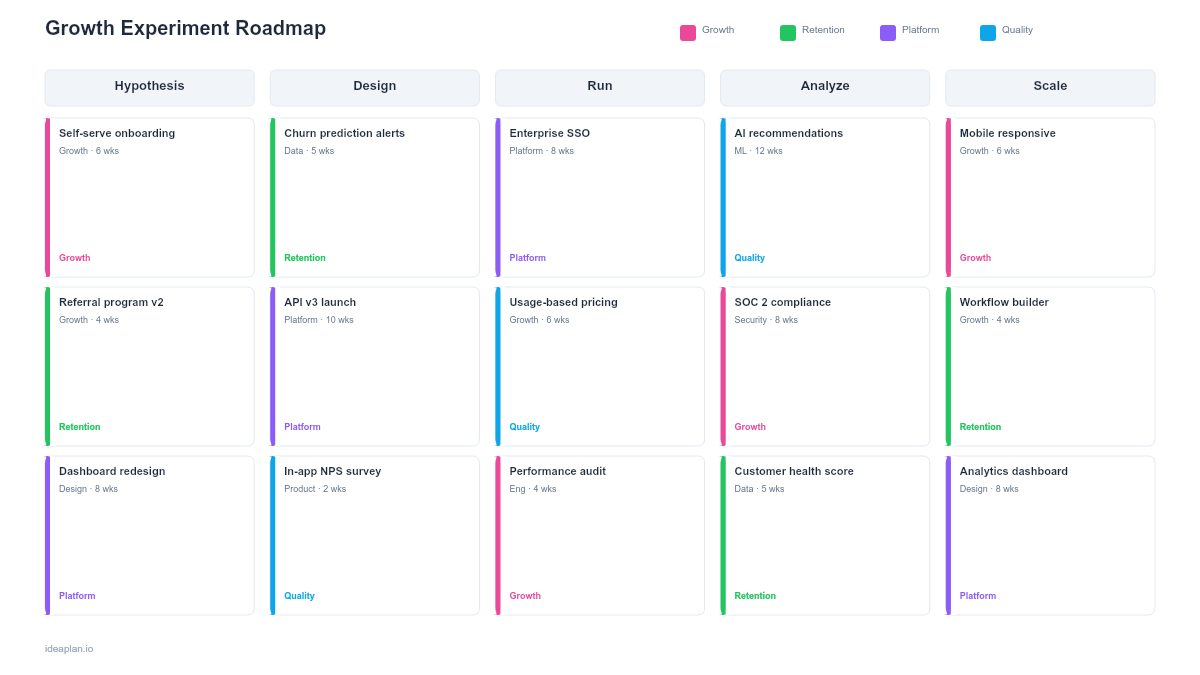
The growth experiment roadmap focuses specifically on acquisition, activation, and retention experiments. It organizes experiments by growth lever (top of funnel, onboarding, engagement, and monetization) with expected impact estimates and actual results tracked side by side. For startups past the MVP stage that need to find repeatable growth, this template turns random growth tactics into a systematic process. Use the LTV/CAC calculator to set targets for your monetization experiments. The now-next-later format works well as a companion planning tool, keeping your growth experiments prioritized without false precision on timelines.
How to Choose the Right Template
If you are pre-product, start with the Proof of Concept Roadmap to validate your idea before investing in a full build. Once validated, switch to the MVP Roadmap for the first build cycle.
When you are ready to ship, choose based on your release strategy: Beta Launch for controlled testing with a select group, Early Access for programs where users opt in knowing the product is incomplete, or jump straight to General Availability if you are confident in product readiness.
After launch, the Experiment Pipeline is for teams that need to learn what works across the entire product, while the Growth Experiment Roadmap is for teams specifically focused on acquisition and retention levers.
Most startups will use three or four of these templates in sequence over their first year. Download all of them now and pull up the one that matches your current stage.
For teams ready to move beyond templates into dedicated tooling, the PM Tool Picker can match you with the right roadmap software.
Explore More
- Top 8 Agile Frameworks for Product Teams (2026) - 8 agile frameworks compared side by side for product teams.
- Top 10 AI Tools for Product Managers (2026) - 10 AI-powered tools that save product managers hours every week.
- Top 10 Competitive Analysis Tools for PMs (2026) - 10 tools and methods for competitive analysis that product managers actually use.
- Top 10 Customer Feedback Tools and Methods (2026) - 10 tools and methods for collecting, organizing, and acting on customer feedback.