Quick Answer (TL;DR)
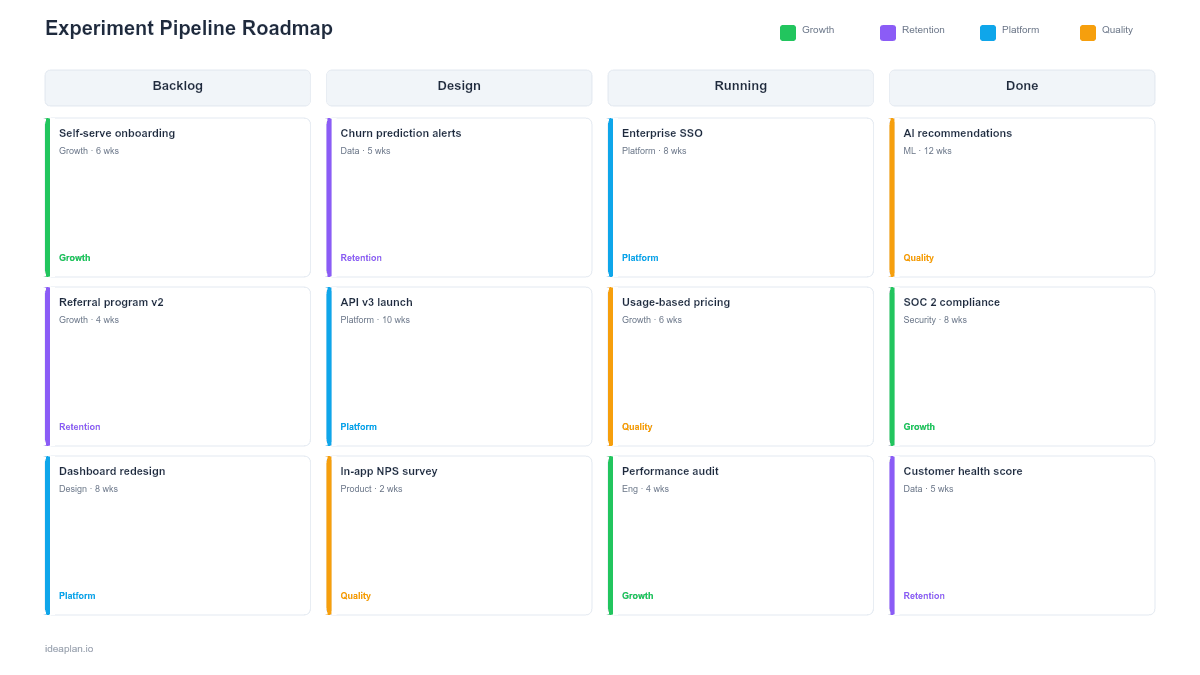
This free PowerPoint template visualizes your experiment pipeline across five stages: Hypothesis Backlog, Design, Running, Analysis, and Rollout Decision. Each experiment card tracks the hypothesis, target metric, confidence level, and outcome. Download the .pptx, populate your pipeline, and give your team a clear operational view of what is being tested, what is being learned, and what is ready to ship or kill.
What This Template Includes
- Cover slide. Team name, experiment throughput (experiments completed per month), cumulative win rate, and active experiment count.
- Instructions slide. How to write structured hypotheses, move experiments through pipeline stages, and document rollout decisions. Remove before presenting.
- Blank template slide. Five pipeline columns with experiment cards containing hypothesis, metric, status, and decision fields.
- Filled example slide. A product team's pipeline with 14 experiments: 5 in Hypothesis Backlog, 2 in Design, 3 Running, 2 in Analysis, and 2 at Rollout Decision (one approved for rollout, one killed with documented learning).
Why Experiment Pipelines Need Their Own Roadmap
Experiment work does not fit neatly on a feature roadmap. Features have defined scope, estimated delivery dates, and binary completion states. Experiments have hypotheses, confidence intervals, and a range of outcomes including "inconclusive. Redesign and rerun." Putting both on the same roadmap misrepresents the nature of experiment work and creates false expectations around delivery certainty.
An experiment pipeline roadmap treats experimentation as a throughput system. The goal is not to deliver a specific experiment by a specific date. The goal is to maintain a steady flow of hypotheses being tested, learnings being documented, and decisions being made based on evidence.
This distinction matters for how teams are evaluated. A feature team is measured on delivery. An experimentation function is measured on velocity (experiments completed per period), learning rate (insights generated), and decision quality (percentage of rollout decisions backed by statistically significant results). The pipeline format makes these operational metrics visible. For a primer on designing experiments with statistical rigor, see the A/B testing guide.
Template Structure
Five Pipeline Stages
The experiment pipeline flows left to right across five stages:
- Hypothesis Backlog. Prioritized list of experiment ideas, each written as a structured hypothesis. Scored by expected impact and confidence. New ideas enter here after validation against existing learnings.
- Design. Experiments being prepared: defining variants, setting sample size requirements, writing the measurement plan, and building the test. Limit to 1-2 experiments in Design at a time.
- Running. Active experiments collecting data. Each card shows start date, expected end date, current sample size, and whether significance thresholds have been reached. Keep concurrent experiments to 3-5 to avoid metric interference.
- Analysis. Completed experiments awaiting result interpretation. Cards show raw results, confidence intervals, and practical significance assessment. This stage should move fast. Experiments sitting in analysis for more than a week are a bottleneck.
- Rollout Decision. The final gate. Each experiment gets one of three outcomes: Roll Out (ship the winning variant), Kill (revert to control), or Iterate (redesign based on learnings and re-enter the pipeline). Every decision is documented with the rationale.
Experiment Cards
Each card includes:
- Experiment name. Short, descriptive (e.g., "Simplified checkout flow" or "Social proof on pricing page").
- Hypothesis. "If we [change], then [metric] will [direction] by [amount], because [rationale]."
- Target metric. The primary product metric being measured.
- Stage status. Visual indicator (green = on track, amber = delayed, red = blocked).
- Outcome. Populated in Analysis and Rollout Decision stages: Win, Loss, Inconclusive.
Throughput Metrics Bar
A footer bar tracks pipeline health over the last 3-6 months:
- Experiments started per month. Are hypotheses flowing into the pipeline consistently?
- Experiments completed per month. Is the team maintaining throughput?
- Win rate. What percentage of completed experiments produced actionable positive results?
- Average time in pipeline. How long from backlog entry to rollout decision?
How to Use This Template
1. Seed the hypothesis backlog
Gather experiment ideas from user research, analytics anomalies, competitor observations, and support ticket patterns. Write each as a structured hypothesis. A good hypothesis is specific and falsifiable: "If we reduce the signup form from 6 fields to 3, trial activation rate will increase by 8%, because form length is the primary drop-off point in our funnel data."
2. Prioritize by impact and confidence
Score each hypothesis on expected impact (how much will the metric move?) and confidence (how strong is the evidence that this will work?). High-impact, high-confidence experiments run first. Low-confidence experiments with high potential impact go into a "worth testing" tier. For structured prioritization, the ICE scoring method works well for experiment backlogs.
3. Move experiments through stages
Pull the top 1-2 hypotheses into Design. Define variants, sample size, duration, and success criteria before building anything. Once designed, launch into Running. Set a firm end date and do not peek at results before reaching statistical significance.
4. Analyze with discipline
When an experiment reaches its end date, move it to Analysis. Document the observed effect, confidence interval, and practical significance. A statistically significant result that moves a metric by 0.02% is not practically significant. Make the distinction explicit.
5. Make and document rollout decisions
For each analyzed experiment, make a clear decision: Roll Out, Kill, or Iterate. Document the reasoning. "Rolled out because the variant improved signup conversion by 12% with 95% confidence" is a complete decision record. "Killed because the 2% improvement did not justify the added code complexity" is equally valid.
When to Use This Template
The experiment pipeline roadmap PowerPoint template works best for:
- Weekly experiment standups where the team reviews pipeline status and moves experiments between stages
- Growth team reviews where leadership wants visibility into experimentation throughput and learning velocity
- Cross-functional alignment where engineering, design, and data science need a shared view of active and upcoming experiments
- Quarterly planning where the team evaluates pipeline health metrics and adjusts capacity allocation for experimentation
If your experimentation program is focused specifically on growth metrics (acquisition, activation, retention), the Growth Experiment Roadmap PowerPoint template adds funnel-stage context. For a deep dive into hypothesis design and validation methods, the Hypothesis Testing Roadmap PowerPoint template provides a more research-oriented format.
Featured in
This template is featured in Roadmap Templates for Startups and MVPs, a curated collection of roadmap templates for this use case.
Key Takeaways
- Experiment pipelines treat testing as a throughput system with stages, velocity, and operational metrics.
- Five stages (Backlog, Design, Running, Analysis, Rollout Decision) give structure to work that traditional roadmaps handle poorly.
- Every experiment ends with a documented decision: Roll Out, Kill, or Iterate. No experiments should sit in limbo.
- Throughput metrics (experiments per month, win rate, time in pipeline) track the health of the experimentation function itself.
- PowerPoint format makes experiment pipeline progress visible to stakeholders who need to understand the testing program without reading statistical reports.
- Compatible with Google Slides, Keynote, and LibreOffice Impress. Upload the
.pptxto Google Drive to edit collaboratively in your browser.