Quick Answer (TL;DR)
This free PowerPoint template translates your product roadmap into investor language. Milestones, growth metrics, and strategic rationale. It pairs each product initiative with the business outcome it drives, so board members see how engineering investment translates to ARR, retention, and market expansion. Download the .pptx, connect your product plan to financial targets, and present a roadmap that investors actually want to see.
What This Template Includes
- Cover slide. Company name, current ARR, planning horizon, and next funding milestone or board date.
- Instructions slide. How to translate product initiatives into investor-relevant language, select the right level of detail, and handle questions about timelines. Remove before presenting.
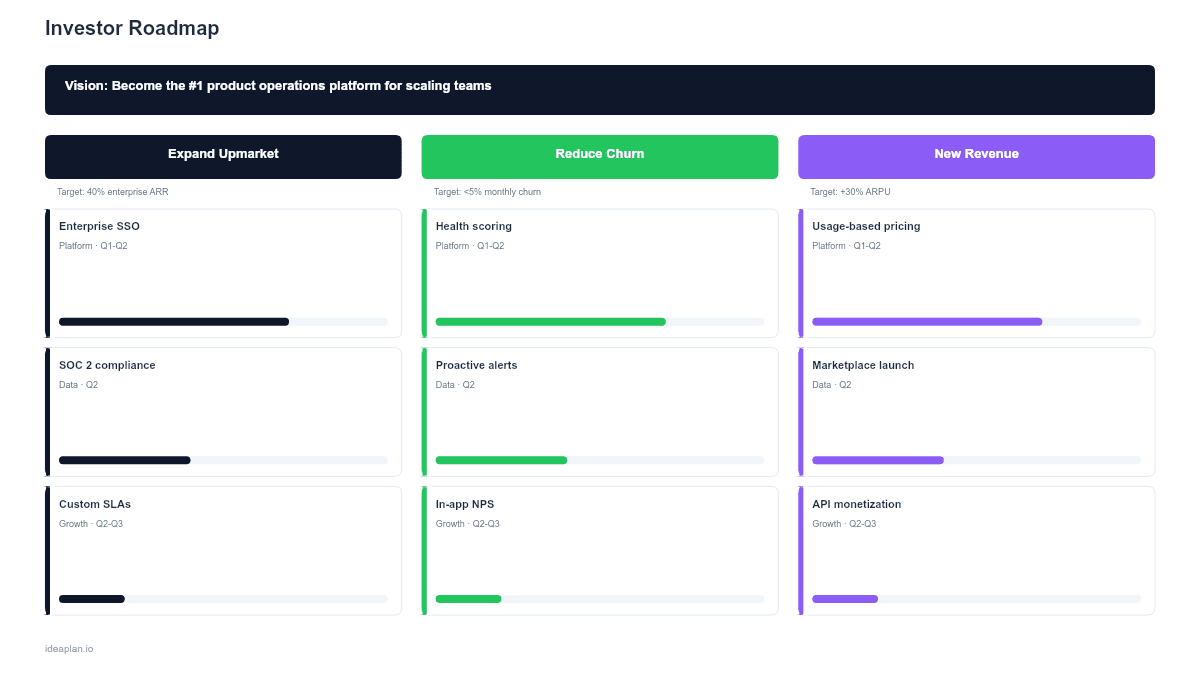
- Blank template slide. Three-horizon layout (Next Quarter, This Year, Long-term Bets) with milestone markers, metric targets, and strategic narrative sections.
- Filled example slide. A Series B SaaS company showing Q1 milestones (enterprise SSO, API v2 launch), annual targets (expand to 3 new verticals, hit $10M ARR), and long-term bets (AI-assisted workflows, platform ecosystem). Each item shows the expected revenue or retention impact.
Why Investors Need a Different Roadmap
The roadmap you share with engineering is not the roadmap you share with investors. Engineers need scope, specs, and sequencing. Investors need three things: what you are building, why it matters for the business, and how confident you are in the timeline.
Investor roadmaps fail in two common ways. The first is too much detail. 40 features on a Gantt chart that makes investors worry you are building a feature factory instead of a business. The second is too little specificity. Vague themes like "improve user experience" that give investors no way to assess execution capability.
The right level sits between these extremes. Investors want to see 3-5 major product milestones per quarter, each connected to a metric they care about: ARR growth, net revenue retention, CAC payback, or market expansion. They want to understand the strategic logic, not the implementation details.
Template Structure
Three Planning Horizons
The roadmap uses three columns representing increasing time horizons and decreasing specificity:
- Next Quarter. High-confidence commitments with specific milestones and dates. These are initiatives already in progress or about to start. Example: "Launch enterprise SSO by March 15" with expected impact on deal close rate.
- This Year. Directional plans with quarterly targets. Less date-specific, more outcome-focused. Example: "Expand into healthcare vertical. First 10 customers by Q3."
- Long-term Bets. 12-24 month strategic investments where timing is uncertain but direction is clear. Example: "Build AI-assisted workflow engine to increase expansion revenue by 30%."
Milestone Markers
Each initiative includes a milestone marker showing:
- Milestone name. Clear, jargon-free label. Replace "Ship RBAC v2" with "Launch enterprise access controls."
- Business impact. The metric it moves and by how much. "Enables enterprise deals >$100K ACV" is more useful to investors than "Supports 500+ user organizations."
- Confidence. High / Medium / Exploratory. Investors appreciate honesty about certainty levels.
- Investment required. Team size or rough cost, so investors can assess capital efficiency.
Metrics Summary Bar
A bottom section shows 4-5 headline metrics with current values, targets, and trend arrows: ARR, NRR, logo count, LTV/CAC ratio, and the Rule of 40 score. This anchors the roadmap in financial reality.
How to Use This Template
1. Start with your financial targets
Work backward from the numbers your board expects. If the target is $10M ARR by year-end, identify which product milestones are required to hit that number. Each milestone should have a clear line to revenue. Either through new customer acquisition, expansion, or reduced churn.
2. Select 3-5 milestones per horizon
Resist the urge to show everything. Investors process information at the strategic level. Pick the milestones that either generate revenue, reduce risk, or expand your addressable market. Everything else is execution detail that belongs in your internal roadmap.
3. Translate product language to business language
Every initiative should answer "so what?" for an investor. "Build real-time collaboration" becomes "Enable multi-user workflows that increase seat expansion by 40%." The product vision guide can help frame product decisions in strategic terms.
4. Add confidence levels honestly
Investors have seen enough roadmaps to know that Q3 plans are less certain than Q1 plans. Mark confidence explicitly. A board that sees "Medium confidence" on a critical Q2 milestone can ask useful questions now rather than hearing bad news in six months.
5. Prepare for the three questions investors always ask
Every investor roadmap presentation gets these questions: "What happens if this milestone slips?", "How does this compare to what [competitor] is doing?", and "What are you not doing?" Prepare answers before presenting. The competitive analysis guide helps structure the competitor question.
When to Use This Template
Investor-facing roadmaps are right for:
- Board meetings where product progress needs to be reported alongside financial metrics
- Fundraising conversations where investors evaluate your execution capability and vision
- Annual planning presentations to existing investors showing how product strategy supports growth targets
- Quarterly business reviews with strategic investors or advisory boards
- Due diligence processes where investors want to see product planning maturity
If you need a roadmap for internal teams or engineering audiences, use the sprint plan template or quarterly roadmap instead. Those formats carry the detail engineers need.
Featured in
This template is featured in Roadmap Templates for Executive and Board Presentations, a curated collection of roadmap templates for this use case.
Key Takeaways
- Investor roadmaps show 3-5 milestones per horizon, each connected to business metrics.
- Three horizons (next quarter, this year, long-term bets) give investors the right level of specificity at each time scale.
- Translate every product initiative into business impact: revenue, retention, or market expansion.
- Confidence levels set honest expectations and invite productive board conversations.
- PowerPoint format is the standard for board meetings and investor presentations. No format conversion needed.
- Compatible with Google Slides, Keynote, and LibreOffice Impress. Upload the
.pptxto Google Drive to edit collaboratively in your browser.