Quick Answer (TL;DR)
This free PowerPoint DevOps roadmap template organizes your engineering team's journey from manual deployments to fully automated CI/CD across four maturity stages: Manual, Standardized, Automated, and Optimized. Each stage maps specific practices (version control workflows, testing automation, infrastructure as code, monitoring) to concrete milestones. Download the .pptx, assess your current stage, and present a clear path from where you are to where you need to be.
What This Template Includes
- Cover slide. Team or platform name, current maturity stage, target maturity stage, and timeline.
- Instructions slide. How to assess your current stage, define milestones, and track DORA metrics. Remove before presenting.
- Blank template slide. Four maturity stages across four practice areas (Build, Test, Deploy, Monitor) with milestone cards and a DORA metrics baseline row.
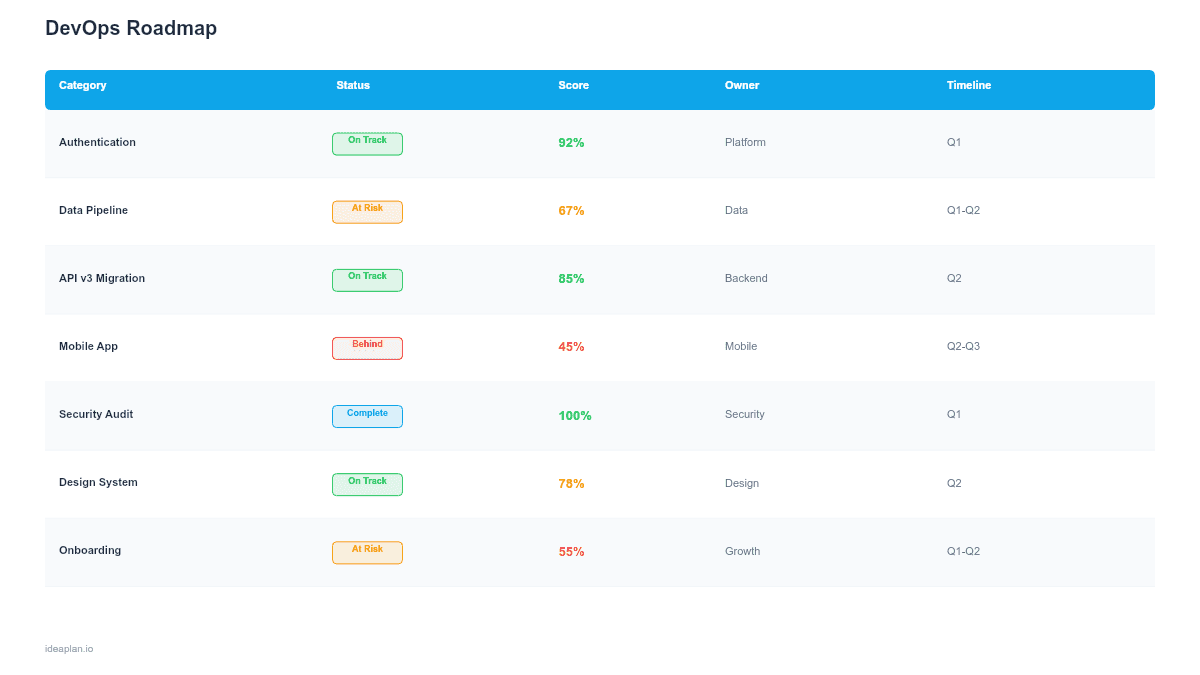
- Filled example slide. A working DevOps roadmap for a 30-person engineering team moving from Standardized to Automated maturity over 6 months, with 12 milestone cards showing owners, target dates, and current DORA metrics.
Why a DevOps Roadmap
Most engineering teams know they need better DevOps practices. Fewer teams have a structured plan for getting there. Without a roadmap, DevOps improvements happen opportunistically. Someone automates a deployment script here, adds a monitoring dashboard there. But the overall capability does not advance systematically.
A DevOps roadmap solves three problems. First, it makes the current state visible. By placing your team on a maturity model, you give leadership and engineering a shared understanding of where things stand. Second, it sequences improvements in the right order. Automated deployments are pointless without automated testing. Monitoring is less useful without standardized logging. The template encodes these dependencies. Third, it ties engineering investment to measurable outcomes using DORA metrics: deployment frequency, lead time for changes, change failure rate, and mean time to recovery.
For teams that track engineering velocity alongside DevOps maturity, see the sprint velocity metric guide.
Template Structure
Four Maturity Stages
The roadmap progresses left to right through:
- Manual. Deployments are manual or scripted ad hoc. Testing is inconsistent. Monitoring is reactive (alerts after incidents). Most teams start here or one step ahead.
- Standardized. Consistent branching strategy, basic CI pipeline running unit tests, deployment checklists documented. The floor is established.
- Automated. Full CI/CD pipeline with automated testing gates, infrastructure as code, and automated rollbacks. Human approval is limited to production deployments.
- Optimized. Canary deployments, feature flags, automated performance testing, SLO-based alerting, and continuous deployment to production with no manual gates.
Four Practice Areas
Each maturity stage is broken into rows:
- Build. Source control workflows, CI pipeline configuration, artifact management, dependency scanning.
- Test. Unit tests, integration tests, end-to-end tests, security scanning, performance benchmarks.
- Deploy. Deployment automation, environment management, rollback procedures, feature flags.
- Monitor. Logging, metrics, alerting, incident response, SLO tracking.
Milestone Cards
Each card shows:
- Milestone name. Specific deliverable (e.g., "Automate staging deployments via GitHub Actions").
- Owner. Individual engineer or tech lead responsible.
- Target date. Quarter or specific date.
- Status. Green (complete), amber (in progress), grey (not started).
DORA Metrics Row
A bottom row tracks the four DORA metrics at each stage, with current values and target values. This connects engineering effort to measurable improvement.
How to Use This Template
1. Assess your current maturity
Walk through each practice area (Build, Test, Deploy, Monitor) and honestly evaluate which maturity stage describes your team today. Most teams are not at the same stage across all practices. You might have Automated builds but Manual monitoring. Mark the current stage for each row.
2. Set target maturity per practice area
Define where each practice area needs to be in 6-12 months. Advancing one full stage across all four areas in 6 months is ambitious but achievable for a focused team. Do not try to jump from Manual to Optimized in one pass.
3. Define milestones for each gap
For every practice area that needs to advance, create 2-4 milestone cards that bridge the gap. Order them by dependency: you cannot automate deployments without first standardizing your build pipeline. Reference the deployment frequency metric to calibrate targets.
4. Assign owners and dates
Each milestone gets one owner and a target date. Avoid assigning milestones to teams. A team does not ship, individuals do. The owner is accountable for coordinating with whoever else needs to contribute.
5. Track DORA metrics monthly
Measure deployment frequency, lead time, change failure rate, and mean time to recovery each month. Plot the trend on the DORA metrics row. If metrics are not improving despite completing milestones, the milestones are solving the wrong problems.
When to Use This Template
A DevOps roadmap PowerPoint template fits when:
- Engineering leadership wants a structured plan for improving deployment and operational capabilities
- The team is past ad-hoc improvements and needs a sequenced path through a maturity model
- Stakeholders outside engineering (product, leadership) need to understand the investment and expected returns
- DORA metrics are tracked or about to be and need concrete improvement targets
- Multiple practice areas need coordinated advancement, not just CI or just monitoring
If your focus is narrower. Specifically planning a single platform migration. The Technology Roadmap PowerPoint template is more appropriate. For sprint-level engineering planning that complements a DevOps roadmap, see the Sprint Plan Roadmap PowerPoint template.
Featured in
This template is featured in Technical and Engineering Roadmap Templates, a curated collection of roadmap templates for this use case.
Key Takeaways
- DevOps roadmaps sequence engineering capability improvements across four practice areas: Build, Test, Deploy, and Monitor.
- Four maturity stages (Manual, Standardized, Automated, Optimized) give teams a shared vocabulary for current state and targets.
- DORA metrics tie each milestone to measurable outcomes, not just checkbox completion.
- Assign individual owners to milestones. Teams do not ship, people do.
- PowerPoint format makes DevOps investment visible and presentable to non-engineering stakeholders.
- Compatible with Google Slides, Keynote, and LibreOffice Impress. Upload the
.pptxto Google Drive to edit collaboratively in your browser.