Quick Answer (TL;DR)
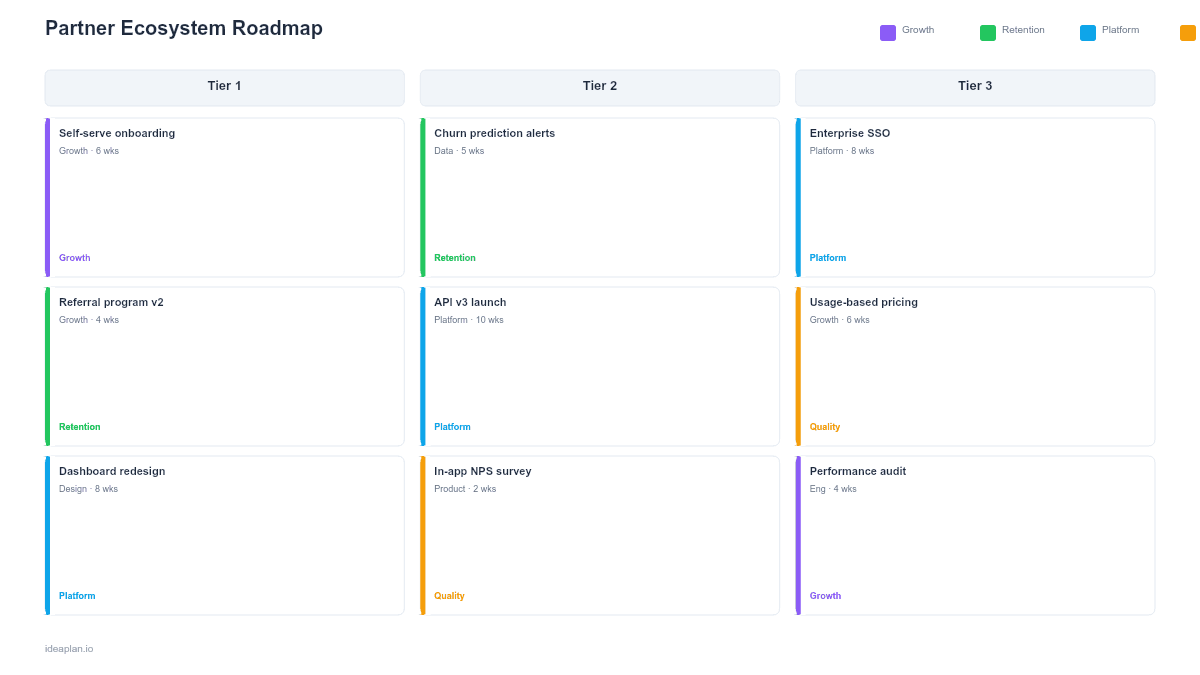
This free PowerPoint template plans partner ecosystem development across three tiers: Strategic Partners, Technology Partners, and Channel Partners. Each tier shows integration milestones, co-marketing activities, and revenue targets by quarter. Download the .pptx, populate it with your partnership pipeline, and use it to align product, BD, and marketing teams around ecosystem growth.
What This Template Includes
- Cover slide. Product name, planning period, and ecosystem strategy summary.
- Instructions slide. How to tier partners, define integration depth, and set ecosystem KPIs. Remove before presenting.
- Blank template slide. Three partner tiers across a quarterly timeline with integration milestones, co-marketing activities, and revenue attribution cards.
- Filled example slide. A B2B SaaS ecosystem roadmap with 12 partner initiatives across three tiers, showing progression from API integrations to joint solutions.
Why Plan Your Ecosystem with a Roadmap
Partner ecosystems grow either deliberately or chaotically. Without a roadmap, the pattern is familiar: BD signs partnerships based on opportunity, engineering builds integrations based on request volume, and marketing runs co-branded campaigns based on whoever asks. The result is a patchwork of partnerships at varying depths with no coherent strategy.
A partner ecosystem roadmap forces three decisions that most teams avoid: which partners get deep investment, which get self-serve tooling, and which get deprioritized. These decisions require input from product (integration feasibility), BD (revenue potential), and marketing (co-marketing value). The roadmap becomes the shared artifact where these perspectives converge.
The platform strategy concept connects directly here. Every ecosystem roadmap is implicitly a platform roadmap. You are deciding which extension points to build, which APIs to expose, and which partner experiences to invest in.
Template Structure
Partner Tiers
Three horizontal rows organize partners by strategic importance:
- Strategic Partners. 2-3 partners that represent major revenue or distribution opportunities. Deep product integrations, joint solutions, co-selling motions, and executive sponsorship. Examples: a CRM platform for a sales tool, a cloud provider for an infrastructure product.
- Technology Partners. 8-15 partners with complementary products. Standard API integrations, marketplace listings, and mutual referrals. The volume tier where most integrations live.
- Channel Partners. Resellers, consultants, and agencies who sell or implement your product. These partners need enablement resources rather than product integrations.
Integration Depth Indicators
Each partner initiative includes a depth marker:
- Native. Built into the core product, native UX. Highest engineering investment.
- API. Programmatic integration via public APIs. Moderate investment with partner doing some work.
- Marketplace. Listed in your marketplace or app directory. Low investment, partner-built.
- Referral. No technical integration. Commercial relationship with lead sharing.
Revenue Attribution
Each partner card shows expected revenue contribution: direct (partner-sourced deals), influenced (partner-touched deals), and ecosystem (retention lift from integration usage). These categories help leadership understand that partner value extends beyond direct referral fees.
How to Use This Template
1. Inventory existing partnerships
List every current partner. For each, note: integration type, revenue attributed last quarter, customer overlap, and strategic alignment. Most teams are surprised to find 30-40% of their "partnerships" are dormant. Signed but inactive.
2. Tier your partners
Place each partner into Strategic, Technology, or Channel based on two criteria: revenue potential (current + projected) and strategic alignment (does this partnership reinforce your product strategy?). Limit Strategic tier to 2-3 partners. If everything is strategic, nothing is.
3. Define quarterly milestones
For each active partner, identify the next milestone: Is it signing? Building the integration? Launching co-marketing? Going live in the marketplace? Place milestones in quarters. Strategic partners should have at least one milestone per quarter. Technology partners might have one milestone per half.
4. Coordinate across functions
Partner work touches product (integration engineering), BD (commercial terms), marketing (co-marketing), and customer success (joint support). Each milestone needs a cross-functional owner. The RACI matrix can clarify who decides, who executes, and who needs to be informed.
5. Set ecosystem metrics
Track three numbers at the portfolio level: total partners active (those with customer usage in the last 90 days), ecosystem-sourced revenue (deals where a partner was involved), and integration adoption (percentage of your customers using at least one partner integration). These metrics tell you if the ecosystem is actually creating value or just accumulating logos.
6. Present to leadership quarterly
Partner roadmaps deserve a quarterly review with executive stakeholders. Show tier movement (which partners graduated from Technology to Strategic), milestone completion rate, and revenue attribution trends. This visibility justifies continued investment in ecosystem development.
When to Use This Template
A partner ecosystem roadmap is the right choice when:
- Your product's value increases with integrations and you need to plan which connections to build and when
- BD has a pipeline of potential partners and product needs to prioritize integration work against that pipeline
- Existing partnerships are underperforming and leadership wants a structured plan to deepen or sunset them
- You are launching a marketplace or app directory and need a phased rollout plan for partner listings
- Revenue targets include partner-sourced deals and the team needs to map partnership milestones to revenue timelines
For broader product platform planning, the platform roadmap PowerPoint template covers APIs, extensibility, and developer experience beyond partnerships. If the focus is on revenue growth across all channels (not just partners), the revenue growth roadmap PowerPoint template provides a wider lens.
Featured in
This template is featured in Growth and Revenue Roadmap Templates, a curated collection of roadmap templates for this use case.
Key Takeaways
- Partner ecosystem roadmaps tier partnerships by strategic importance, preventing the common trap of treating all partners equally.
- Three tiers (Strategic, Technology, Channel) create different investment levels and milestone cadences.
- Revenue attribution across direct, influenced, and ecosystem categories captures the full value of partnerships.
- Quarterly executive reviews keep ecosystem development visible and funded.
- PowerPoint format makes the ecosystem roadmap easy to share with partner teams, BD, and executive leadership.
- Compatible with Google Slides, Keynote, and LibreOffice Impress. Upload the
.pptxto Google Drive to edit collaboratively in your browser.