Quick Answer (TL;DR)
This free PowerPoint platform roadmap template maps API capabilities, developer ecosystem investments, and platform infrastructure work onto a quarterly timeline with adoption milestones. It is built for platform strategy teams that need to communicate a dual roadmap: what the platform enables and what platform teams are building to support it. Download the .pptx, fill in your platform layers and ecosystem initiatives, and use it to align product teams, engineering, and developer relations on a shared plan.
What This Template Includes
- Cover slide. Platform name, planning horizon, and platform product manager.
- Instructions slide. How to structure platform layers, map capabilities, and set adoption milestones. Remove before presenting.
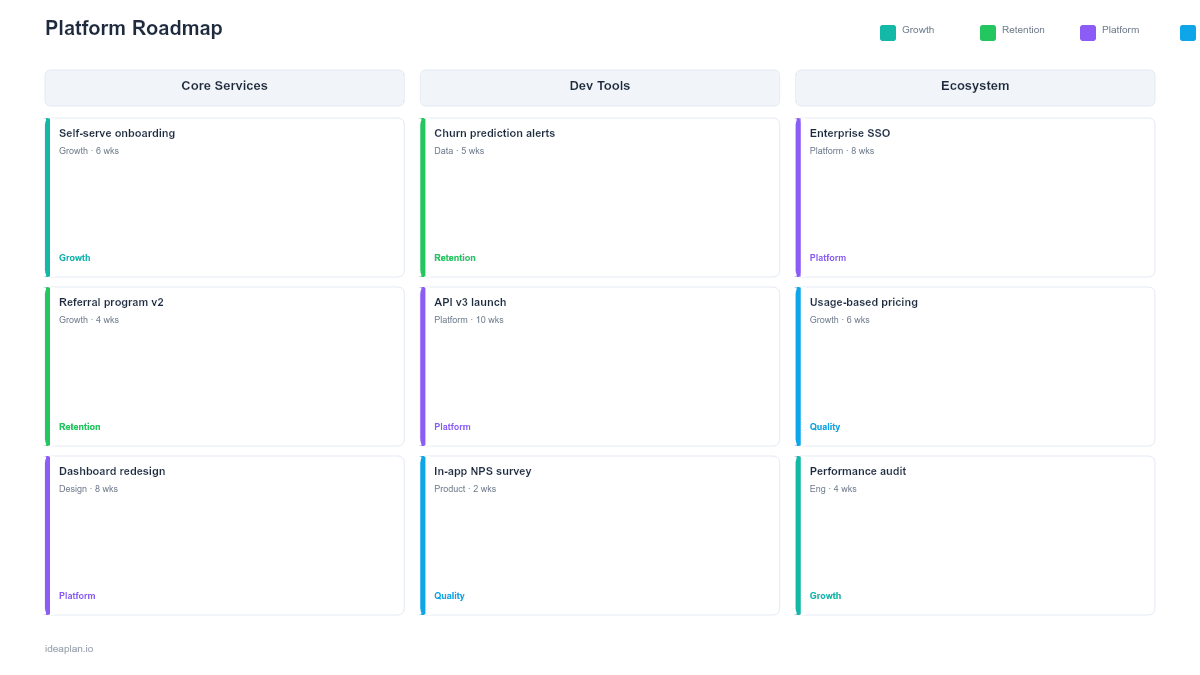
- Blank platform roadmap slide. A four-quarter timeline with three horizontal sections: Platform Infrastructure (bottom), API & Services (middle), and Developer Ecosystem (top). Each section holds initiative bars with adoption metric targets. Vertical milestone lines mark platform releases.
- Filled example slide. A realistic platform roadmap for a mid-stage SaaS platform showing infrastructure scaling, three new API endpoints, SDK improvements, and a developer portal launch, with adoption targets at each milestone.
Why PowerPoint for Platform Roadmaps
Platform roadmaps face a unique communication challenge: they serve both internal product teams (who consume platform capabilities) and external developers (who build on the platform). A single artifact needs to show infrastructure investments that most stakeholders do not care about alongside developer-facing capabilities that everyone has opinions about.
PowerPoint's layered format solves this by separating the platform into visible sections. In a leadership review, you can focus on the Ecosystem layer for business context. In an engineering review, you can focus on the Infrastructure layer for technical alignment. The same slide serves both audiences at different depths.
Template Structure
Platform Infrastructure Layer
The bottom section covers foundational technical work: database scaling, compute capacity, security hardening, monitoring and observability, and deployment pipeline improvements. This work is rarely visible to customers or developers but is essential for platform reliability and performance. Each initiative shows the engineering team, effort estimate, and the performance target it supports (e.g., "p99 API latency < 200ms").
API & Services Layer
The middle section maps new API endpoints, service capabilities, and integration features that product teams and external developers consume. Each capability card includes: API name, target consumers (internal teams, partners, public developers), versioning plan, and expected consumption volume. This layer is where most cross-team dependencies live, since product teams schedule feature work around API availability dates.
Developer Ecosystem Layer
The top section covers developer-facing investments: documentation, SDKs, sample apps, developer portal, developer events, and partner integrations. These initiatives directly affect developer experience and adoption metrics. Each initiative links to an adoption milestone: number of active API consumers, SDK downloads, or third-party integrations live.
Adoption Milestones
Vertical milestone lines span all three layers and mark key platform releases. Each milestone includes quantitative adoption targets: "100 active API consumers by Q2," "3 partner integrations live by Q3," "API call volume > 1M/day by Q4." These targets connect platform engineering work to measurable business outcomes.
How to Use This Template
1. Define platform layers for your context
The three-layer structure (Infrastructure, API & Services, Ecosystem) works for most platforms, but adapt the labels to fit your organization. An internal platform team might replace "Developer Ecosystem" with "Internal Consumer Teams." A data platform might use "Data Infrastructure," "Data Services," and "Self-Service Analytics." The layers should reflect how your platform creates value.
2. Map current and planned capabilities
For each layer, list the capabilities that exist today and the capabilities planned for the next four quarters. Place them on the timeline based on engineering estimates and dependency sequencing. Infrastructure work that enables new API capabilities must ship first. Use the timeline to verify sequencing.
3. Set adoption milestones with targets
Define 1-2 adoption milestones per quarter. Each milestone should have a quantitative target tied to platform usage: active consumers, API call volume, integration count, or developer satisfaction score. These metrics track whether the platform is actually being used, not just whether it was built. The product metrics guide covers how to select leading indicators for platform adoption.
4. Review with platform consumers
Present the roadmap to internal product teams and key external partners. Ask: "Does this timeline support your product plans?" and "Are there capabilities you need that are not on this roadmap?" Platform roadmaps that are built in isolation from consumer needs waste engineering resources on capabilities nobody uses. The stakeholder management guide covers techniques for gathering and prioritizing consumer input.
When to Use This Template
Platform roadmaps are essential when:
- Internal product teams depend on shared platform capabilities and need visibility into what is coming and when
- External developers or partners build on your platform and need a public or semi-public roadmap for planning
- Platform engineering investment needs justification through adoption metrics and business impact
- Multiple API versions are active and deprecation timelines need clear communication
- The organization is shifting to a platform strategy and needs to articulate the investment thesis
If your platform is a single internal service consumed by one product team, a technology roadmap is simpler and sufficient. The full platform roadmap template adds value when multiple consumers (internal or external) depend on platform capabilities and need coordinated communication about timelines and capabilities.
Featured in
This template is featured in Technical and Engineering Roadmap Templates, a curated collection of roadmap templates for this use case.
Key Takeaways
- Platform roadmaps use three layers (Infrastructure, API & Services, Ecosystem) to communicate to both technical and business audiences.
- Adoption milestones with quantitative targets connect platform engineering work to measurable business outcomes.
- Review the roadmap with platform consumers (internal teams and external developers) to validate that planned capabilities match actual needs.
- Allocate 20-30% of engineering capacity to platform work and justify it with adoption data.
- Separate infrastructure investments (which most stakeholders do not need to see) from developer-facing capabilities (which everyone has opinions about).
- Compatible with Google Slides, Keynote, and LibreOffice Impress. Upload the
.pptxto Google Drive to edit collaboratively in your browser.