Quick Answer (TL;DR)
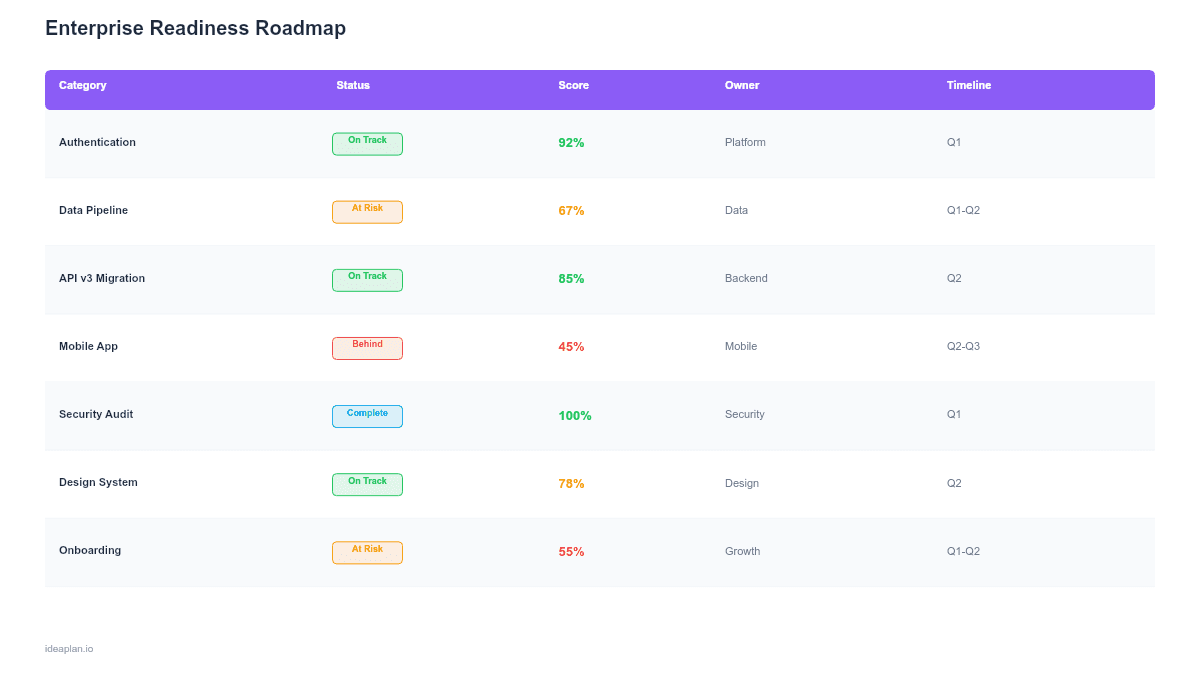
This free PowerPoint template organizes enterprise readiness features into four capability tracks. Identity & Access, Security & Compliance, Administration, and Data & Integration. Plotted across maturity phases from "startup-ready" to "enterprise-grade." Each slide maps specific features (SSO, RBAC, audit logs, SCIM provisioning) to delivery phases with buyer readiness checkpoints. Download the .pptx, assess which capabilities your product already has, and build a plan to close the gaps blocking enterprise deals.
What This Template Includes
- Cover slide. Product name, target enterprise tier, and a readiness score summary showing completion percentage across capability tracks.
- Instructions slide. How to assess current maturity, fill capability gaps, and present the roadmap to enterprise prospects. Remove before external sharing.
- Blank template slide. Four capability rows across three maturity phases (Foundation, Growth, Enterprise-Grade) with placeholder feature cards and buyer gate markers.
- Filled example slide. A complete enterprise readiness plan showing 20 features across tracks, with dependency links and timeline estimates for reaching each maturity phase.
Why Enterprise Readiness Needs a Dedicated Roadmap
Moving upmarket is not a single feature. It is a coordinated investment across security, administration, compliance, and integration capabilities. Most products fail to land enterprise deals not because of one missing feature but because of ten small gaps that collectively signal immaturity to procurement teams.
A dedicated enterprise readiness roadmap addresses this by:
- Making the gap visible. Listing every capability an enterprise buyer expects (SSO, SOC 2, SLAs, data residency) forces an honest assessment of where you stand today.
- Sequencing work by deal impact. Not all enterprise features matter equally. SSO and RBAC are table-stakes that block deals immediately. Advanced audit logging might only matter for regulated industries. The roadmap helps you prioritize features by which ones unblock the most revenue.
- Coordinating across teams. Enterprise readiness touches product, engineering, security, legal, and sales. Without a shared artifact, each team works on their piece without seeing the full picture.
For teams evaluating whether to pursue enterprise customers at all, the product strategy guide provides a framework for making that strategic decision before committing to this roadmap.
Template Structure
Capability Tracks
Four horizontal tracks cover the full enterprise readiness surface:
- Identity & Access. SSO (SAML/OIDC), RBAC with custom roles, SCIM user provisioning, multi-factor authentication, session management.
- Security & Compliance. SOC 2 Type II, encryption at rest and in transit, vulnerability scanning, penetration testing, data processing agreements.
- Administration. Admin console, organization management, usage analytics for admins, sandbox environments, custom branding (white-label).
- Data & Integration. API rate limits and SLAs, webhook delivery guarantees, data export/import, SSO-protected API keys, SIEM integration.
Maturity Phases
Three columns represent progressive maturity levels:
- Foundation. Minimum features to close your first 10 enterprise deals. Focus: SSO, basic RBAC, SOC 2 readiness, admin console.
- Growth. Features that accelerate enterprise adoption and reduce sales cycle friction. Focus: SCIM, advanced roles, audit logging, sandbox environments.
- Enterprise-Grade. Capabilities expected by Fortune 500 buyers and regulated industries. Focus: data residency, custom SLAs, SIEM integration, advanced compliance certifications.
Buyer Gate Markers
Star-shaped markers on the timeline indicate points where a specific set of capabilities opens a new buyer segment. For example, completing SSO + RBAC + SOC 2 might open "mid-market SaaS" while adding SCIM + audit logs + data residency opens "regulated enterprise."
How to Use This Template
1. Audit your current enterprise capabilities
Walk through each capability track and mark features as Complete, Partial, or Missing. Be honest. Partial implementations that fail during a security review count as missing for roadmap purposes.
2. Talk to sales about deal blockers
Pull the last 10 lost enterprise deals and categorize why they were lost. If 7 out of 10 cite "no SSO," that feature goes in the Foundation phase. The win-loss analysis glossary entry provides a structured approach to this research.
3. Sequence by deal-blocking impact
Place features that block the most deals in the earliest phase. Resist the temptation to build what is technically interesting. Enterprise readiness is about removing buyer objections in the order they appear during sales cycles.
4. Add timeline estimates per phase
Each phase should have an estimated completion quarter. Foundation might take one quarter if SSO and RBAC are partially built. Enterprise-Grade might take 4-6 quarters for a product starting from scratch.
5. Share with sales and customer success
Enterprise readiness roadmaps serve double duty: they guide engineering and they give sales a concrete artifact to share with prospects who ask "when will you support X?" Update quarterly and distribute after each phase completion.
When to Use This Template
This template is the right choice when:
- Enterprise deals are stalling because procurement teams flag missing security or compliance capabilities during vendor evaluation.
- You are moving upmarket from SMB/mid-market to enterprise and need to identify and close capability gaps systematically.
- A large prospect has sent a security questionnaire and you realize several answers are "not yet". The roadmap helps you commit to dates.
- Multiple teams (product, engineering, security, legal) need coordination on enterprise-readiness work that crosses organizational boundaries.
- Board or leadership is asking for a clear plan to reach enterprise-grade maturity with defined milestones. See the product vision guide for connecting enterprise readiness to your broader product direction.
For teams focused specifically on security capabilities, the Security Roadmap PowerPoint template goes deeper on that single track. For broader SaaS product planning, the SaaS Product Roadmap PowerPoint template covers feature, growth, and platform work alongside enterprise readiness.
Key Takeaways
- Enterprise readiness is a coordinated investment across identity, security, administration, and integration. Not a single feature.
- Sequence features by deal-blocking impact: build what unblocks the most revenue first.
- Three maturity phases (Foundation, Growth, Enterprise-Grade) let you close progressively larger deals as you build.
- Buyer gate markers connect feature delivery to revenue milestones, making the business case tangible.
- Share the roadmap with sales to give prospects concrete timelines during vendor evaluations.
- Compatible with Google Slides, Keynote, and LibreOffice Impress. Upload the
.pptxto Google Drive to edit collaboratively in your browser.