Quick Answer (TL;DR)
This free PowerPoint template helps you plan third-party integrations systematically. From selecting which platforms to connect first, through API development, to marketplace launch. Each integration gets a demand score, technical complexity rating, and revenue impact estimate so you build the right connectors in the right order. Download the .pptx and turn ad-hoc integration requests into a strategic ecosystem plan.
What This Template Includes
- Cover slide. Product name, current integration count, and the target number of integrations for this planning cycle.
- Instructions slide. How to score integration demand, assess technical complexity, and sequence build-vs-partner decisions. Remove before presenting.
- Integration priority matrix slide. A 2x2 grid plotting demand (vertical) against complexity (horizontal) for candidate integrations, with each quadrant mapped to an action: Build Now, Build Next, Partner, and Defer.
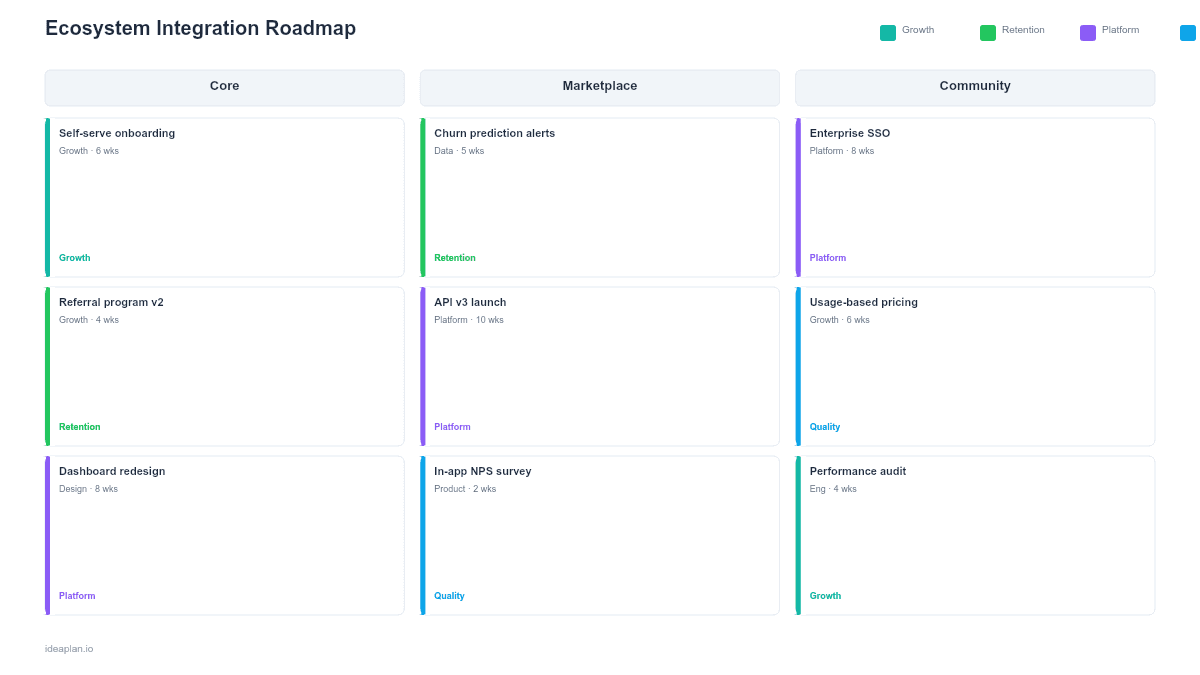
- Phased roadmap slide. Three phases (Core Connectors, Extended Ecosystem, Marketplace) with integration cards showing demand score, effort, partner status, and target quarter.
- Filled example slide. A B2B SaaS integration roadmap with Phase 1 (Slack, Salesforce, Jira), Phase 2 (HubSpot, Zendesk, Google Sheets), Phase 3 (public API + marketplace for community-built integrations).
Why Integrations Need a Roadmap
Integration requests pile up fast. Sales wants Salesforce. Support wants Zendesk. Enterprise prospects want SSO and SCIM. Without a roadmap, the team chases whatever deal is largest this quarter and ends up with a fragile patchwork of one-off connectors.
A structured integration roadmap solves three problems. First, it prioritizes by demand breadth rather than deal size. An integration that 40% of your customers need is more valuable than one that closes a single enterprise contract. Second, it separates build decisions from partner decisions. Some integrations are better served by a Zapier connector or embedded iPaaS than custom development. Third, it sequences API maturity alongside integration delivery. You cannot build reliable third-party integrations on a brittle API.
Integration strategy connects directly to platform strategy. The roadmap should answer whether you are building a closed product with selective integrations or an open platform with a self-serve marketplace.
Template Structure
Integration Priority Matrix
The matrix slide plots every candidate integration on two axes:
- Demand score (vertical). Percentage of customers or prospects who have requested this integration, weighted by segment value. Pull this from CRM tags, support tickets, and win/loss data.
- Technical complexity (horizontal). Estimated engineering effort considering API quality, auth model, data mapping, and sync requirements. Score as Low / Medium / High.
The four quadrants map to actions:
- High demand, low complexity. Build now. These are quick wins with clear ROI.
- High demand, high complexity. Build next. Invest engineering time but plan for longer cycles.
- Low demand, low complexity. Partner. Use middleware (Zapier, Make) or partner-built connectors.
- Low demand, high complexity. Defer. Revisit when demand increases.
Phased Roadmap
The roadmap slide shows three delivery phases:
- Phase 1: Core Connectors. The 3-5 integrations that cover 60-70% of customer demand. Build these natively with deep data sync and real-time events.
- Phase 2: Extended Ecosystem. The next tier of integrations. Some built natively, some via middleware. This phase also includes API documentation and developer sandbox.
- Phase 3: Marketplace. Open a public API for third-party developers. Launch an integration marketplace with listing, review, and install tracking.
Each integration card includes demand score, complexity, build-vs-partner decision, owner, and target quarter.
Dependency Row
A bottom row tracks shared infrastructure: API versioning, webhook framework, OAuth provider, rate limiting, and integration testing pipeline. These are prerequisites that gate specific integrations.
How to Use This Template
1. Audit integration demand
Collect every integration request from the past 12 months across sales, support, and product feedback channels. Count unique customer mentions per integration, not raw ticket volume. Weight enterprise accounts higher if integration availability affects deal size.
2. Score technical complexity
For each candidate integration, assess the partner's API maturity (REST vs. legacy SOAP, webhook support, rate limits, sandbox availability). Factor in data model alignment. Does their object model map cleanly to yours, or does the integration require custom transformation logic?
3. Plot the priority matrix
Place each integration on the 2x2 grid. The quadrant assignments drive your build/partner/defer decisions. Challenge assumptions. If the team rates everything as "high complexity," they may be over-engineering scope. Check whether a lightweight unidirectional sync covers 80% of the use case.
4. Sequence the phases
Load Phase 1 with high-demand, low-to-medium complexity integrations. Include API infrastructure work (auth framework, webhook system) as Phase 1 prerequisites. Phase 2 adds medium-demand integrations and public API documentation. Phase 3 opens the partner ecosystem to external developers.
5. Define success metrics per integration
Track adoption rate (percentage of eligible customers who enable the integration), sync reliability (error rate, latency), and retention impact (do integrated customers churn less?). These metrics justify continued investment and help prioritize maintenance.
When to Use This Template
- Annual platform planning when deciding which integrations to invest in over the next 4 quarters
- Sales enablement alignment where closing enterprise deals depends on specific connector availability
- API strategy kickoffs when building the foundation for a partner or developer ecosystem
- Competitive positioning where integration breadth is a differentiator in your category
- Post-acquisition integration when merging product lines requires connecting to each other's ecosystems
If you need to plan internal API architecture rather than third-party connections, see the API roadmap template.
Featured in
This template is featured in Multi-Product and Portfolio Roadmap Templates, a curated collection of roadmap templates for this use case.
Key Takeaways
- A priority matrix (demand vs. complexity) prevents the team from chasing low-value integrations.
- Phase 1 covers the top 3-5 integrations that address the majority of customer demand.
- Build-vs-partner decisions should be explicit: native for high-demand connectors, middleware for the long tail.
- Track adoption rate and retention impact per integration to justify continued investment.
- PowerPoint format lets you present the integration strategy in sales kickoffs, platform reviews, and partner meetings.
- Compatible with Google Slides, Keynote, and LibreOffice Impress. Upload the
.pptxto Google Drive to edit collaboratively in your browser.