Quick Answer (TL;DR)
This free PowerPoint template maps content initiatives. Pillar content builds, distribution channel launches, content refresh cycles, and editorial experiments. Onto a quarterly timeline. Each initiative is organized by content function (creation, distribution, optimization, measurement) so teams can see the full lifecycle from production to performance. Download the .pptx, fill in your content plan, and use it to align content, product marketing, SEO, and demand generation teams on priorities and deadlines.
What This Template Includes
- Cover slide. Title slide with content program name, planning period, and content lead.
- Instructions slide. How to categorize content by function, assign priority tiers, and track performance targets. Remove before presenting externally.
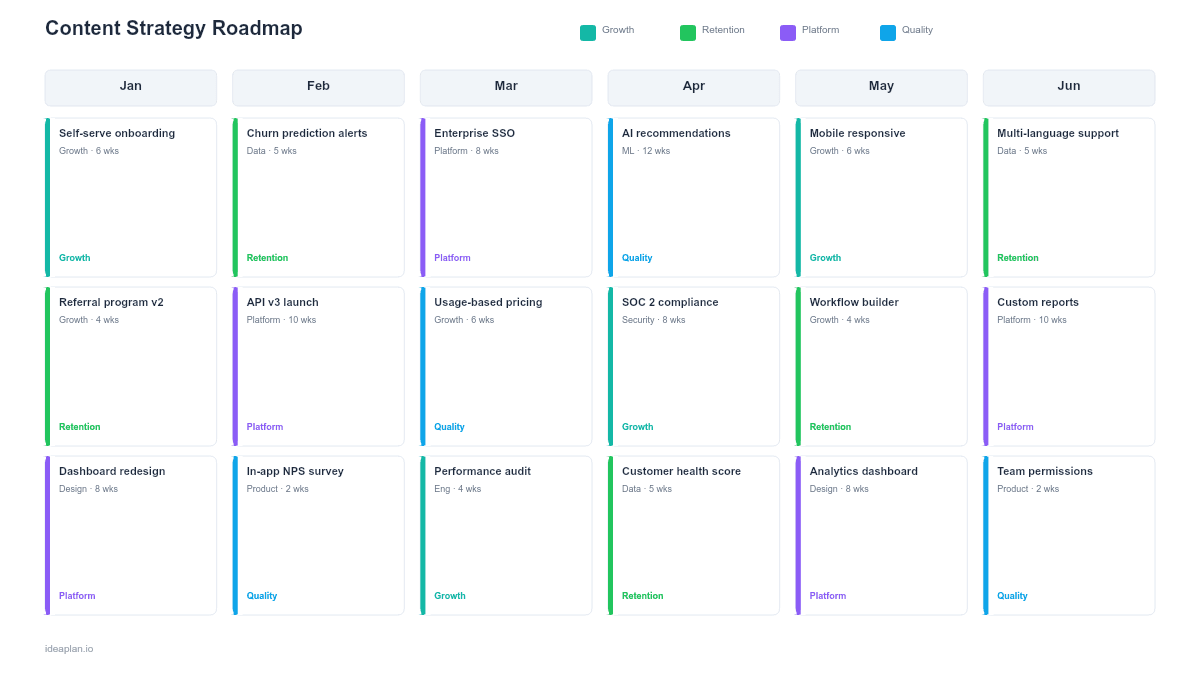
- Blank content strategy timeline slide. A four-quarter grid with rows for each content function (creation and production, distribution and promotion, optimization and refresh, measurement and iteration). Each card shows content type, target audience segment, effort estimate, and key performance metric.
- Filled example slide. A realistic content roadmap for a B2B SaaS company showing a pillar page strategy build, email nurture sequence launch, SEO content refresh for 40 existing articles, blog-to-gated-asset conversion experiment, and quarterly content performance review cadence.
Why PowerPoint for Content Strategy Roadmaps
Content teams often operate from spreadsheet-based editorial calendars that show what gets published when but not why. A PowerPoint roadmap elevates the conversation from "we are publishing 12 blog posts this quarter" to "we are investing in three content pillars that support product positioning, then distributing through two new channels to reach a segment we are underperforming in."
The slide format also connects content work to business outcomes. When a CMO asks why the content team needs a dedicated quarter for SEO refreshes instead of new content, the roadmap shows the organic traffic trajectory and the revenue pipeline that depends on it. Spreadsheets bury this context; a timeline makes it the focal point.
Template Structure
Content Function Rows
Four rows organize content work by lifecycle stage: creation and production (pillar pages, blog series, video scripts, case studies, templates), distribution and promotion (email campaigns, social media, syndication, paid amplification, partnership content swaps), optimization and refresh (SEO updates, content consolidation, format migration, underperforming content pruning), and measurement and iteration (analytics setup, attribution modeling, content experiments, quarterly performance reviews).
Content Type and Audience Tags
Each card carries a content type badge (pillar, blog, video, email, template, case study) and a target audience tag (prospect, trial user, customer, champion). This dual-tagging prevents the common failure mode of producing content that does not map to any audience segment in the customer journey.
Performance Metric Targets
Each initiative card includes one key metric target: organic traffic increase, email click-through rate, lead-to-customer rate improvement, or content engagement score. Attaching a metric to every initiative forces the team to define what success looks like before production begins rather than rationalizing performance after publication.
How to Use This Template
1. Define content pillars and audience segments
Before filling in the timeline, clarify two things: the 3-5 topic pillars your content program will own, and the audience segments each pillar targets. Topic pillars should align with product positioning and the problems your product solves. Audience segments should map to stages in your buyer journey. Awareness, consideration, decision, expansion.
2. Audit existing content against pillars
Review your published content and classify it by pillar and audience segment. Identify gaps (pillars with no content), imbalances (one pillar with 50 articles, another with 3), and performance issues (high-traffic content with low conversion, or high-quality content with no traffic). This audit determines whether Q1 should focus on new creation or optimization.
3. Sequence by impact and dependency
Place foundational work first. Pillar page creation, analytics and attribution setup, and distribution channel configuration. These enable everything that follows. Then layer in ongoing production (blog cadence, email sequences) and optimization work (SEO refreshes, content pruning). Schedule measurement milestones at quarter boundaries to create review checkpoints. The OKR framework can help set quarterly content goals that tie to business objectives.
4. Review with stakeholders across marketing and product
Content marketing leads validate production capacity and editorial calendar feasibility. Demand generation validates that content supports pipeline targets. Product marketing validates messaging alignment with product launches. SEO validates keyword targeting. A content roadmap without these inputs risks producing material that is well-written but disconnected from the business.
When to Use This Template
A content strategy roadmap adds the most value when:
- Content production spans multiple teams (content marketing, product marketing, SEO, demand gen) that need coordinated priorities
- A new content strategy requires a phased buildout of pillars, channels, and measurement infrastructure
- Content refresh and optimization represent a significant portion of the work alongside new creation
- Leadership requests visibility into content investment and its connection to pipeline and conversion rate metrics
- Content and product launches need synchronized timelines so supporting content ships alongside features
If your content program is one person publishing a weekly blog post, a simple editorial calendar in Notion or Google Sheets works fine. This template is for teams that treat content as a strategic program with multiple work streams, audience segments, and measurable goals.
Featured in
This template is featured in Product Strategy Roadmap Templates, a curated collection of roadmap templates for this use case.
Key Takeaways
- Content strategy roadmaps organize work by lifecycle stage (creation, distribution, optimization, measurement) rather than by publication date.
- Attach a performance metric target to every initiative so the team defines success before production begins.
- Sequence foundational work (pillars, analytics, distribution setup) before ongoing production and optimization cadences.
- Balance new creation with optimization work. Refreshed content often outperforms net-new content for established programs.
- Coordinate with product marketing, demand gen, and SEO so content strategy aligns with product launches and pipeline targets.
- Compatible with Google Slides, Keynote, and LibreOffice Impress. Upload the
.pptxto Google Drive to edit collaboratively in your browser.