Quick Answer (TL;DR)
This free PowerPoint template maps the full compliance audit lifecycle. Gap analysis, control implementation, evidence collection, and audit execution. Across multiple certification frameworks on a shared timeline. Each framework (SOC 2, GDPR, HIPAA, ISO 27001) gets its own row with control milestones and audit dates. Download the .pptx, input your target certifications and deadlines, and use it to coordinate compliance work across engineering, security, legal, and operations teams.
What This Template Includes
- Cover slide. Title slide with organization name, compliance officer, and audit period.
- Instructions slide. How to map controls to frameworks, track implementation status, and prepare for auditor site visits. Remove before external distribution.
- Blank audit timeline slide. A multi-track timeline with rows for each compliance framework, columns for quarterly phases, and milestone markers for audit readiness dates, auditor engagement windows, and certification issuance targets.
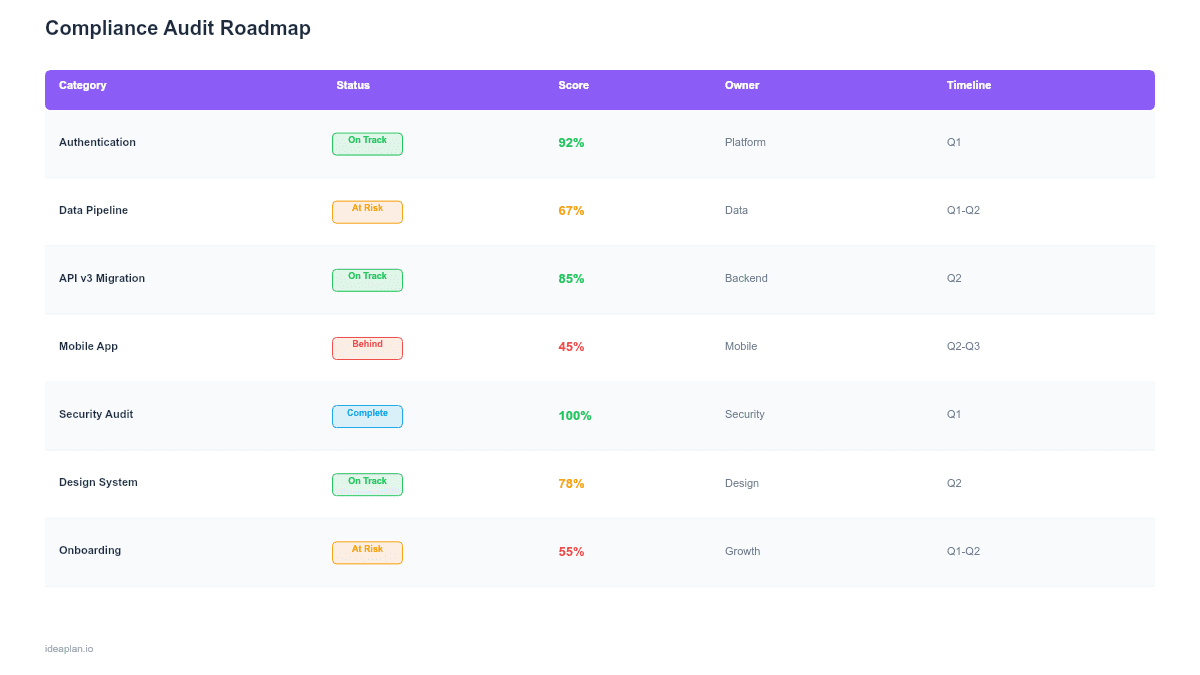
- Filled example slide. A realistic compliance roadmap for a Series B SaaS company pursuing SOC 2 Type II and GDPR compliance simultaneously, showing overlapping control implementation, evidence collection periods, and staggered audit windows.
Why Compliance Audits Need a Roadmap
Compliance certifications fail most often not because of technical gaps, but because of poor timing. Teams implement controls too late to build the evidence trail auditors require. SOC 2 Type II, for example, demands that controls operate effectively for a minimum observation period. Typically 6-12 months. If you finish implementing access controls two months before the audit window closes, you do not have enough evidence, and the audit fails.
A compliance roadmap makes these timing dependencies visible. It shows when each control must be operational, how long the evidence collection period runs, and when auditors arrive. This backward-planning approach prevents the most common failure: discovering in month 10 that a control needed to be running since month 1.
The roadmap also clarifies overlap between frameworks. Roughly 60-70% of SOC 2 and ISO 27001 controls address the same underlying risks. Mapping controls to multiple frameworks on a single timeline shows where one implementation satisfies two certification requirements, which reduces total engineering effort and prevents duplicate work across compliance workstreams.
Template Structure
Framework Rows
Each certification gets its own row on the timeline: SOC 2 Type II, GDPR, HIPAA, and ISO 27001 are the most common for SaaS companies. Within each row, control implementation milestones are color-coded by status: not started, in progress, implemented, and evidence collecting. This gives a quick visual read of where each framework stands.
Control Categories
Controls are grouped into categories that span frameworks: access management, data protection, incident response, change management, vendor management, and business continuity. Each category maps to specific requirements across frameworks. The product management in regulated industries guide covers how these controls interact with product development workflows.
Audit Windows
Shaded blocks on the timeline show when auditors are engaged. For SOC 2 Type II, this includes the observation period (when controls must be operating) and the audit fieldwork (when auditors review evidence and test controls). For ISO 27001, it includes the Stage 1 documentation review and Stage 2 certification audit. Making these windows explicit prevents scheduling conflicts and ensures the team is prepared when auditors arrive.
How to Use This Template
1. Run a gap analysis
Start with a formal gap analysis against your target frameworks. For each control requirement, document whether it is fully implemented, partially implemented, or missing. If you do not have a recent assessment, hire a compliance consultant or use your auditor's readiness assessment service. Building a roadmap without knowing the gaps is planning blind.
2. Map controls to frameworks
Create a control-to-framework mapping that shows which implementations satisfy multiple certifications. Encryption at rest, for example, satisfies requirements in SOC 2 (CC6.1), GDPR (Article 32), and HIPAA (164.312(a)(2)(iv)). Prioritize controls that cover the most frameworks per implementation, following a similar logic to prioritization in product planning.
3. Sequence by evidence collection requirements
Work backward from your target audit date. If SOC 2 Type II requires a 9-month observation period and the audit starts in November, controls must be operational by February at the latest. Place each control implementation milestone on the timeline with enough lead time for the required evidence period.
4. Assign owners and track status
Each control category needs a clear owner: access management might be engineering, vendor management might be operations, and data protection might be split between security and legal. The roadmap slide should show ownership alongside implementation status so it is immediately clear who is responsible for each gap.
5. Review monthly with cross-functional stakeholders
Compliance touches every department. Run a monthly review with engineering, security, legal, HR, and operations to update control status, flag blockers, and adjust timelines. The roadmap slide serves as the single artifact for these reviews. Update it live during the meeting so everyone leaves with the same view of progress.
When to Use This Template
A compliance audit roadmap is essential when:
- Pursuing first-time certifications where the team has not been through the audit process before and needs clear milestones
- Multiple certifications are in progress simultaneously and overlapping controls need coordinated implementation
- Enterprise sales require compliance and delayed certifications directly block revenue. customer acquisition cost increases when deals stall on security questionnaires
- Auditor engagement dates are fixed and the team needs to work backward from immovable deadlines
- Cross-functional coordination is breaking down because engineering, legal, and operations are working on compliance independently
If you are maintaining an existing certification with minor control updates, a regulatory compliance roadmap focused on ongoing maintenance may be more appropriate. This template is for the initial push to certification or for organizations adding new frameworks to their compliance portfolio.
Key Takeaways
- Work backward from audit dates to determine when controls must be operational, accounting for evidence observation periods.
- Map controls to multiple frameworks to identify implementations that satisfy SOC 2, GDPR, HIPAA, and ISO 27001 simultaneously.
- Automated evidence collection is not optional. Auditors require proof that controls operated effectively, not just that they were implemented.
- Stagger audit windows for simultaneous certifications to avoid overwhelming the team with parallel auditor engagements.
- Run monthly cross-functional reviews to surface blockers early, when there is still time to adjust the timeline.
- Compatible with Google Slides, Keynote, and LibreOffice Impress. Upload the
.pptxto Google Drive to edit collaboratively in your browser.