Quick Answer (TL;DR)
This free PowerPoint template structures your annual product plan around strategic themes, quarterly milestones, and resource allocation. It bridges the gap between high-level product vision and quarter-by-quarter execution by showing leadership where the team will invest time, money, and headcount across the year. Download the .pptx, fill in your themes and bets, and walk into annual planning with a roadmap that connects every quarter to the strategy.
What This Template Includes
- Cover slide. Product name, fiscal year, and the 2-3 strategic themes that frame the annual plan.
- Instructions slide. How to define themes, allocate budget across quarters, and balance bets between growth and foundation. Remove before presenting.
- Strategic themes slide. Three theme cards, each with a one-line goal, the metric it targets, the percentage of total capacity allocated, and the executive sponsor.
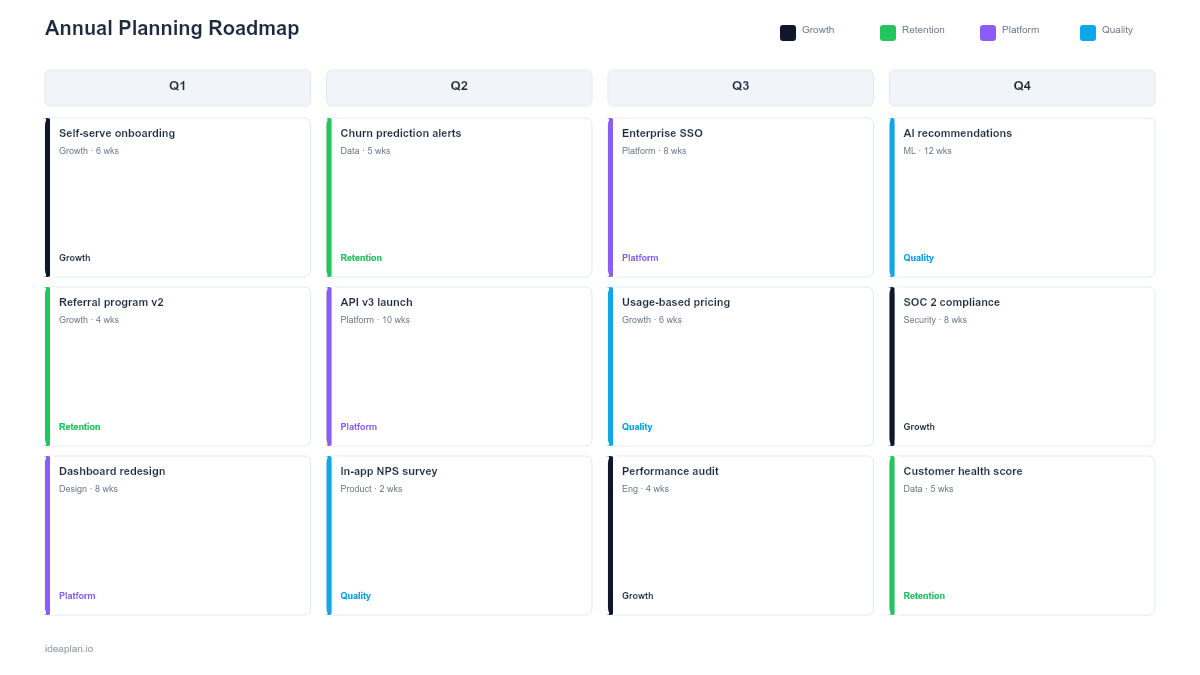
- Quarterly roadmap slide. Four columns (Q1-Q4) showing the top 3-5 initiatives per quarter, color-coded by theme, with effort and confidence indicators.
- Budget allocation slide. A stacked bar chart showing how engineering, design, and product capacity distributes across themes by quarter.
- Filled example slide. A SaaS annual plan with themes "Expand Enterprise" (40% allocation), "Reduce Churn" (35%), and "Platform Foundation" (25%), broken into quarterly initiatives.
Why Annual Planning Needs Structure
Annual planning without a template degrades into two failure modes. The first is a 50-slide strategy deck that nobody reads after January. The second is no written plan at all. Just quarterly scrambling disguised as agility.
The right format sits between those extremes. It commits to strategic themes for the year (what the team will focus on) without committing to specific features twelve months out (how they will execute). Themes are stable. Tactics flex quarter to quarter as the team learns.
Budget allocation is the other piece most annual roadmaps miss. A theme like "Expand Enterprise" means nothing unless it comes with a capacity commitment. This template forces the conversation: if enterprise expansion gets 40% of engineering time, what does not get built? Making trade-offs visible is the whole point of product strategy.
Template Structure
Strategic Themes
The themes slide presents 2-4 strategic themes for the year. More than four dilutes focus. Each theme card contains:
- Theme name. A short label: "Expand Enterprise," "Reduce Churn," "Platform Foundation."
- Goal statement. One sentence describing the desired outcome. Example: "Win 15 new enterprise logos by adding SSO, audit logs, and dedicated support tiers."
- Target metric. The number that defines success. Ties to the north star metric or a key supporting indicator.
- Capacity allocation. Percentage of total product and engineering capacity dedicated to this theme. Forces the "what do we stop doing?" conversation.
- Executive sponsor. The leader accountable for the theme's outcome across the organization.
Quarterly Breakdown
Each quarter column shows 3-5 initiatives that advance the year's themes. Initiative cards include:
- Initiative name. Scoped enough to estimate but abstract enough to allow tactical flexibility.
- Theme color. Visual link to the strategic theme it supports.
- Effort estimate. T-shirt size (S/M/L/XL) based on cross-functional input.
- Confidence level. High / Medium / Low. Q1 and Q2 should be mostly high confidence. Q3 and Q4 are naturally lower. That is expected, not a planning failure.
Budget Allocation Chart
A stacked bar chart shows quarterly capacity distribution across themes. This reveals two common problems: themes that lose funding mid-year because urgent work displaces them, and themes where funding is front-loaded with no sustained investment. Both patterns undermine strategic intent.
How to Use This Template
1. Define 2-4 strategic themes from the product vision
Start with the product vision and last year's outcomes. Where did the product fall short? Where did the market shift? Each theme should address a gap between current state and the vision. Align themes with company-level OKRs if your organization uses them.
2. Allocate capacity before filling in initiatives
Decide what percentage of total capacity each theme gets before discussing specific projects. This prevents the loudest stakeholder from consuming 80% of engineering time. A simple rule: no theme gets less than 15% (otherwise it is not a real priority) and no theme gets more than 50% (otherwise you are a single-initiative team).
3. Fill Q1 with high-confidence initiatives
Q1 should be detailed and mostly committed. These are the initiatives the team starts executing in January. Use frameworks like RICE or weighted scoring to rank candidate initiatives within each theme.
4. Sketch Q2-Q4 at decreasing fidelity
Q2 gets medium-detail initiative cards. Q3 and Q4 get directional bets that will be refined when their quarter approaches. Label Q3-Q4 items as "planned" rather than "committed." This sets honest expectations with leadership about planning certainty.
5. Review and re-plan quarterly
At each quarter boundary, review actual outcomes against planned, adjust capacity allocations if a theme is over- or under-delivering, and detail the next quarter's initiatives. The annual plan is a living document, not a fixed contract.
When to Use This Template
- Fiscal year kickoffs where leadership needs the product plan for board and investor reviews
- Cross-functional planning where product, engineering, marketing, and sales align on yearly priorities
- Headcount and budget requests where the roadmap justifies resource investment per theme
- Portfolio-level coordination where multiple product teams need to show how their plans connect
- Strategic pivots where mid-year re-planning requires a fresh annual roadmap for the remaining quarters
If your planning cadence is quarterly rather than annual, use the quarterly product roadmap template. For multi-product portfolio views, see the portfolio roadmap template.
Featured in
This template is featured in Quarterly and Timeline Roadmap Templates, a curated collection of roadmap templates for this use case.
Key Takeaways
- Annual planning works best when it commits to strategic themes and capacity allocation, not specific features for every quarter.
- Two to four themes with explicit capacity percentages force trade-off conversations that vague priority lists avoid.
- Front-load Q1 with high-confidence, detailed initiatives. Keep Q3-Q4 directional.
- Review and re-plan at each quarter boundary. The annual roadmap is a living document.
- PowerPoint format lets you present the annual plan in board meetings, all-hands, and cross-functional planning sessions without format conversion.
- Compatible with Google Slides, Keynote, and LibreOffice Impress. Upload the
.pptxto Google Drive to edit collaboratively in your browser.