Quick Answer (TL;DR)
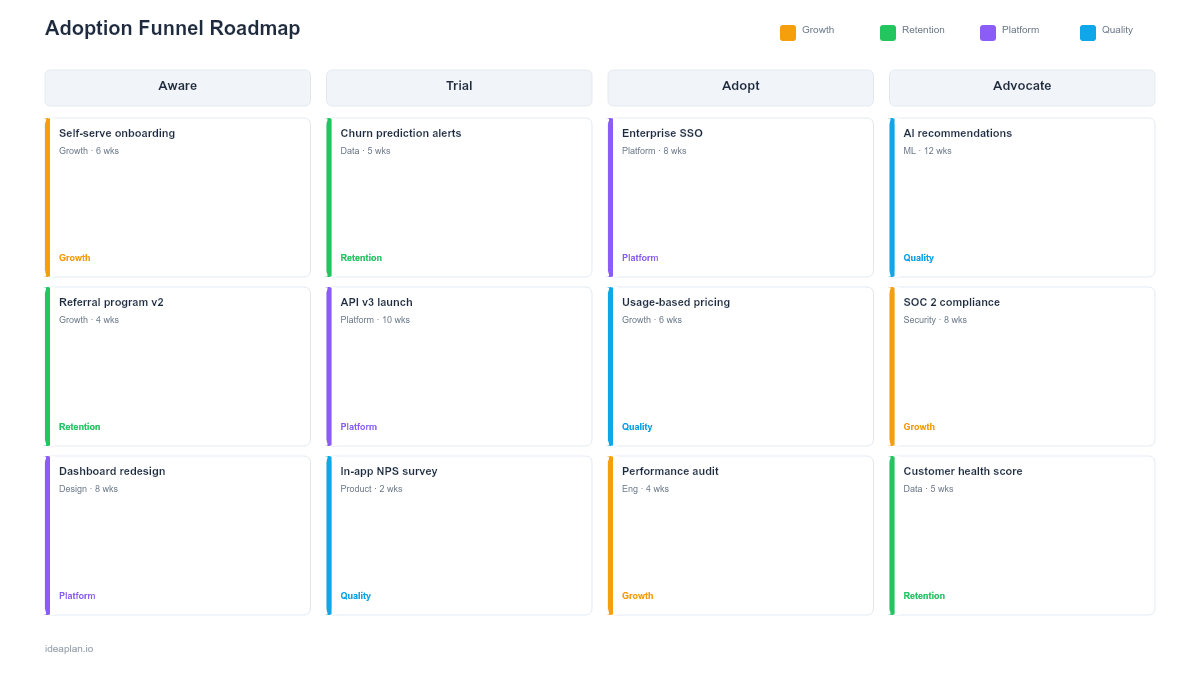
This free PowerPoint template maps your product initiatives to five adoption funnel stages: Awareness, Trial, Activation, Habit Formation, and Expansion. Each stage shows its conversion rate, drop-off percentage, and planned initiatives to improve flow. Download the .pptx, fill in your funnel metrics, and use it to focus product and growth work on the stages where the biggest drop-offs are costing you the most users.
What This Template Includes
- Cover slide. Product name, overall funnel conversion (awareness to expansion), planning period, and top-line adoption target.
- Instructions slide. How to define stage boundaries, calculate conversion rates, and map initiatives to the right stage. Remove before presenting.
- Blank template slide. Five funnel stages arranged left to right with conversion metrics between stages and initiative cards within each stage.
- Filled example slide. A B2B SaaS adoption funnel showing 10,000 awareness-stage visitors narrowing to 450 expanded accounts, with 8 improvement initiatives targeting the three stages with the highest drop-off rates.
Why Adoption Funnels Drive Better Roadmap Decisions
Every product has an adoption funnel, whether the team has mapped it or not. Users discover the product, try it, reach first value, build a habit around it, and eventually expand their usage (or leave). The conversion rate between each stage determines how efficiently the product turns attention into revenue.
The problem with most roadmaps is that they distribute features evenly across the product without regard to where users are actually dropping out. A team might spend a quarter improving the core workflow (Habit Formation stage) while 70% of trial users never complete onboarding (Activation stage). The adoption funnel roadmap prevents this by making drop-off rates the foundation of prioritization.
The math is straightforward. If 1,000 users enter the trial stage and only 200 activate, your activation rate is 20%. Improving it to 30% adds 100 activated users. Without spending a dollar on acquisition. This is typically the highest-ROI work a product team can do, and the funnel format makes it impossible to ignore. For a deeper exploration of this approach, the product-led growth model builds an entire strategy around funnel optimization.
Template Structure
Five Funnel Stages
Each stage represents a step in the user's journey from stranger to power user:
- Awareness. The user learns your product exists. Driven by marketing, content, referrals, and organic search. Key metric: unique visitors or qualified impressions.
- Trial. The user creates an account or starts a free trial. Key metric: signup rate. The conversion from Awareness to Trial depends on messaging clarity and perceived value.
- Activation. The user experiences first value. This is the "aha moment". The point where the user understands why the product matters. Key metric: activation rate. The time to value (TTV) determines how quickly users reach this stage.
- Habit Formation. The user returns repeatedly without prompting. The product has become part of their workflow. Key metric: DAU/MAU ratio or week-over-week retention.
- Expansion. The user upgrades, invites teammates, or increases usage. Key metric: expansion rate or invites sent per user.
Conversion Metrics Between Stages
Between each pair of stages, a conversion arrow shows the current conversion rate and the drop-off percentage. A 35% conversion from Trial to Activation means 65% of trial users never reach first value. These numbers are the roadmap's priority signal. The stages with the largest drops deserve the most investment.
Initiative Cards Per Stage
Within each stage, 1-3 initiative cards describe planned improvements:
- Initiative name. What the team will build or change.
- Expected impact. How much the stage conversion rate should improve.
- Effort. T-shirt size estimate.
- Owner. Product, growth, marketing, or engineering.
How to Use This Template
1. Define your funnel stages
Start with the five stages above and customize to match your product. Some products split Activation into "Setup Complete" and "First Value Moment." Others merge Awareness and Trial if the signup flow is embedded in the marketing site. Use the stage definitions that match how your analytics are instrumented.
2. Measure current conversion rates
For each stage transition, calculate the conversion rate over the last 90 days. If you lack precise data for a stage, estimate it. Even rough numbers reveal where the funnel is leaking. The product analytics setup guide covers instrumentation for each stage.
3. Identify the biggest drop-offs
Sort stage transitions by drop-off percentage. The transition with the largest absolute drop-off is usually the highest-impact improvement target. But also consider volume: a 50% drop-off at Awareness (high volume) might cost you more users than a 60% drop-off at Expansion (low volume).
4. Plan stage-specific initiatives
For each of the top 2-3 drop-off points, brainstorm 1-3 initiatives that address the root cause. Activation drop-offs are often caused by confusing onboarding. Trial drop-offs are often caused by unclear value propositions. Habit Formation drop-offs often indicate the product solves a problem users have occasionally, not daily.
5. Set targets and review monthly
For each stage, set a conversion rate target for the planning period. Review monthly to track progress. If an initiative is not moving the conversion rate, investigate whether the root cause was correctly identified or whether the initiative needs iteration.
When to Use This Template
The adoption funnel roadmap PowerPoint template works best for:
- Growth team planning where the team needs to prioritize based on funnel data rather than feature requests
- Executive reviews where leadership wants to see how product work connects to acquisition and retention metrics
- Cross-functional alignment between product, marketing, and customer success around the full adoption journey
- Fundraising and board presentations where investors want to see a structured approach to improving unit economics
If your focus is on the customer's emotional experience rather than conversion metrics, the Customer Journey Roadmap PowerPoint template adds qualitative context. For onboarding-specific improvements, the Onboarding Program Roadmap PowerPoint template provides deeper focus on the Trial-to-Activation transition.
Featured in
This template is featured in SaaS Product Roadmap Templates, a curated collection of roadmap templates for this use case.
Key Takeaways
- Adoption funnels organize the roadmap around where users drop off, not around what the team wants to build.
- Five stages (Awareness, Trial, Activation, Habit Formation, Expansion) capture the full journey from stranger to power user.
- Conversion rates between stages are the priority signal. The biggest drops deserve the most investment.
- Initiative cards per stage connect planned work to measurable funnel improvements.
- PowerPoint format makes the adoption funnel visible to executives, investors, and cross-functional partners in planning and review meetings.
- Compatible with Google Slides, Keynote, and LibreOffice Impress. Upload the
.pptxto Google Drive to edit collaboratively in your browser.