Quick Answer (TL;DR)
This free PowerPoint template maps your vertical market strategy across industry-specific swimlanes, showing the features, compliance work, partnerships, and go-to-market motions each vertical requires by quarter. It helps product leaders see at a glance which verticals are investment-ready and which need more groundwork. Download the .pptx, add your target industries, and use it to coordinate product, compliance, and sales efforts per vertical.
What This Template Includes
- Cover slide. Product name, target verticals, planning period, and vertical strategy owner.
- Instructions slide. How to evaluate verticals, define industry-specific requirements, and set vertical-level OKRs. Remove before presenting.
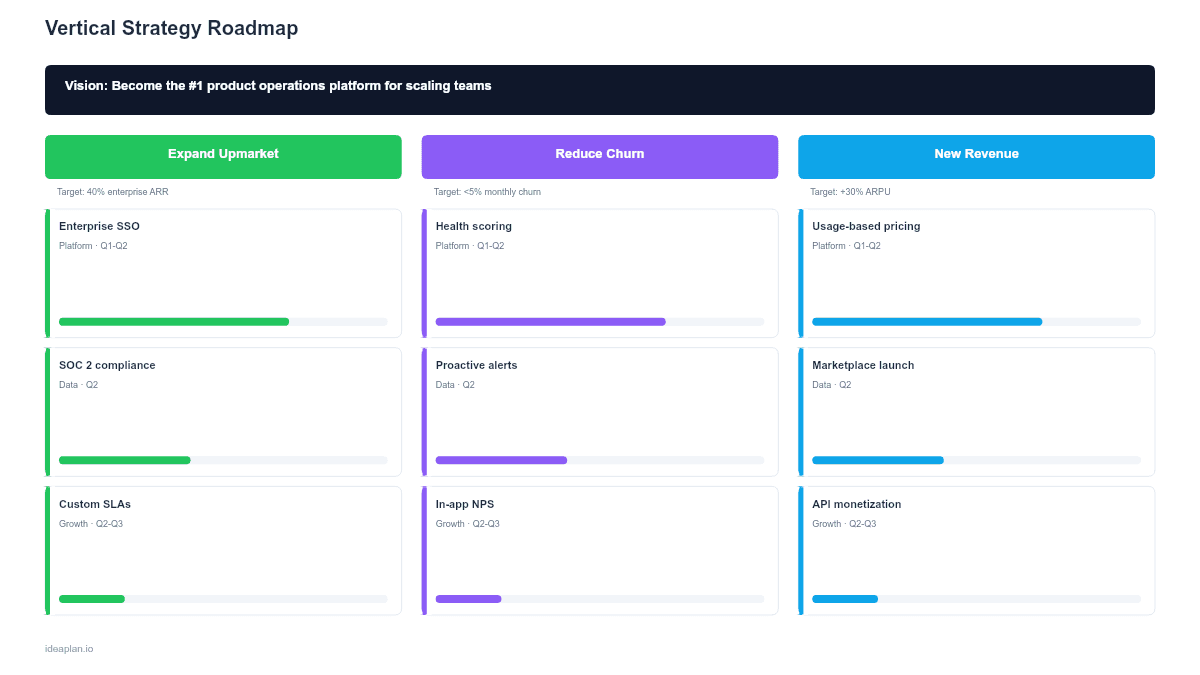
- Blank vertical roadmap slide. Three vertical swimlanes across a quarterly timeline, each with four tracks: Industry Features, Compliance & Certification, Partnerships, and GTM. Activity cards include effort estimates, owners, and revenue targets.
- Filled example slide. A horizontal SaaS product expanding into healthcare, financial services, and education, with 15 initiatives across three verticals showing different maturity levels.
Why Verticals Need Their Own Roadmap
Horizontal products that move into verticals face a specific trap: they try to serve every industry with the same product and the same sales motion. The result is a product that is 80% right for everyone and 100% right for no one. Enterprise buyers in regulated industries will not tolerate that last 20%.
A vertical strategy roadmap forces you to name the gap between your horizontal product and what each industry actually requires. Healthcare needs HIPAA compliance and EHR integrations. Financial services needs SOC 2, audit trails, and specific data residency. Education needs LMS integrations and FERPA compliance. These are not feature requests. They are table stakes that determine whether you can sell at all.
The product differentiation strategy shifts from "we do everything" to "we do this industry better than anyone." That specificity is what the vertical roadmap creates.
Template Structure
Vertical Swimlanes
Each horizontal row represents one target vertical. The template starts with three verticals, but you can add or remove rows. Each swimlane operates semi-independently because different industries move at different speeds: a healthcare vertical might need 6 months of compliance work before the first sale, while a marketing tech vertical might start selling next quarter.
Industry Features Track
Features that exist only for a specific vertical: healthcare-specific reporting templates, financial services audit logging, education grade-book integrations. These features live in the top track of each swimlane with effort estimates and engineering team assignments.
Compliance & Certification Track
Regulatory requirements specific to the vertical: certifications to obtain, audits to pass, documentation to produce. Each compliance item includes the certification name, estimated timeline, cost, and the sales impact (how many deals are blocked until this is complete).
Partnerships Track
Industry partnerships that accelerate market entry: system integrators, industry consultants, technology partners with complementary products, and industry associations. Each partnership card shows the partner type, deal stage, and expected contribution (leads, credibility, integration).
GTM Track
Vertical-specific go-to-market activities: industry event sponsorships, vertical-specific case studies, dedicated sales specialists, and pricing adjustments. This track ensures that building vertical features without building vertical sales motions does not happen.
How to Use This Template
1. Score and select target verticals
Evaluate candidate verticals on four dimensions: market size, competitive intensity, product gap (how much you need to build), and sales readiness (do you have people who understand this industry?). The RICE framework can structure this scoring. Select 2-3 verticals to pursue actively; more than three splits engineering and sales focus too thin.
2. Map the gap per vertical
For each selected vertical, document what is missing across all four tracks. Interview 5-10 potential customers in the industry. Ask: "What would you need to see before you could buy this product?" Their answers populate the roadmap. Some verticals will have a short gap list; others will reveal a 12-month buildout. Both are useful findings.
3. Sequence by speed to revenue
Place the vertical with the shortest path to revenue first. If financial services needs 3 months of compliance work and education needs 9 months, start financial services in Q1 and education in Q3. Staggered entry lets you apply learnings from the first vertical to the second.
4. Assign vertical owners
Each vertical needs a single owner who coordinates across the four tracks. In smaller organizations this is the product manager. In larger ones it might be a vertical GM or a dedicated vertical lead. Without ownership, vertical initiatives compete for attention and none reach completion.
5. Set vertical-level revenue targets
Attach revenue targets to each vertical by quarter. These targets are the primary measure of whether the vertical investment is paying off. Track pipeline, closed revenue, and net revenue retention per vertical. If a vertical is not generating pipeline after two quarters of investment, reassess the strategy.
When to Use This Template
A vertical strategy roadmap is essential when:
- Your horizontal product is hitting growth ceilings and leadership has identified industry specialization as the next growth vector
- Enterprise prospects keep asking for industry-specific features that do not exist yet
- Competitors are winning deals by positioning as vertical specialists in industries you also serve
- Compliance requirements vary by industry and you need to plan certification timelines alongside feature work
- Sales is pursuing multiple verticals ad hoc without a coordinated plan for which industries to prioritize
For expanding into new geographies rather than new industries, the market expansion roadmap PowerPoint template is a better fit. For building the underlying platform that supports vertical customization, the platform roadmap PowerPoint template covers the infrastructure layer.
Featured in
This template is featured in Product Strategy Roadmap Templates, a curated collection of roadmap templates for this use case.
Key Takeaways
- Vertical strategy roadmaps separate industry-specific work into four tracks: Features, Compliance, Partnerships, and GTM.
- Selecting 2-3 verticals and sequencing them by speed to revenue outperforms broad, unfocused vertical expansion.
- Compliance and certification timelines often gate everything else. Surface them early so they do not surprise the team in Q3.
- Each vertical needs a dedicated owner who coordinates across product, compliance, sales, and partnerships.
- PowerPoint format lets you present vertical strategy to leadership and board members who evaluate growth investments per industry.
- Compatible with Google Slides, Keynote, and LibreOffice Impress. Upload the
.pptxto Google Drive to edit collaboratively in your browser.