Quick Answer (TL;DR)
This free PowerPoint template structures market expansion into four phases: Market Assessment, Entry Strategy, Go-to-Market Execution, and Scale & Optimize. Each phase includes decision gates, resource requirements, and success criteria so leadership can track progress from initial research through sustained growth. Download the .pptx, fill in your target markets, and use it to align product, marketing, and sales teams around a shared expansion plan.
What This Template Includes
- Cover slide. Product name, target markets, planning horizon, and expansion owner.
- Instructions slide. How to define target markets, set decision gates, and customize scoring criteria. Remove before presenting.
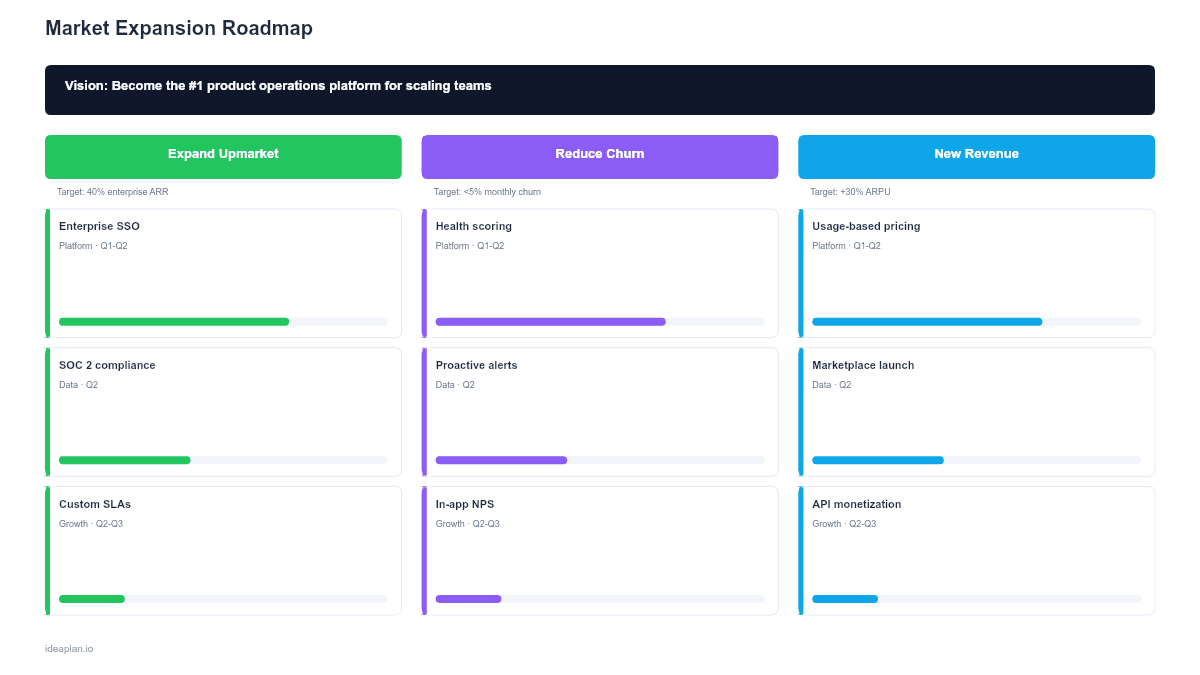
- Blank expansion roadmap slide. Four phase columns with swimlanes for market research, product adaptation, go-to-market, and operations. Each cell holds activity cards with owners, budgets, and milestone dates.
- Filled example slide. A B2B SaaS expansion into two new markets showing 14 activities across four phases, with decision gates between each phase and revenue targets at the scale stage.
Why Plan Market Expansion with a Roadmap
Most market expansions fail not because the market was wrong but because the company moved too fast or too slow. Moving too fast means committing engineering resources to localization before validating demand. Moving too slow means a competitor establishes themselves while you are still running surveys.
A market expansion roadmap creates deliberate pacing. Each phase has a clear set of activities and a decision gate that asks: "Based on what we learned, should we proceed, adjust, or exit?" This structure turns market entry from a bet into a process.
The product strategy should define which markets to consider. This template picks up from that decision and plans the execution.
Template Structure
Phase 1: Market Assessment
The first column covers research activities: total addressable market sizing, competitive analysis, regulatory review, and customer discovery interviews. Each activity has a deliverable (market sizing report, competitor matrix, regulatory checklist) and a scoring rubric. The decision gate at the end of this phase asks: Does the market meet our minimum thresholds for size, competition level, and regulatory feasibility?
Use the competitive analysis framework to structure the competitor evaluation within this phase.
Phase 2: Entry Strategy
Once a market clears assessment, the entry strategy phase defines how you will enter: pricing adjustments, product adaptations, channel selection, and partnership requirements. This is where you decide between direct sales, channel partners, or marketplace distribution. Each decision is captured as a card with rationale, alternatives considered, and expected impact.
Phase 3: Go-to-Market Execution
The execution phase covers the actual launch activities: localized marketing campaigns, sales team hiring or training, customer success preparation, and product deployment. Activities are sequenced so that product readiness precedes sales activation, which precedes marketing campaigns. The go-to-market roadmap PowerPoint template provides additional detail for this phase if needed.
Phase 4: Scale & Optimize
Post-launch activities focus on growth: customer acquisition cost optimization, product-market fit validation in the new market, expansion of local teams, and iteration on positioning based on early customer feedback. Revenue targets and retention benchmarks at this stage determine whether the market becomes a sustained investment or a controlled exit.
How to Use This Template
1. Select target markets
List 2-4 candidate markets ranked by strategic fit. Each market gets its own row within the template or its own copy of the slide. Avoid evaluating more than four markets simultaneously. The research effort dilutes and timelines stretch.
2. Define decision gate criteria
Set quantitative thresholds for each phase transition. For example: "Proceed from Assessment to Entry Strategy if TAM exceeds $50M, competitive density is below 5 established players, and regulatory requirements can be met within 6 months." Written criteria prevent emotional escalation where teams keep investing because they have already spent time, not because the data supports it.
3. Assign cross-functional owners
Market expansion touches product (adaptation), marketing (localization), sales (new channels), legal (compliance), and finance (budget allocation). Each phase needs a named owner who coordinates across these functions. The stakeholder management guide covers techniques for keeping cross-functional teams aligned.
4. Set phase timelines
Assessment typically takes 4-8 weeks. Entry strategy takes 4-6 weeks. Execution takes 8-16 weeks depending on product complexity. Scale runs indefinitely with quarterly checkpoints. Place these on the PowerPoint timeline and adjust based on your organization's speed and the market's complexity.
5. Present at quarterly business reviews
Market expansion roadmaps belong in QBR discussions alongside revenue reports and product roadmaps. Show which markets are in which phase, what the decision gates revealed, and what resources are needed for the next phase. This cadence keeps leadership informed without micromanaging the expansion team.
When to Use This Template
A market expansion roadmap is the right choice when:
- Your current market is saturating and growth requires finding new customer segments or geographies
- A competitive threat is moving into adjacent markets and you need a structured response plan
- Leadership has identified expansion targets but no plan exists for evaluating and entering them
- Previous expansion attempts failed due to unstructured entry without clear decision gates
- The board or investors expect a growth plan that extends beyond the current market
For geographic-specific expansion, the geographic expansion roadmap PowerPoint template adds detail around regulatory, localization, and infrastructure requirements. For industry-specific expansion, the vertical strategy roadmap PowerPoint template covers vertical market entry.
Featured in
This template is featured in Growth and Revenue Roadmap Templates, a curated collection of roadmap templates for this use case.
Key Takeaways
- Four phases (Assessment, Entry Strategy, Execution, Scale) create deliberate pacing with decision gates that prevent premature commitment.
- Quantitative decision gate criteria at each phase transition replace gut-feel decisions with data-driven go/no-go calls.
- Sequential market entry outperforms parallel entry for most teams. Focus beats breadth.
- Cross-functional ownership across product, marketing, sales, and legal is essential because expansion touches every function.
- PowerPoint format makes the expansion plan easy to present in QBRs and board meetings where growth strategy is reviewed.
- Compatible with Google Slides, Keynote, and LibreOffice Impress. Upload the
.pptxto Google Drive to edit collaboratively in your browser.