Quick Answer (TL;DR)
This free PowerPoint template plans geographic expansion across four tracks per region: Regulatory & Compliance, Product Localization, Infrastructure & Operations, and Local Partnerships. Each track shows the work required to enter a new country or region with milestones gated by regulatory readiness. Download the .pptx, add your target regions, and use it to coordinate legal, engineering, operations, and business development teams around a shared geographic launch plan.
What This Template Includes
- Cover slide. Product name, target regions, expansion timeline, and geographic strategy owner.
- Instructions slide. How to evaluate regions, map regulatory requirements, and define launch readiness criteria. Remove before presenting.
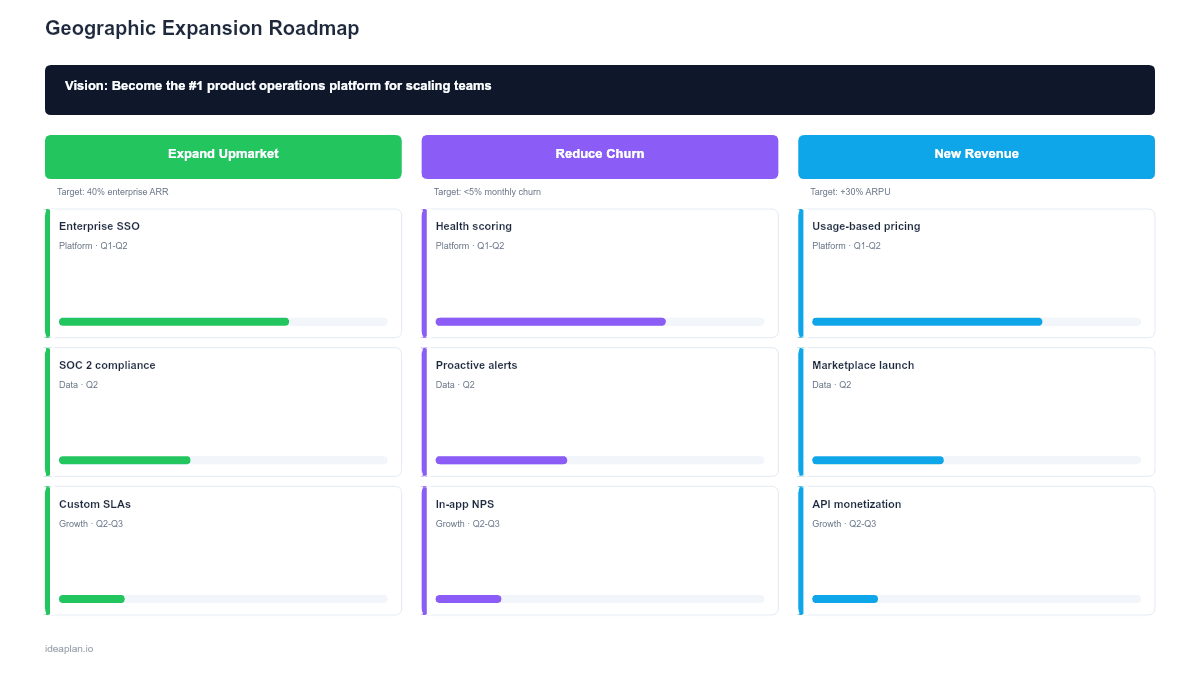
- Blank geographic roadmap slide. Two region columns, each with four horizontal tracks and quarterly milestones. Regulatory gates appear as decision diamonds that block downstream activities until compliance is confirmed.
- Filled example slide. A SaaS product expanding into the EU and Japan showing 16 activities across two regions, with GDPR compliance gating the EU launch and APPI compliance gating the Japan launch.
Why Geographic Expansion Needs Its Own Roadmap
Expanding into a new country is not a feature launch. It involves legal obligations, infrastructure decisions, and operational changes that have nothing to do with building product. A team that treats geographic expansion as a checkbox on the product roadmap will miss the regulatory deadline, discover they cannot process payments in the local currency, or learn at launch that their data hosting violates residency laws.
A dedicated geographic roadmap separates these concerns into parallel tracks so they can progress simultaneously. Legal works on compliance while engineering handles localization while operations sets up infrastructure. The key constraint is that regulatory approval gates everything else: you cannot launch marketing, sign local partners, or process customer data until compliance is confirmed.
The internationalization roadmap PowerPoint template covers technical i18n work (string extraction, RTL support, timezone handling) that feeds into this template's Product Localization track.
Template Structure
Regulatory & Compliance Track
The top track covers every legal requirement for the target region: data protection laws (GDPR, LGPD, APPI), industry-specific regulations, tax registration, entity establishment, and employment law for local hires. Each requirement has a status indicator, a legal owner, and an estimated completion date. This track is the critical path. Everything else waits until compliance is achievable.
Product Localization Track
Language translation, currency support, date and number formatting, local payment methods, and region-specific feature adjustments. Each localization item ties to a user experience impact: "Payment checkout supports Boleto for Brazil" or "Date format defaults to DD/MM/YYYY for EU." The localization roadmap PowerPoint template provides deeper detail if localization is the primary workstream.
Infrastructure & Operations Track
Data hosting and residency decisions, CDN configuration for regional performance, local support hours and language coverage, local banking and invoicing setup, and third-party vendor evaluation. These operational items often take longer than expected because they require procurement, contracts, and testing that cannot be parallelized.
Local Partnerships Track
Regional system integrators, resellers, technology partners, and industry associations that accelerate market entry. Each partnership card shows the partner type, relationship status, expected contribution (credibility, leads, implementation support), and timeline to activation. In many markets, a local partner is the difference between 6 months to first customer and 18 months.
How to Use This Template
1. Select target regions based on data
Rank candidate regions by three signals: existing customer demand (are customers already asking?), market size in the region, and regulatory complexity. A region with strong demand and moderate regulation is a better first target than a larger market with regulatory requirements that take 12 months to clear.
2. Map the regulatory critical path
For each region, list every compliance requirement and estimate timelines with legal counsel. Regulatory work is the longest lead-time item and the hardest to compress. Start it first, even before other tracks begin. Place regulatory milestones on the roadmap and draw dependency lines from them to downstream activities.
3. Parallel-track the other workstreams
Once regulatory work is underway, start localization, infrastructure, and partnership development in parallel. These tracks can progress independently up to a point: you can translate the product before regulatory approval, but you cannot host customer data until data residency is resolved.
4. Define launch readiness criteria
Create a checklist per region: regulatory approval obtained, product localized and tested, infrastructure deployed and load-tested, support coverage scheduled, payment processing validated, and at least one local partner activated. Use the checklist as the final gate before marketing launch. The product launch guide covers launch execution mechanics.
5. Plan a phased rollout
Do not launch all features in a new region simultaneously. Start with a limited feature set for early adopters, collect feedback, fix localization issues, and expand to general availability. A phased approach reduces risk and builds early reference customers before the full marketing push.
When to Use This Template
A geographic expansion roadmap is the right choice when:
- Your product is entering a new country or region with distinct regulatory, language, or infrastructure requirements
- Data residency laws require hosting and processing decisions that affect architecture
- Local payment methods and currency support need to be built or integrated before launch
- Leadership wants a coordinated plan across legal, engineering, operations, and BD functions
- Previous international launches stalled because compliance or localization work was underestimated
For broader market expansion that includes new segments and use cases (not just new geographies), the market expansion roadmap PowerPoint template provides a wider framework. For the technical internationalization work specifically, the internationalization roadmap PowerPoint template covers the engineering details.
Featured in
This template is featured in Growth and Revenue Roadmap Templates, a curated collection of roadmap templates for this use case.
Key Takeaways
- Geographic expansion requires four parallel tracks: Regulatory, Localization, Infrastructure, and Partnerships. With regulatory approval gating everything else.
- Start compliance work first because it has the longest lead time and cannot be compressed.
- Phased rollouts with limited feature sets reduce risk and build early reference customers before general availability.
- Local partnerships accelerate market entry by providing credibility, leads, and implementation support that takes years to build organically.
- PowerPoint format makes the geographic plan presentable to leadership and board members who evaluate international growth investments.
- Compatible with Google Slides, Keynote, and LibreOffice Impress. Upload the
.pptxto Google Drive to edit collaboratively in your browser.