Quick Answer (TL;DR)
This free PowerPoint template organizes locale and language rollouts across a quarterly timeline, grouped by market priority tier. Each locale card tracks translation coverage, locale-specific feature requirements, regulatory needs, and go-live readiness. Download the .pptx, rank your target markets by revenue opportunity, and use it to coordinate product, engineering, and content teams on a phased international expansion plan.
What This Template Includes
- Cover slide. Product name, localization program scope, and the PM or program lead responsible.
- Instructions slide. How to tier markets, assess locale readiness, and track translation coverage. Remove before presenting.
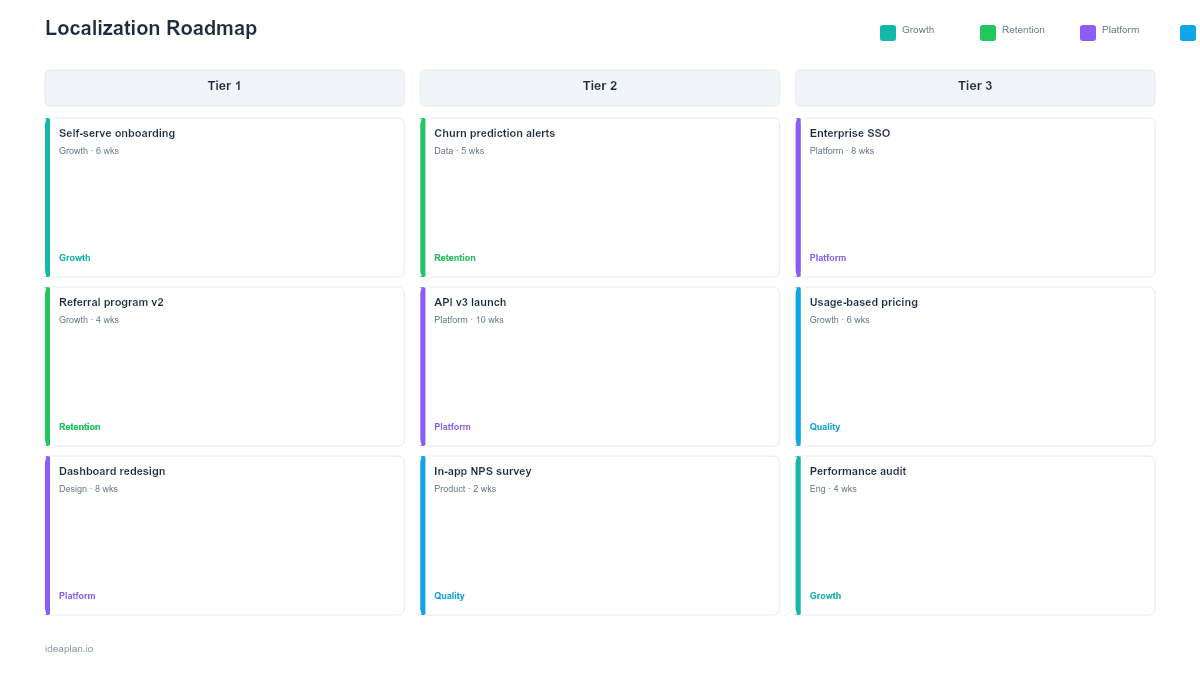
- Blank localization slide. Three market-tier rows (Tier 1, Tier 2, Tier 3) across a quarterly timeline with locale cards showing coverage percentage, regulatory status, and go-live date.
- Filled example slide. A SaaS product localizing into seven markets: German and French (Tier 1, Q1), Japanese and Spanish (Tier 2, Q2), Portuguese, Korean, and Italian (Tier 3, Q3-Q4), with translation coverage percentages and locale-specific feature callouts.
Why Localization Deserves Its Own Roadmap
Localization is not "just translation." A locale rollout involves UI translation, content localization, date/currency/number formatting, right-to-left layout support, payment provider integration, regulatory compliance (GDPR, local data residency), and sometimes locale-specific feature development (e.g., tax calculation rules for Japan, invoice formats for Germany).
Tracking this work on a standard feature roadmap buries it among unrelated feature work. Tracking it in a spreadsheet loses the timeline and cross-team coordination context. A dedicated localization roadmap gives the program its own visual surface where every stakeholder. Product, engineering, legal, content, marketing. Can see which markets launch when and what remains to be done.
The internationalization roadmap template covers the engineering infrastructure (i18n framework, string extraction, locale-aware components). This template focuses on the locale-by-locale rollout plan that uses that infrastructure.
Template Structure
Market Tier Rows
Three rows group target markets by priority:
- Tier 1. Largest revenue opportunity, launched first. Typically 1-2 markets that represent the biggest international revenue potential based on existing demand signals: inbound leads, organic traffic by country, competitor presence.
- Tier 2. Strong opportunity, launched in the next wave. Markets where you have early traction but need localized content and compliance work before a full launch.
- Tier 3. Emerging or long-tail markets, planned for later quarters. Lower effort if the i18n framework and translation pipeline are already established from Tier 1 and Tier 2 launches.
Locale Cards
Each card represents one locale and contains:
- Locale identifier. Language and region code (e.g., de-DE, ja-JP, pt-BR).
- Translation coverage. Percentage of UI strings and content translated. Track separately for UI, help docs, marketing pages, and email templates.
- Locale-specific requirements. Features or configurations unique to this market: payment methods, tax rules, data residency, regulatory filings.
- Go-live readiness. A status indicator (ready, in progress, blocked) showing whether the locale can launch on schedule.
Readiness Checklist Track
A horizontal track at the bottom lists the cross-cutting readiness gates that every locale must pass: translation QA, legal review, payment integration, customer support coverage, and marketing launch materials. This track prevents teams from launching a locale that is technically translated but operationally unsupported.
How to Use This Template
1. Rank markets by opportunity
Score each target market on revenue potential, existing demand (inbound inquiries, organic traffic), competitive pressure, and localization effort. Markets with high revenue potential and low localization effort go first. The market sizing glossary entry provides a framework for quantifying opportunity by region.
2. Assess locale requirements
For each target locale, document what is needed beyond translation: payment methods, regulatory compliance, date and currency formatting, right-to-left support, locale-specific features. This assessment determines the engineering effort per locale and may reorder your tier assignments.
3. Sequence by tier
Place Tier 1 locales in the earliest quarter with full locale cards. Tier 2 follows in the next quarter. Tier 3 fills out the year. Avoid launching more than two locales simultaneously unless your translation pipeline and QA process can handle the throughput.
4. Track translation coverage
Update translation coverage percentages weekly during active localization work. Set a minimum threshold for go-live. Typically 95% for UI strings and 80% for help documentation. Content that is not translated should fall back gracefully to the default locale rather than showing broken strings.
5. Run readiness checks
Before each locale go-live, walk through the readiness checklist: Is payment working? Is customer support staffed for this language? Are marketing pages live? Has legal signed off on the privacy policy and terms of service in this language? Missing any gate means the locale is not ready regardless of translation coverage.
6. Review monthly
Update the roadmap monthly to reflect progress. Locales that are blocked should show the specific blocker on their card. If a Tier 2 locale finishes early, consider pulling it forward. If a Tier 1 locale has regulatory delays, adjust the timeline and communicate downstream impacts to marketing and sales.
When to Use This Template
A localization roadmap is the right format when:
- International expansion is a strategic priority with multiple markets planned
- Cross-functional coordination is needed between product, engineering, content, legal, and marketing for each locale launch
- Phased rollout across markets requires clear sequencing and readiness tracking
- Leadership visibility is needed to show progress toward international revenue targets
- Past launches have suffered from missing translations, unsupported payment methods, or compliance gaps
If you are localizing into a single market, the effort can be tracked on a standard quarterly roadmap. For the underlying engineering infrastructure (i18n framework, translation management), use the internationalization roadmap template.
Key Takeaways
- Localization roadmaps organize market launches by priority tier, ensuring the highest-opportunity markets ship first.
- Each locale card tracks translation coverage, locale-specific requirements, and go-live readiness.
- A readiness checklist prevents launching locales that are translated but not operationally supported.
- Sequence no more than two simultaneous locale launches unless your pipeline is mature.
- Update translation coverage weekly during active work and review the full roadmap monthly.
- Compatible with Google Slides, Keynote, and LibreOffice Impress. Upload the
.pptxto Google Drive to edit collaboratively in your browser.