Quick Answer (TL;DR)
This free PowerPoint template structures the consolidation of multiple platforms, products, or systems into a unified architecture. It maps the work across four phases. Discovery, parallel running, phased cutover, and decommission. With risk indicators, data migration milestones, and stakeholder communication checkpoints. Download the .pptx, identify the systems being consolidated, and use it to give engineering, product, and leadership a shared view of what merges when and what gets retired.
What This Template Includes
- Cover slide. Consolidation project name, source systems being merged, target platform, and program owner.
- Instructions slide. How to map source systems, identify overlap, plan phased cutover, and set decommission criteria. Remove before distributing.
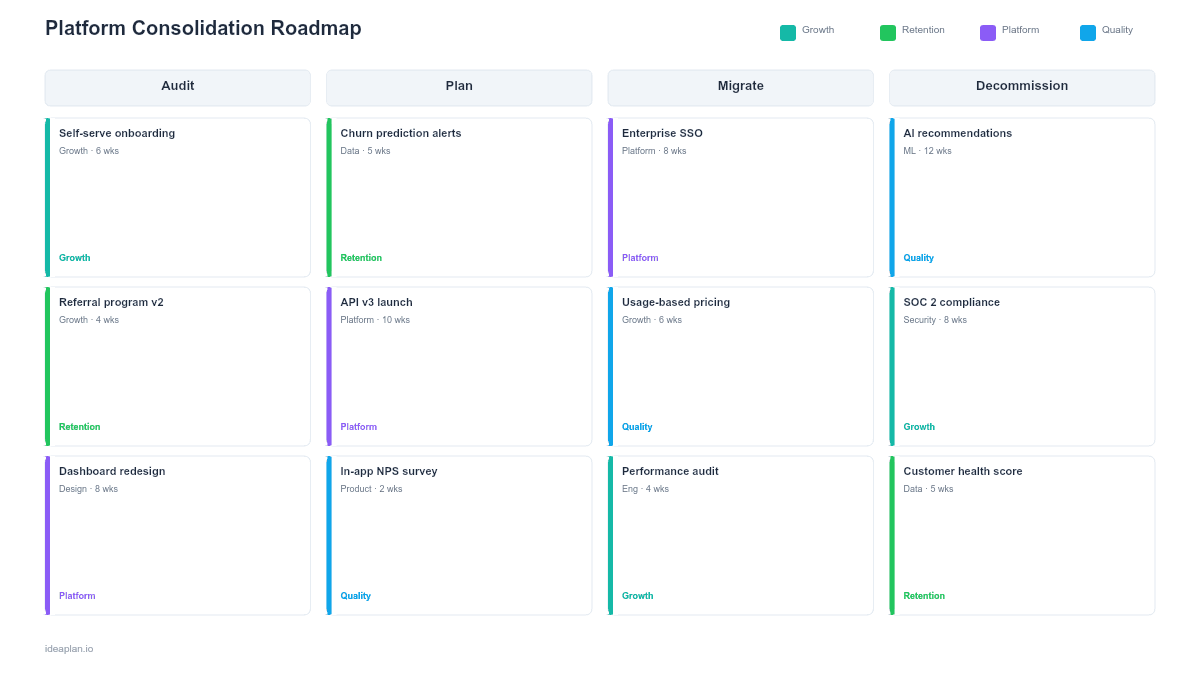
- Blank consolidation timeline slide. A four-phase timeline (Discovery, Parallel Run, Phased Cutover, Decommission) with swim lanes for each source system. Cards show migration status, data dependency flags, risk level, and user migration percentage.
- Filled example slide. A realistic consolidation roadmap for a company merging three acquired products into a single platform, showing feature mapping, data migration waves, parallel running period, and staged customer cutover with rollback checkpoints.
Why PowerPoint for Platform Consolidation
Consolidation projects fail most often from poor communication, not poor engineering. Teams building the target platform make assumptions about source system behavior. Customers on legacy systems get surprised by migration timelines. Leadership expects cost savings that will not materialize until decommission is complete. Which is always later than planned.
A PowerPoint timeline forces all four phases onto a single view. It shows when parallel running starts (the period of maximum cost, since both systems are active), when each customer cohort migrates, and when each legacy system can finally be shut down. This prevents the most common consolidation mistake: declaring the project "done" after building the new platform while three legacy systems are still running and costing money.
Template Structure
Discovery Phase
Maps the feature overlap and gaps between source systems and the target platform. Each source system gets a feature audit: which features exist in the target platform already, which need to be built, and which will be intentionally dropped. Cards show feature count, gap severity, and estimated build effort for missing capabilities. This phase ends with a signed-off product brief that defines exactly what "consolidated" means.
Parallel Run Phase
Both old and new systems run simultaneously. This phase validates that the target platform handles real production traffic and data without regressions. Cards track system health metrics: error rates, latency comparison, data consistency checks, and feature adoption on the new platform versus the old. Set clear exit criteria for ending parallel run. Do not let it run indefinitely as a safety blanket.
Phased Cutover Phase
Customer cohorts migrate to the target platform in waves, typically starting with internal users, then low-risk external accounts, then high-value accounts last. Each wave card shows the customer count, data volume, cutover date, rollback window, and success criteria. The phased rollout approach limits blast radius if something goes wrong.
Decommission Phase
Legacy systems are shut down after all users have migrated and the rollback window has passed. Cards track remaining dependencies: data archives, API consumers still pointing to old endpoints, regulatory retention requirements, and infrastructure cost savings realized. Decommission is not a single event. It is a checklist of dependencies that must clear before you can turn off the servers.
How to Use This Template
1. Inventory source systems and their users
For each platform being consolidated, document: active user count, data volume, unique features, integration points, and contractual commitments. The most common consolidation blind spot is undocumented integrations. Third-party systems that call your API or depend on specific data formats. Audit these before committing to a timeline.
2. Define the target state and gap list
Specify exactly what the consolidated platform will do. Use the feature audit from Discovery to create a gap list. Features that exist in source systems but not yet in the target. Prioritize gaps using weighted scoring: features used by 80% of users across source systems are non-negotiable; features used by 2% of users on one legacy system are candidates for deprecation.
3. Plan migration waves by risk tier
Start with the lowest-risk cohort: internal users or a small subset of external accounts who have agreed to early migration. Each successive wave increases in size and risk. Define rollback criteria for each wave. If error rates exceed a threshold, the wave pauses and users revert to the source system. Place wave dates on the timeline with buffer between waves for issue resolution.
4. Set decommission criteria and track cost savings
For each source system, define what must be true before it can be shut down: zero active users, data archived per retention policy, no remaining API consumers, and sign-off from legal and compliance. Track the cost of running each legacy system monthly so leadership can see the real savings timeline. The consolidation is not complete until legacy systems are off.
When to Use This Template
A platform consolidation roadmap is necessary when:
- Post-acquisition integration requires merging acquired products into your core platform
- Multiple internal tools serve the same function and maintenance cost exceeds the value of keeping them separate
- Technical debt from legacy systems is blocking new feature development on the modern stack
- Customer experience suffers from inconsistent behavior across platforms that should be unified
- Cost reduction targets depend on shutting down redundant infrastructure
If you are migrating a single system to a new technology stack without merging multiple sources, the platform migration template is a better fit. Consolidation implies multiple source systems converging into one target, which adds the complexity of feature reconciliation and multi-cohort migration.
Featured in
This template is featured in Multi-Product and Portfolio Roadmap Templates, a curated collection of roadmap templates for this use case.
Key Takeaways
- Platform consolidation roadmaps cover four phases: Discovery, Parallel Run, Phased Cutover, and Decommission. Skipping any phase creates risk.
- The consolidation is not complete when the new platform launches. It is complete when legacy systems are shut down and cost savings are realized.
- Migrate in waves starting with low-risk cohorts, with rollback criteria defined for each wave.
- Freeze new feature development on source systems during consolidation to prevent the gap list from growing.
- Data migration is the highest-risk activity. Run automated validation and dry runs well before cutover begins.
- Compatible with Google Slides, Keynote, and LibreOffice Impress. Upload the
.pptxto Google Drive to edit collaboratively in your browser.