Quick Answer (TL;DR)
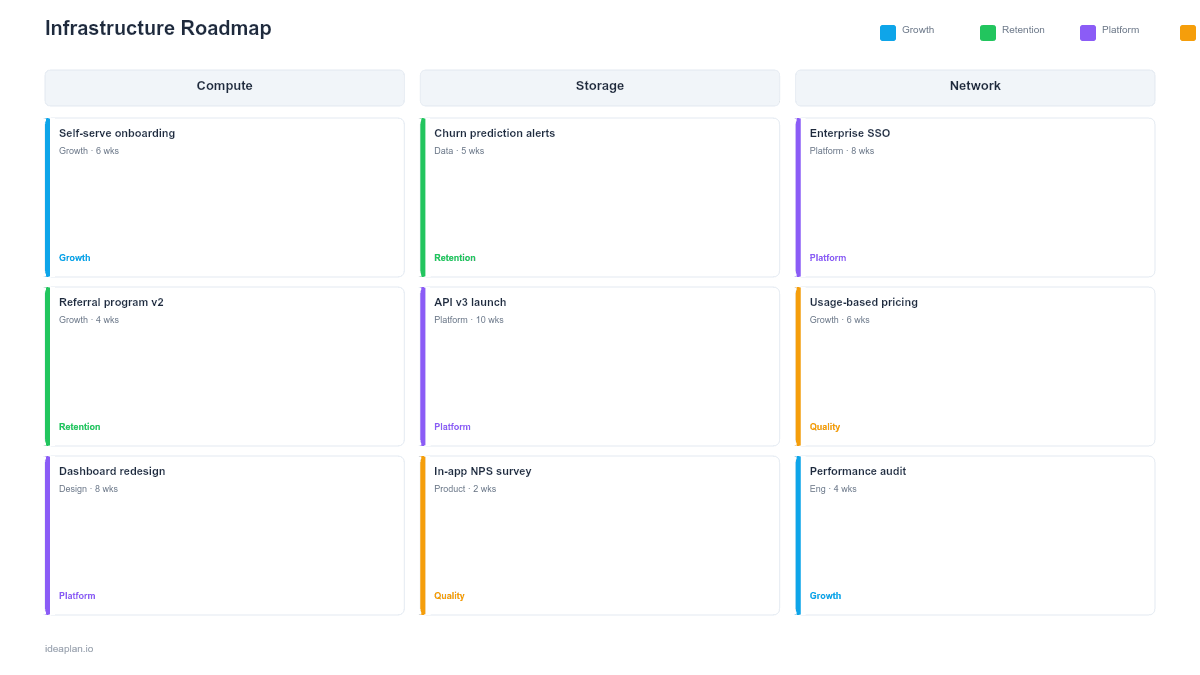
This free PowerPoint template plans infrastructure work across four layers: Compute & Hosting, Data & Storage, Networking & Security, and Observability & Reliability. Each layer shows quarterly milestones with capacity targets, cost projections, and reliability metrics. Download the .pptx, fill in your infrastructure priorities, and use it to communicate technical investments to engineering leadership and non-technical stakeholders who approve the budget.
What This Template Includes
- Cover slide. Product name, infrastructure vision statement, and planning period.
- Instructions slide. How to define layers, set capacity targets, and link infrastructure work to business outcomes. Remove before presenting.
- Blank template slide. Four infrastructure layers across a quarterly timeline with capacity gauges, cost indicators, and reliability targets per layer.
- Filled example slide. A SaaS platform infrastructure roadmap showing migration from monolith to microservices, database scaling, CDN rollout, and observability platform buildout over four quarters.
Why Infrastructure Needs a Separate Roadmap
Infrastructure work is invisible until it breaks. Product teams ship features that customers see. Infrastructure teams prevent outages that customers would notice. This asymmetry creates a chronic funding problem: infrastructure investment is easy to defer because the cost of deferral is probabilistic (you might have an outage) while the cost of a new feature is concrete (you will lose this deal).
A dedicated infrastructure roadmap solves this by making invisible work visible. It translates technical concepts into metrics that business leaders care about: uptime percentages, page load times, cost per transaction, and capacity headroom. When a VP asks "Why do we need to spend Q3 on database migration instead of building features?", the roadmap shows that the current database hits capacity at 150K users and the pipeline projects 200K by Q4.
For teams carrying significant technical debt, this template works alongside the technical debt roadmap PowerPoint template. Infrastructure covers the platform layer while tech debt covers application-level code quality.
Template Structure
Infrastructure Layers
Four horizontal rows organize work by system layer:
- Compute & Hosting. Server provisioning, container orchestration, auto-scaling, serverless migration, cloud region expansion. Where your code runs.
- Data & Storage. Database scaling, caching layers, data warehousing, backup and recovery, data pipeline infrastructure. Where your data lives.
- Networking & Security. CDN, load balancing, API gateways, firewall rules, DDoS protection, SSL/TLS management. How traffic flows and stays safe.
- Observability & Reliability. Monitoring, alerting, distributed tracing, error tracking, incident response automation, chaos engineering. How you know when things break.
Capacity Gauges
Each layer includes a capacity gauge showing current utilization versus maximum capacity. A Compute layer at 78% utilization with a projection to hit 95% in two quarters makes the urgency of scaling work concrete without requiring the audience to understand Kubernetes pod limits.
Cost Indicators
Monthly infrastructure cost per layer, with projected cost after planned changes. This framing helps leadership evaluate trade-offs: "We can reduce data storage costs by 40% with tiered storage, freeing $50K/month for feature development."
Reliability Targets
Each layer shows its current and target reliability metric: uptime percentage for Compute, query latency P99 for Data, response time for Networking, MTTR for Observability. These connect infrastructure work to the SLA commitments the business makes to customers.
How to Use This Template
1. Assess current state per layer
For each infrastructure layer, document: current capacity utilization, monthly cost, reliability metrics (uptime, latency, MTTR), and known risks. This assessment often reveals that the team is running closer to capacity limits than anyone realized. Pull data from your monitoring tools. Do not rely on engineering's intuition, which tends to underestimate risk.
2. Project growth requirements
Use product roadmap timelines and business projections to estimate future load. If the product team plans to launch in two new markets in Q3, what does that mean for Compute capacity, data residency requirements, and CDN coverage? Map product plans to infrastructure implications quarter by quarter.
3. Identify critical path items
Some infrastructure work blocks product features. A real-time analytics feature cannot ship until the data pipeline supports streaming. Multi-region deployment cannot happen until the database supports cross-region replication. Mark these dependencies explicitly. They justify infrastructure investment in terms product leaders understand.
4. Estimate costs and savings
For each planned initiative, calculate implementation cost (engineering time) and operational impact (cost reduction or avoidance). Infrastructure work often pays for itself: migrating to reserved instances saves 30-40% on compute costs, implementing caching reduces database load and defers a costly database upgrade.
5. Set quarterly reliability targets
Define measurable targets per layer per quarter. Compute uptime moving from 99.9% to 99.95% is a meaningful improvement that translates to 4 fewer hours of downtime per year. Present these as commitments that the infrastructure investment enables.
6. Present in business terms
When showing this roadmap to non-technical stakeholders, lead with the business metrics: cost reduction, capacity headroom (months until we hit limits), and customer-facing reliability improvements. Save the technical details (Kubernetes cluster migration, PostgreSQL to CockroachDB) for engineering-audience versions of the same roadmap.
When to Use This Template
An infrastructure roadmap is the right choice when:
- Scaling pressure is real and the engineering team is spending increasing time on firefighting rather than building features
- Cloud costs are growing faster than revenue and leadership wants a plan to optimize infrastructure spending
- Reliability is slipping and customers or sales teams are flagging uptime issues that affect retention and deals
- A major migration is planned (monolith to microservices, on-prem to cloud, single-region to multi-region) that requires phased execution over multiple quarters
- Engineering leadership needs to justify headcount for platform and infrastructure roles
For application-level technical work, the technical debt roadmap PowerPoint template focuses on code quality and architecture debt. For a broader technology strategy, the technology roadmap PowerPoint template covers tooling and platform decisions alongside infrastructure.
Featured in
This template is featured in Technical and Engineering Roadmap Templates, a curated collection of roadmap templates for this use case.
Key Takeaways
- Infrastructure roadmaps make invisible technical investment visible to business stakeholders.
- Four layers (Compute, Data, Networking, Observability) provide a clear structure without getting into implementation details.
- Capacity gauges and cost indicators translate technical constraints into business language.
- Reliability targets connect infrastructure work to SLA commitments and customer experience.
- PowerPoint format enables infrastructure planning conversations with engineering leadership, finance, and executive teams.
- Compatible with Google Slides, Keynote, and LibreOffice Impress. Upload the
.pptxto Google Drive to edit collaboratively in your browser.