Quick Answer (TL;DR)
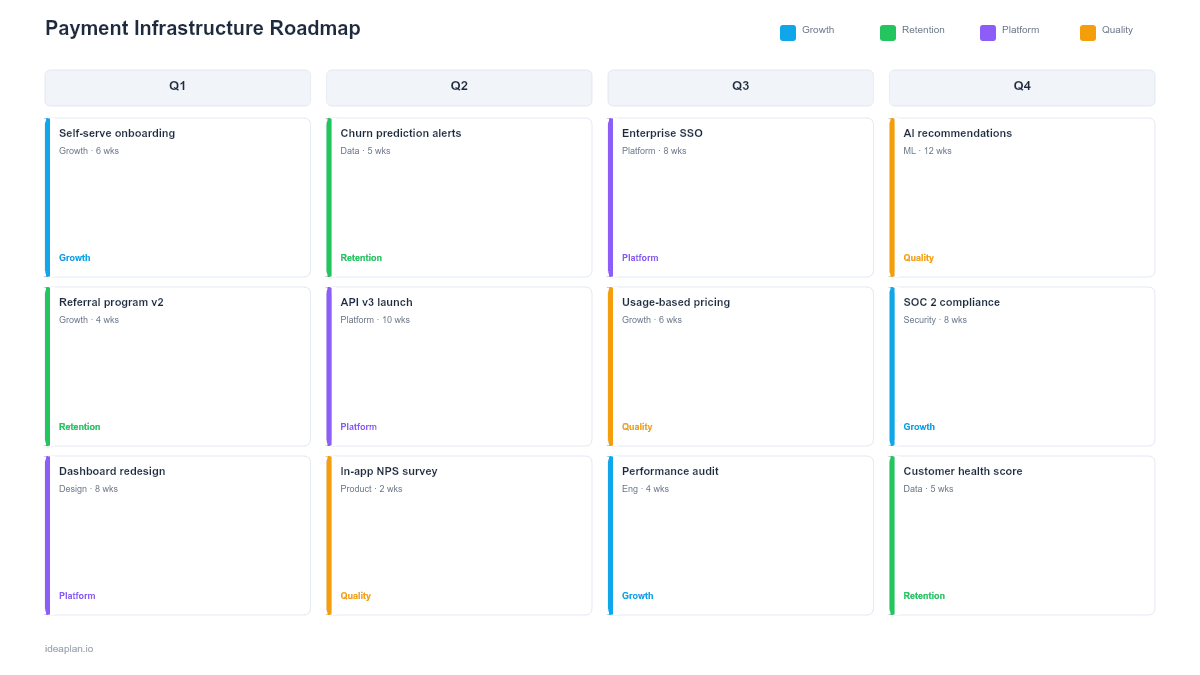
This free PowerPoint template maps out your payment and billing infrastructure across quarterly phases. From payment gateway integration to subscription management, invoicing, and compliance. Each slide covers a workstream (checkout, billing, fraud, compliance) with dependency callouts and go-live criteria. Download the .pptx, replace the placeholder milestones with your own payment initiatives, and align engineering, finance, and compliance teams on a shared delivery plan.
What This Template Includes
- Cover slide. Product name, planning horizon, and a summary of payment workstreams covered.
- Instructions slide. Guidance on customizing workstreams, setting dependency links, and updating compliance checkpoints. Remove before presenting.
- Blank template slide. Four payment workstream rows (Checkout, Billing & Subscriptions, Fraud & Risk, Compliance) across four quarterly columns with placeholder milestone cards.
- Filled example slide. A complete annual plan showing 16 milestones across workstreams, including PCI DSS audit gates, payment provider migrations, and subscription tier launches.
Why Payment Infrastructure Needs Its Own Roadmap
Payment systems touch every revenue-generating flow in a product. A broken checkout costs you money every minute it is down. A billing error creates support tickets and erodes trust. Yet payment work often gets buried inside broader feature roadmaps where its complexity is invisible.
A dedicated payment infrastructure roadmap solves three problems:
- Dependency visibility. Payment changes frequently block or are blocked by other teams. A checkout redesign might depend on a new payment provider integration. A subscription model change might require billing engine updates before marketing can announce pricing.
- Compliance tracking. PCI DSS, PSD2, and regional tax requirements have hard deadlines. Embedding these in a general feature roadmap risks them being deprioritized against feature work.
- Cross-functional alignment. Finance, legal, engineering, and product all have stakes in payment infrastructure. A shared visual artifact prevents the "I didn't know that was happening" problem.
For teams evaluating how to prioritize features across payment and non-payment work, separating payment infrastructure into its own roadmap makes the trade-offs explicit.
Template Structure
Payment Workstream Rows
Four horizontal rows represent the core payment workstreams:
- Checkout. Payment form, gateway integrations, currency support, express checkout methods.
- Billing & Subscriptions. Invoicing, plan management, proration logic, dunning flows.
- Fraud & Risk. Transaction monitoring, 3D Secure, chargeback management, velocity checks.
- Compliance. PCI DSS, tax calculation, data residency, regional payment regulations.
Each row operates semi-independently but shares dependency links shown as dotted connectors between cards.
Milestone Cards
Each card includes:
- Milestone name. Specific deliverable (e.g., "Stripe Connect integration" or "Automated dunning sequence").
- Owner. Engineering team or individual responsible.
- Dependency flag. Red border if the milestone blocks or is blocked by another workstream.
- Go-live criteria. One-line summary of what "done" means (e.g., "Processing $10K+ daily with <0.1% error rate").
Compliance Gates
Diamond-shaped markers on the timeline indicate hard compliance deadlines. These cannot be moved without legal or regulatory consequence and are visually distinct from regular milestones.
How to Use This Template
1. Map your current payment stack
Before filling in the roadmap, document what payment providers, billing systems, and compliance certifications you currently have. This baseline determines which workstreams need the most investment.
2. Define quarterly outcomes by workstream
For each row, identify 2-3 milestones per quarter. Near-term quarters should reflect committed engineering work. Later quarters should capture directional goals like "evaluate alternative payment providers" rather than specific implementation plans.
3. Mark dependencies between workstreams
Payment work is heavily interdependent. If a new subscription model requires billing engine changes before checkout can support it, draw the dependency connector. Use the dependency management glossary entry to standardize how your team talks about blockers.
4. Add compliance gates
Plot known regulatory deadlines as diamond markers. PCI DSS audits, tax law changes, and regional payment mandate deadlines should be non-negotiable fixed points on the timeline.
5. Review with finance and legal monthly
Payment roadmaps are not just engineering documents. Schedule a monthly review with finance (for revenue impact) and legal (for compliance risk). Update milestone statuses and adjust priorities based on business context.
When to Use This Template
This template fits when:
- You are migrating payment providers and need to coordinate the cutover across checkout, billing, and fraud systems simultaneously.
- Subscription pricing is changing and billing, invoicing, and checkout all need synchronized updates.
- A compliance deadline is approaching (PCI DSS recertification, new tax regulation) and you need to track readiness across teams.
- Multiple payment methods are being added (Apple Pay, BNPL, crypto) and each requires checkout, fraud, and compliance work.
- Revenue operations needs visibility into when billing improvements will reduce churn from failed payments. See the revenue churn rate metric to quantify the impact.
For broader infrastructure planning beyond payments, consider the Infrastructure Roadmap PowerPoint template. For security-focused work that intersects with payment compliance, the Security Roadmap PowerPoint template provides a complementary view.
Key Takeaways
- Payment infrastructure deserves a separate roadmap because it has unique compliance deadlines, heavy cross-team dependencies, and direct revenue impact.
- Four workstream rows (Checkout, Billing, Fraud, Compliance) cover the full payment stack without oversimplifying.
- Compliance gates are non-negotiable and should be visually distinct from regular milestones.
- Dependencies between workstreams are the most common source of delays. Make them visible.
- Monthly reviews with finance and legal keep the roadmap aligned with business reality.
- Compatible with Google Slides, Keynote, and LibreOffice Impress. Upload the
.pptxto Google Drive to edit collaboratively in your browser.