Quick Answer (TL;DR)
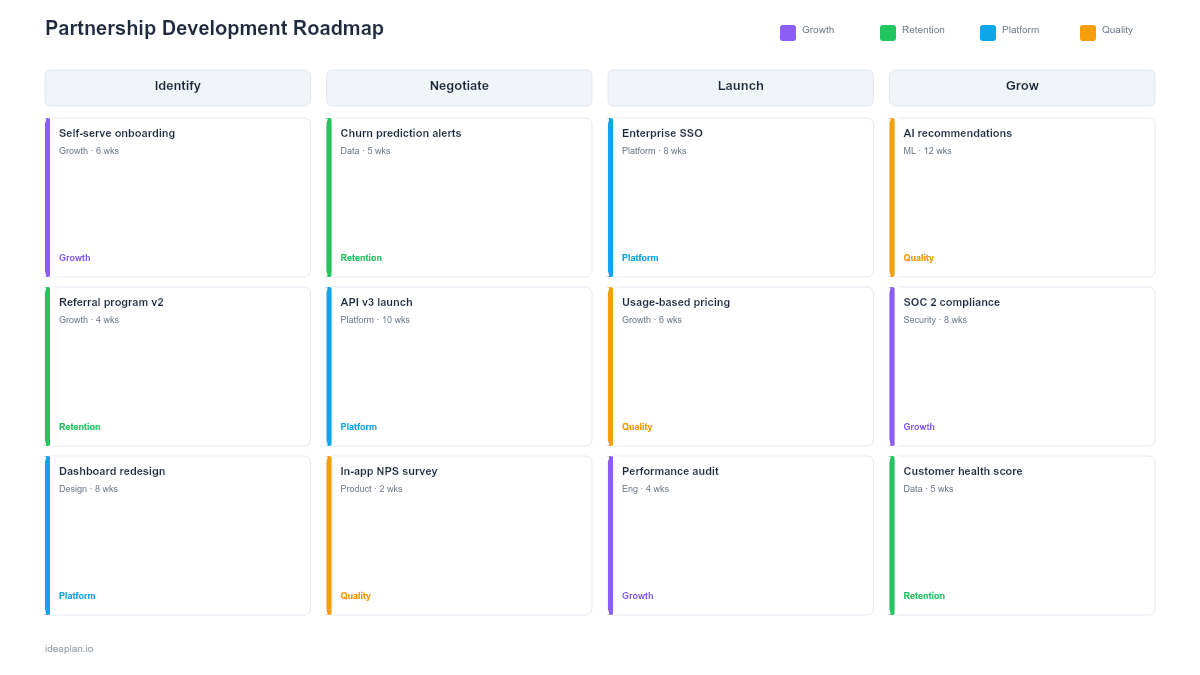
This free PowerPoint template tracks individual partnerships through five lifecycle stages: Identification, Negotiation, Integration, Co-Marketing, and Optimization. Each stage has defined activities, deliverables, and success criteria that move the partnership from initial contact to measurable revenue contribution. Download the .pptx, add your top partnership prospects, and use it to keep BD, product, and marketing teams aligned on where each partnership stands and what happens next.
What This Template Includes
- Cover slide. Company name, partnership strategy summary, and BD team owner.
- Instructions slide. How to define partnership stages, set success criteria per stage, and run partnership pipeline reviews. Remove before presenting.
- Blank partnership lifecycle slide. Five stage columns with 3-4 partner rows. Each cell contains activity cards with owners, timelines, and deliverables. Stage gates between columns define the criteria for advancing a partnership.
- Filled example slide. Three partnerships at different lifecycle stages: one in Negotiation, one in Integration, and one in Optimization, showing the full pipeline view with revenue attribution at the final stage.
Why Partnership Development Needs Structure
Partnerships die in the middle. The BD team signs a deal with enthusiasm, engineering builds a basic integration, and then momentum stalls. Nobody owns the co-marketing plan. The integration sits unused. The partnership report shows "active" but the actual revenue contribution is zero.
The root cause is that most companies manage partnerships as relationships rather than processes. A structured lifecycle with defined stages, owners, and success criteria treats partnerships the way product teams treat features: with a clear path from concept to delivery to measurement.
This template borrows from the product development lifecycle concept and applies it to partnerships. Each stage has inputs, outputs, and a gate that prevents moving forward until the current stage is complete.
Template Structure
Stage 1: Identification
Qualifying potential partners before investing time. Each partner card captures: company name, strategic rationale (why this partner?), customer overlap estimate, integration feasibility, and BD owner. The stage gate requires a scored evaluation against partnership criteria and an executive sponsor on both sides. A pipeline of 10-15 identified partners typically yields 3-5 that advance to negotiation.
Stage 2: Negotiation
Structuring the commercial and technical terms. Activities include: defining partnership type (referral, integration, co-sell, OEM), drafting the commercial agreement, aligning on technical integration scope, and agreeing on success metrics. The deliverable is a signed partnership agreement with clear commitments from both sides. The stage gate requires legal review completion and executive sign-off.
Stage 3: Integration
Building the technical connection between products. Activities cover: API integration development, testing in sandbox environments, documentation creation, and joint QA. Each integration card shows engineering effort, timeline, and the customer experience it enables. The stage gate requires the integration passing joint testing and documentation being published. The ecosystem integration roadmap PowerPoint template provides deeper planning for technically complex integrations.
Stage 4: Co-Marketing
Launching the partnership to customers. Activities include: joint press release or blog post, co-branded landing page, joint webinar or event, shared case study, and marketplace listing. Each activity has a marketing owner from both companies. The stage gate requires at least two co-marketing activities completed and the integration live for mutual customers.
Stage 5: Optimization
Measuring and improving partnership performance. Activities include: quarterly business reviews, revenue attribution analysis, customer feedback collection, integration enhancement planning, and expansion discussions. Success metrics track revenue per partner, mutual customer count, integration usage rate, and co-sourced pipeline. Partnerships that do not meet minimum thresholds after two quarters trigger a restructure or wind-down discussion.
How to Use This Template
1. Build the partnership pipeline
List all current and prospective partners. Place each in the appropriate lifecycle stage based on where the relationship stands today. This snapshot reveals your pipeline balance: if all partners are in Identification and none in Optimization, your partnership program is all potential and no results.
2. Define stage gate criteria
Write explicit criteria for advancing from one stage to the next. Examples: "Identification to Negotiation requires a scored evaluation above 7/10 and executive sponsor confirmation." "Integration to Co-Marketing requires integration passing joint QA and documentation published." These gates prevent partnerships from advancing prematurely.
3. Assign owners per stage
Different stages need different owners. BD owns Identification and Negotiation. Product/Engineering owns Integration. Marketing owns Co-Marketing. A partnership manager or BD lead owns Optimization. Make ownership transitions explicit on the roadmap so handoffs do not drop the partnership.
4. Set timeline expectations
Each stage has a typical duration: Identification (2-4 weeks), Negotiation (4-8 weeks), Integration (6-12 weeks), Co-Marketing (4-6 weeks), Optimization (ongoing). Place these on the quarterly timeline. A partnership identified in January should be generating measurable results by Q3 or Q4, not lingering in Negotiation for six months.
5. Run monthly pipeline reviews
Review the partnership roadmap monthly with BD, product, and marketing. For each partnership, ask: "What stage is this in? What is blocking advancement to the next stage? When do we expect it to produce revenue?" This cadence prevents the common pattern of partnerships that are "almost done" for quarters at a time. Use OKRs to set quarterly partnership targets.
When to Use This Template
A partnership development roadmap fits when:
- BD has a growing pipeline of potential partners and needs a structured process to evaluate and advance them
- Existing partnerships are stuck in early stages without clear paths to revenue contribution
- Engineering resources for integrations need to be planned alongside the product roadmap
- Marketing needs lead time to prepare co-marketing campaigns for partnerships nearing launch
- Leadership wants visibility into partnership ROI and the pipeline of future partnership revenue
For managing an established ecosystem of many partners, the partner ecosystem roadmap PowerPoint template provides a portfolio view by tier. For planning distribution channels broadly, the channel strategy roadmap PowerPoint template covers the full channel mix.
Featured in
This template is featured in Growth and Revenue Roadmap Templates, a curated collection of roadmap templates for this use case.
Key Takeaways
- Five lifecycle stages (Identification, Negotiation, Integration, Co-Marketing, Optimization) create a structured process from first contact to measurable results.
- Stage gates with explicit criteria prevent partnerships from advancing before they are ready.
- Different functions own different stages. BD, Engineering, and Marketing hand off responsibility at defined transition points.
- Monthly pipeline reviews keep partnerships moving forward and surface blockages before they become stalls.
- PowerPoint format makes the partnership pipeline presentable to leadership, potential partners, and cross-functional teams.
- Compatible with Google Slides, Keynote, and LibreOffice Impress. Upload the
.pptxto Google Drive to edit collaboratively in your browser.