Quick Answer (TL;DR)
This free PowerPoint template maps your distribution strategy across four channel types: Direct Sales, Partner/Reseller, Marketplace, and OEM/Embedded. Each channel shows enablement activities, revenue targets, and operational milestones by quarter. Download the .pptx, define your channel mix, and use it to align sales, partnerships, and product teams around a shared plan for how your product reaches customers.
What This Template Includes
- Cover slide. Product name, channel strategy summary, planning period, and channel strategy owner.
- Instructions slide. How to evaluate channels, set revenue allocation targets, and define channel-specific enablement needs. Remove before presenting.
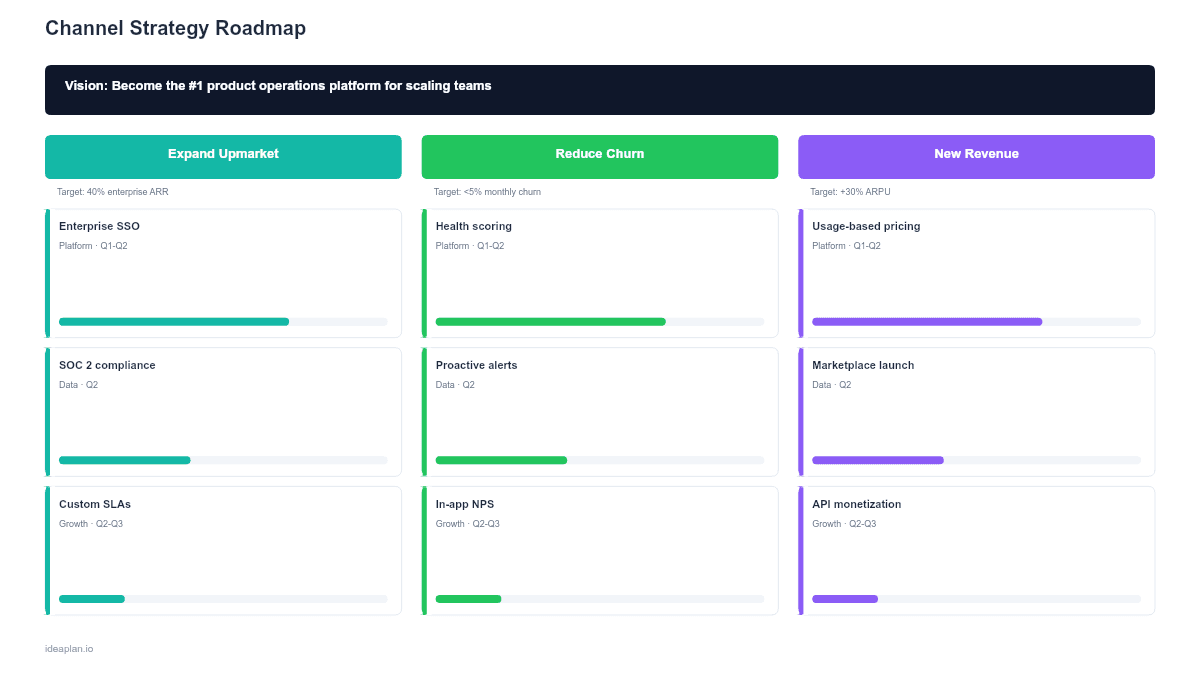
- Blank channel roadmap slide. Four channel swimlanes across a quarterly timeline with activity cards for enablement, revenue targets, and operational readiness milestones. A revenue allocation bar at the bottom shows the target percentage split by channel per quarter.
- Filled example slide. A mid-stage B2B SaaS company's channel plan showing direct sales scaling, two reseller partnerships ramping, marketplace listing, and an OEM exploration track, with revenue split shifting from 90% direct to 65% direct over four quarters.
Why Channel Strategy Needs a Roadmap
Most B2B companies start with one channel: the founder sells directly. As the company grows, new channels appear. A partner asks to resell, a marketplace opens, a larger company wants to embed your product. Without a plan, each channel develops ad hoc with inconsistent pricing, conflicting territory rules, and no shared understanding of how the revenue mix should evolve.
A channel strategy roadmap makes three things explicit: which channels you are investing in, what each channel needs to perform (enablement, tooling, pricing), and how the revenue allocation shifts over time. The shift matters because channel economics vary widely. Direct sales has high CAC but full control, while marketplace has lower CAC but platform fees and less customer relationship ownership.
The go-to-market strategy defines the overall distribution approach. This template plans the execution across specific channels.
Template Structure
Direct Sales Channel
The first swimlane covers your internal sales team's plan: hiring targets, territory assignments, quota structures, and sales process improvements. Activity cards track enablement milestones like CRM setup, talk track creation, and competitive training. Revenue targets per quarter show the expected contribution from direct selling.
Partner/Reseller Channel
The second swimlane maps reseller and referral partner development: partner recruitment, certification programs, deal registration processes, and partner enablement resources. Each partner initiative includes expected deal volume, average deal size, and margin-sharing terms. This channel requires the most upfront investment in enablement before producing revenue.
Marketplace Channel
The third swimlane covers distribution through third-party platforms: app store submissions, listing optimization, marketplace-specific pricing and packaging, and integration requirements. Activity cards track technical readiness (API compliance, sandbox testing) alongside go-to-market readiness (listing copy, screenshots, reviews strategy). Marketplace channels scale with less effort per deal but give you less control over the customer relationship.
OEM/Embedded Channel
The fourth swimlane plans white-label or embedded distribution: identifying OEM prospects, defining the embedded product scope, building the customization layer, and negotiating commercial terms. OEM deals are high-effort to close but produce recurring revenue with minimal ongoing sales cost. Each OEM opportunity gets its own card with deal stage, technical requirements, and revenue projection.
How to Use This Template
1. Audit your current channel mix
Document where revenue comes from today. For most early-stage companies it is 90-100% direct sales. Calculate customer acquisition cost per channel if you have enough data. This baseline reveals whether you are over-reliant on a single channel and where the economics favor diversification.
2. Define your target channel mix
Set a target revenue split for 12 months out. Example: shift from 90% direct / 10% referral to 65% direct / 20% partner / 10% marketplace / 5% OEM. The shift should be gradual. Channels take 2-3 quarters to ramp. Plot the quarterly progression across the bottom revenue allocation bar.
3. Identify channel-specific requirements
Each channel has prerequisites. Partners need certification programs and deal registration systems. Marketplaces need API compliance and listing assets. OEM requires a customization framework and dedicated account management. List these requirements as activity cards in the appropriate swimlane, sequenced before the revenue ramp.
4. Align pricing across channels
Channel conflict kills distribution strategies. If direct sales offers 20% discounts that undercut partner pricing, partners stop selling. Define pricing guardrails: minimum resale prices, discount authority levels, and territory rules. Document these in the Partner/Reseller swimlane as operational milestones. The pricing strategy should account for multi-channel economics.
5. Set quarterly revenue targets per channel
Each channel swimlane needs a revenue target per quarter. Make these targets specific: "$200K partner-sourced pipeline in Q2" rather than "grow partner revenue." Track actual vs. target in quarterly reviews and adjust channel investment based on performance. Channels that miss targets for two consecutive quarters need a strategy change or reduced investment.
When to Use This Template
A channel strategy roadmap is the right choice when:
- Revenue is concentrated in one channel and leadership wants to diversify distribution risk
- Partner or marketplace opportunities are emerging and the team needs a structured approach to evaluate and enable them
- Channel conflict is occurring between direct sales and partners or between multiple partner types
- The company is scaling beyond founder-led sales and needs to define how new channels complement direct selling
- Board or investor presentations require a distribution strategy that shows how the company reaches customers beyond the direct sales team
For deeper partner planning, the partner ecosystem roadmap PowerPoint template covers partner tiering and ecosystem development. For the sales team's enablement specifically, the sales enablement roadmap PowerPoint template covers training, content, and tools.
Featured in
This template is featured in Product Strategy Roadmap Templates, a curated collection of roadmap templates for this use case.
Key Takeaways
- Four channel types (Direct, Partner, Marketplace, OEM) each require different enablement, pricing, and operational readiness.
- The revenue allocation bar shows how the channel mix shifts over time, preventing over-reliance on a single distribution path.
- Channel conflict is the number one killer of multi-channel strategies. Define pricing and territory rules before enabling partners.
- Channels take 2-3 quarters to ramp, so enablement work must precede revenue expectations by at least one quarter.
- PowerPoint format makes the channel strategy presentable in sales leadership meetings, board reviews, and partner kickoff sessions.
- Compatible with Google Slides, Keynote, and LibreOffice Impress. Upload the
.pptxto Google Drive to edit collaboratively in your browser.