Quick Answer (TL;DR)
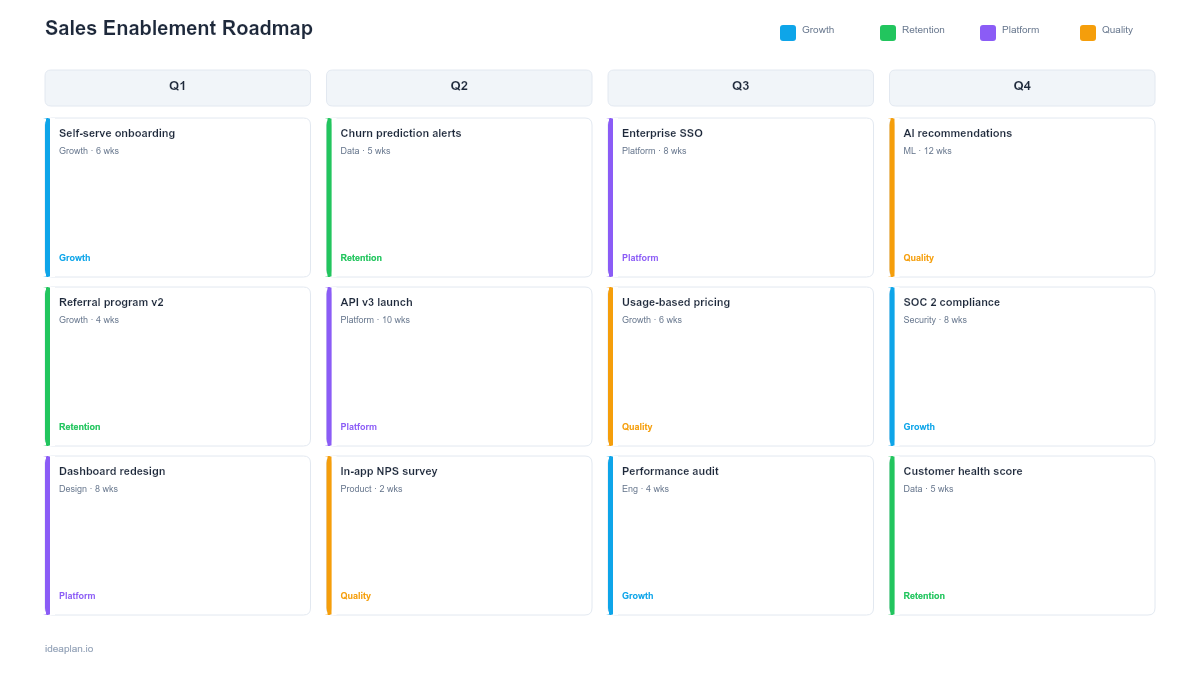
This free PowerPoint template organizes sales enablement work into four tracks: Content & Collateral, Training & Onboarding, Tools & Technology, and Process & Playbooks. Each track shows quarterly milestones, owners, and readiness scores. Download the .pptx, map your enablement initiatives across tracks, and use it to keep product, marketing, and sales leadership aligned on what sellers need and when they will get it.
What This Template Includes
- Cover slide. Product name, planning period, and the enablement framework overview.
- Instructions slide. How to define enablement tracks, assign owners, and set readiness benchmarks. Remove before presenting.
- Blank template slide. Four enablement tracks across a quarterly timeline with milestone markers, owner tags, and readiness score indicators.
- Filled example slide. A B2B SaaS sales enablement roadmap with 16 initiatives across four tracks, showing progression from foundational content through advanced competitive tooling.
Why a Dedicated Sales Enablement Roadmap
Product teams build features. Marketing creates campaigns. But the materials that help sellers actually close deals. Battle cards, demo scripts, objection handlers, ROI calculators. Often fall through the cracks between these two functions.
A sales enablement roadmap makes this work visible. It answers three questions that product and go-to-market leaders ask repeatedly: What resources do sellers have today? What do they need? When will they get it?
Without a dedicated plan, enablement work happens reactively. A rep loses a deal to a competitor, so someone scrambles to build a battle card. A new feature ships, but the sales team learns about it from a customer. The sales enablement roadmap replaces this reactive pattern with planned investment.
Template Structure
Enablement Tracks
Four horizontal tracks organize all enablement work by type:
- Content & Collateral. Battle cards, case studies, one-pagers, ROI calculators, demo decks. The artifacts sellers share with prospects.
- Training & Onboarding. New hire ramp programs, product certification, competitive training, sales methodology workshops.
- Tools & Technology. CRM configurations, sales intelligence integrations, content management systems, conversation intelligence platforms.
- Process & Playbooks. Discovery call scripts, qualification frameworks, handoff procedures, deal desk workflows.
Quarterly Columns
Each track spans four quarters. Initiatives are placed in the quarter when they will be ready for sellers to use. Not when development begins. This output-oriented timing aligns with how sales leadership thinks about readiness.
Readiness Scores
Each quarter includes a readiness score (1-5) per track indicating how well-equipped sellers are in that area. A score of 2 in Content & Collateral for Q1 with a target of 4 by Q4 creates a clear improvement trajectory that leadership can track.
Owner Tags
Every initiative shows a functional owner: Product Marketing, Sales Ops, Enablement, or Product. This surfaces who is responsible and prevents the common failure of assuming "someone" will create the battle card.
How to Use This Template
1. Audit current state
List every enablement resource your sales team has today. Categorize each into one of the four tracks. Rate each track 1-5 for completeness. This baseline reveals where the gaps are. Most teams find Content & Collateral is strong but Process & Playbooks is weak, or vice versa.
2. Gather sales input
Interview 3-5 reps and 2 sales managers. Ask: "What do you wish you had when talking to prospects?" and "Where do you lose deals?" Their answers populate the initiative backlog. The voice of customer discipline applies internally too. Your sellers are your internal customers.
3. Prioritize by revenue impact
Rank initiatives by how directly they affect win rates, deal velocity, or average deal size. A competitive battle card for your top-3 competitors likely matters more than a generic product overview refresh. Use the RICE framework if you need a structured scoring approach.
4. Assign owners and timelines
Place each initiative in a quarter and assign a functional owner. Be realistic about capacity. Most enablement teams can deliver 3-4 substantial resources per quarter. Overloading the plan guarantees nothing ships well.
5. Set readiness targets
Define what a score of 5 looks like for each track. For Content & Collateral, that might mean "battle cards for all 5 competitors, 10 customer case studies, ROI calculator." These targets make progress measurable rather than subjective.
6. Review monthly with sales leadership
Present updates in a 30-minute monthly sync. Show what shipped, what shifted, and what the readiness scores look like. This cadence keeps enablement visible and gives sales leaders a forum to reprioritize based on what they are hearing in deals.
When to Use This Template
A sales enablement roadmap fits when:
- A new product or major feature is launching and the sales team needs collateral, training, and updated playbooks before they can sell it effectively
- Win rates are declining and the team needs a structured plan to close specific gaps in sales readiness
- Sales and product teams are misaligned on what enablement resources exist and when new ones are coming
- New reps are ramping slowly and leadership wants to formalize the onboarding and certification process
- Competitive pressure is increasing and sellers need updated positioning, battle cards, and objection handling
For broader product planning, the go-to-market roadmap PowerPoint template covers the full GTM strategy. If your focus is on communicating the product direction to stakeholders rather than sales resources, the stakeholder communication roadmap PowerPoint template is a better fit.
Featured in
This template is featured in Go-to-Market and Product Launch Roadmap Templates, a curated collection of roadmap templates for this use case.
Key Takeaways
- Sales enablement roadmaps organize seller resources across four tracks: Content, Training, Tools, and Process.
- Readiness scores per track per quarter create a measurable improvement trajectory.
- Output-oriented timing (when sellers can use it) matters more than development start dates.
- Monthly reviews with sales leadership keep enablement visible and responsive to changing deal dynamics.
- PowerPoint format makes the roadmap easy to present in sales leadership meetings and cross-functional planning sessions.
- Compatible with Google Slides, Keynote, and LibreOffice Impress. Upload the
.pptxto Google Drive to edit collaboratively in your browser.
The Champion Enablement Template for Product Strategy pairs well with this one.