Quick Answer (TL;DR)
This free PowerPoint template maps marketing campaigns. Product launches, seasonal promotions, demand gen programs, and brand initiatives. Onto a quarterly timeline with channel allocation, budget indicators, and performance targets. Work is organized by campaign phase (planning, creation, execution, analysis) so the full lifecycle is visible in a single view. Download the .pptx, populate it with your campaign plan, and use it to coordinate marketing, product, sales, and creative teams on what launches when.
What This Template Includes
- Cover slide. Title slide with marketing program name, fiscal year, and marketing lead.
- Instructions slide. How to categorize campaigns by phase, assign budget tiers, and set channel targets. Remove before presenting externally.
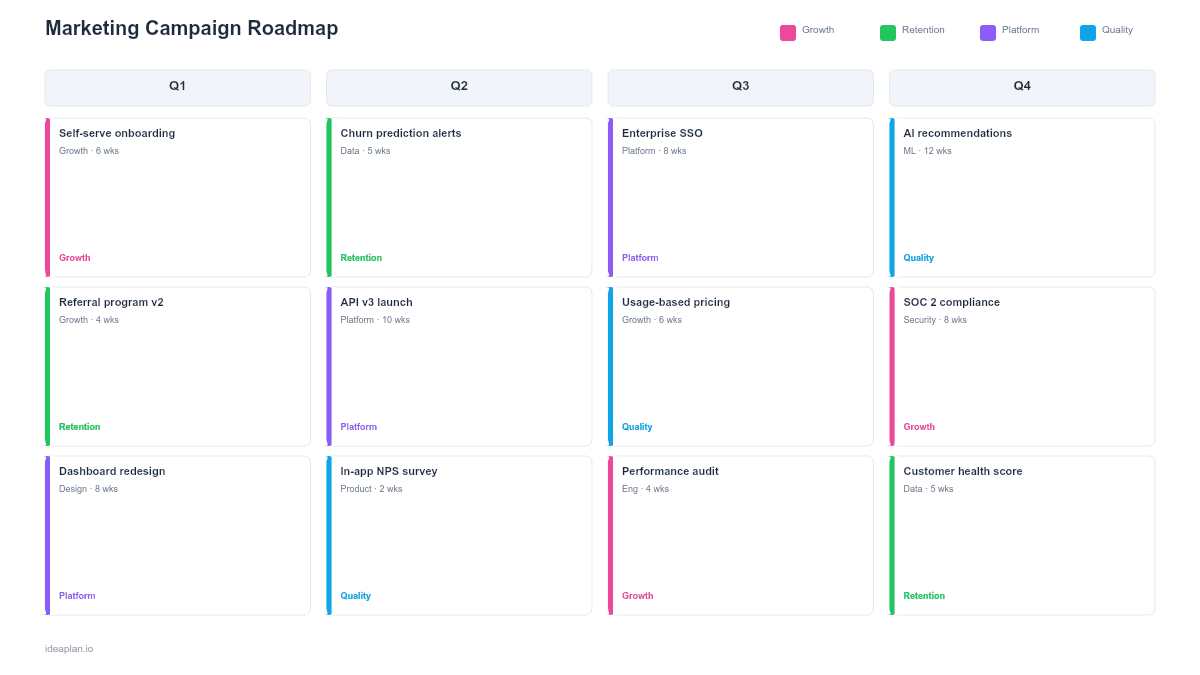
- Blank campaign timeline slide. A four-quarter grid with rows for each campaign phase (planning and strategy, creative and production, execution and distribution, measurement and optimization). Each card shows campaign name, primary channels, budget tier (low/medium/high), and target KPI.
- Filled example slide. A realistic marketing roadmap for a SaaS company showing a product launch campaign, Q2 demand gen push, annual user conference promotion, and end-of-year renewal campaign, with budget allocation bars and conversion targets on each initiative.
Why PowerPoint for Marketing Campaign Roadmaps
Marketing teams juggle dozens of campaigns, channels, and deadlines. The typical planning tool is a Google Sheet with 200 rows that nobody reviews until something falls through the cracks. A PowerPoint roadmap compresses the entire campaign calendar into a strategic view that shows how campaigns relate to each other, where budget is concentrated, and when production bottlenecks will form.
The format is especially useful for executive communication. When a CEO asks "what is marketing doing next quarter?" the answer should not be a 30-minute walk through a project management tool. It should be a single slide showing three campaigns, their channel mix, and the pipeline metrics they target. That clarity builds confidence and protects marketing budgets during planning season.
Template Structure
Campaign Phase Rows
Four rows represent the campaign lifecycle: planning and strategy (audience targeting, messaging development, channel selection, budget requests), creative and production (ad creative, landing pages, email copy, video scripts, collateral), execution and distribution (paid media, email sends, social campaigns, event activations, partner co-marketing), and measurement and optimization (performance dashboards, A/B test results, attribution analysis, budget reallocation).
Budget Tier Indicators
Each campaign card includes a budget badge: low (mostly organic channels, minimal paid spend), medium (balanced paid and organic, moderate production investment), or high (significant paid media spend, agency involvement, event production). This visual makes it immediately clear where marketing dollars are concentrated and helps the CMO or CFO assess allocation balance across the year.
Channel Tags
Cards carry channel tags showing the primary distribution channels: email, paid search, paid social, organic social, events, webinars, partnerships, direct mail. Multi-channel campaigns show all active channels. This helps teams identify channel overload. If every Q3 campaign is email-heavy, the email team becomes a bottleneck.
How to Use This Template
1. Map campaigns to business objectives
Start with the company's revenue and growth targets for the year. Each campaign should trace directly to a business objective. A product launch drives signup rate, a demand gen program drives pipeline, a retention campaign reduces churn. Campaigns without a clear objective are either missing context or should not exist.
2. Allocate budget and select channels
For each campaign, assign a budget tier and select primary channels based on where your target audience engages. Budget should follow performance data from previous campaigns. Double down on channels with proven cost per acquisition efficiency and reduce spend on underperforming ones. The go-to-market roadmap template can help structure the channel strategy for product launch campaigns specifically.
3. Sequence phases and identify dependencies
Place planning phases 4-6 weeks before execution dates. Creative production needs start 6-8 weeks before launch for campaigns with custom video or design assets. Map dependencies between campaigns. If the Q2 demand gen program repurposes content from the Q1 product launch, the launch content must be finalized first. Also map dependencies with the product team. Feature launch campaigns cannot go live before the feature does.
4. Review with cross-functional stakeholders
Marketing ops validates budget and channel capacity. Creative team validates production timelines. Sales validates that campaign timing aligns with selling cycles and quota periods. Product marketing validates messaging alignment with product positioning. Run this review quarterly, not annually. Marketing plans that do not adapt to performance data and market changes produce declining returns.
When to Use This Template
A marketing campaign roadmap is most valuable when:
- Multiple campaigns run concurrently across different channels and teams
- Product and marketing launches need synchronized timelines with shared dependencies
- Budget allocation needs to be visible across the year for executive approval and ongoing optimization
- Creative and production teams are shared resources that serve multiple campaign workstreams
- Sales and marketing alignment requires clear visibility into when campaigns will generate pipeline and in which segments
If your marketing is a single person running one campaign at a time, a project management board handles it. This template becomes essential when marketing operates as a multi-team program with competing priorities, shared resources, and executive scrutiny on spend.
Featured in
This template is featured in Go-to-Market and Product Launch Roadmap Templates, a curated collection of roadmap templates for this use case.
Key Takeaways
- Marketing campaign roadmaps organize work by lifecycle phase (planning, creative, execution, measurement) to show when each function needs to contribute.
- Budget tier badges and channel tags make resource allocation visible at a glance, preventing bottlenecks and spend concentration.
- Every campaign must trace to a business objective. Pipeline, signups, retention. Not just marketing activity metrics.
- Sequence creative production 6-8 weeks ahead of execution dates and map dependencies with product launch timelines.
- Reserve 15-20% capacity as buffer for unplanned campaigns so planned work stays on track when reactive requests arise.
- Compatible with Google Slides, Keynote, and LibreOffice Impress. Upload the
.pptxto Google Drive to edit collaboratively in your browser.