Quick Answer (TL;DR)
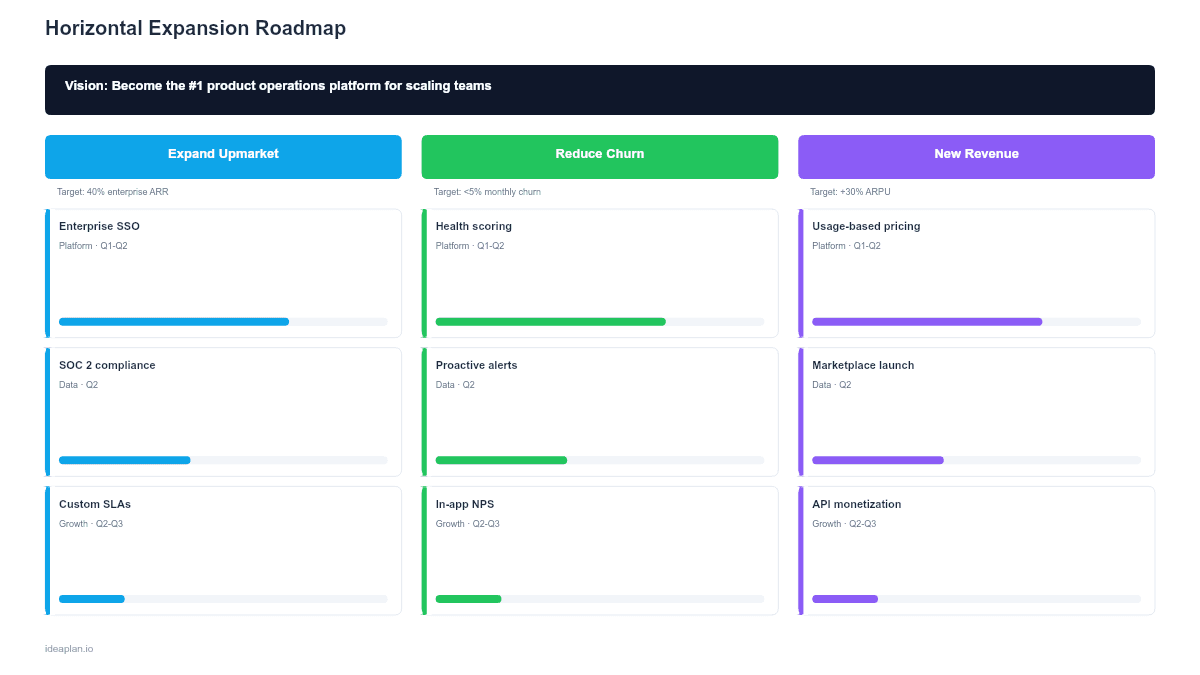
This free PowerPoint template plans horizontal product expansion across three dimensions: Adjacent Use Cases, New User Segments, and Platform Capabilities. Each dimension shows the product changes, user research, and go-to-market activities needed to broaden your market by quarter. Download the .pptx, map your expansion opportunities, and use it to align product, engineering, and marketing teams around a plan that grows the product's reach without fragmenting its identity.
What This Template Includes
- Cover slide. Product name, expansion thesis, planning period, and strategy owner.
- Instructions slide. How to identify adjacent opportunities, score them against core product fit, and set expansion milestones. Remove before presenting.
- Blank expansion roadmap slide. Three dimension rows (Use Cases, Segments, Platform) across a quarterly timeline with opportunity cards, validation checkpoints, and adoption targets.
- Filled example slide. A project management SaaS expanding from engineering teams to marketing and operations teams, with 12 initiatives showing new use cases, segment-specific onboarding, and API extensibility.
Why Horizontal Expansion Needs a Roadmap
Horizontal expansion is how single-use-case products become platforms. Slack moved from engineering chat to company-wide communication. Notion moved from note-taking to project management. Figma moved from interface design to the full product development workflow.
The risk is spreading too wide too fast. Every adjacent use case adds surface area: new features, new user expectations, new competitive dynamics. Without a roadmap, product teams chase whichever opportunity the loudest customer or most persuasive sales rep brings forward. The result is a product that serves six use cases poorly instead of three use cases well.
This template creates structure around which expansions to pursue, in what order, and what each expansion requires from product, engineering, and go-to-market teams. The product strategy guide covers how to set the strategic direction; this template plans the execution.
Template Structure
Adjacent Use Cases
The first row maps new jobs-to-be-done that your product can serve with moderate adaptation. Each use case card includes: the job statement, the current workaround users employ, the product changes required, estimated engineering effort, and the total addressable market the use case opens. Validation checkpoints appear before committing engineering resources. Typically user interviews and prototype tests.
New User Segments
The second row covers expansion to new buyer personas or team types. Each segment card describes the target user, their workflow differences from existing users, onboarding requirements, and pricing considerations. Segment expansion often requires more go-to-market investment than product changes: different messaging, different channels, different case studies. The persona framework helps define each segment precisely.
Platform Capabilities
The third row tracks the infrastructure that enables horizontal growth: APIs, integrations, extensibility frameworks, and self-serve customization tools. These capabilities are the foundation that makes individual use case and segment expansions possible without building bespoke features for each. Each capability card shows dependent use cases and segments so the team can sequence platform work ahead of expansion initiatives.
How to Use This Template
1. Map the opportunity space
List every adjacent use case and user segment your product could serve. Source these from customer requests, competitive analysis, and product usage data showing how customers already stretch your product beyond its intended use. Limit the list to 8-12 candidates. The opportunity solution tree helps structure this discovery.
2. Score opportunities against core fit
Rate each candidate on three criteria: how much product change it requires (less is better), how large the addressable market is, and how well it reinforces the existing product's positioning. Opportunities that require heavy product changes for a small market are traps. Opportunities that open a large market with minor product adaptation are gold.
3. Select and sequence 3-5 expansions
Choose the top-scoring opportunities and sequence them across quarters. Early expansions should be low-effort, high-learning: they validate whether your product can stretch without building massive new features. Later expansions can be more ambitious once the team has pattern-matched what works.
4. Define platform prerequisites
Before committing to a use case or segment expansion, check whether the platform capabilities track has the required infrastructure. A new use case that needs API webhooks only works if webhooks ship first. Place platform work in the quarters before the expansions that depend on it.
5. Set adoption metrics per expansion
Each use case and segment expansion needs its own adoption target: number of users, feature adoption rate, or revenue attributed. Track these independently from core product metrics. If a new use case has 500 active users after 6 months and your core has 50,000, that context matters for deciding whether to keep investing.
When to Use This Template
A horizontal expansion roadmap fits when:
- Core product growth is decelerating and adjacent opportunities represent the next growth phase
- Customers are hacking your product for use cases it was not designed for, signaling latent demand
- Competitive products are expanding horizontally into your space from adjacent categories
- The platform layer is mature enough to support new use cases without re-architecting the core
- Leadership wants a structured plan for growing the product's market beyond the original beachhead
For expanding into specific industries rather than adjacent use cases, the vertical strategy roadmap PowerPoint template is a better fit. For managing multiple products that resulted from horizontal expansion, the multi-product roadmap PowerPoint template covers cross-product coordination.
Featured in
This template is featured in Growth and Revenue Roadmap Templates, a curated collection of roadmap templates for this use case.
Key Takeaways
- Horizontal expansion across three dimensions (Use Cases, Segments, Platform) creates structured growth without unfocused sprawl.
- Score every expansion opportunity against core product fit before committing engineering resources.
- Platform capabilities must ship before the use case and segment expansions that depend on them.
- Independent adoption metrics per expansion prevent masking weak performance behind core product growth.
- PowerPoint format makes the expansion strategy presentable to leadership and board members evaluating growth investments.
- Compatible with Google Slides, Keynote, and LibreOffice Impress. Upload the
.pptxto Google Drive to edit collaboratively in your browser.