Quick Answer (TL;DR)
This free PowerPoint hardware product roadmap template coordinates hardware, firmware, and software development cycles on a shared quarterly timeline with manufacturing milestones. It is built for IoT product managers, hardware product teams, and physical product companies that need to align cross-functional work across long lead times. Download the .pptx, fill in your hardware, firmware, and software initiatives, and use it to communicate development plans to engineering, manufacturing, and executive teams.
What This Template Includes
- Cover slide. Product name, planning horizon, and product team.
- Instructions slide. How to structure hardware/firmware/software tracks, account for manufacturing lead times, and set certification milestones. Remove before presenting.
- Blank hardware roadmap slide. A four-quarter timeline with three horizontal swimlanes: Hardware (industrial design, PCBs, manufacturing), Firmware (embedded code), and Software (mobile apps, cloud services). Each swimlane holds initiative bars with engineering estimates and certification deadlines.
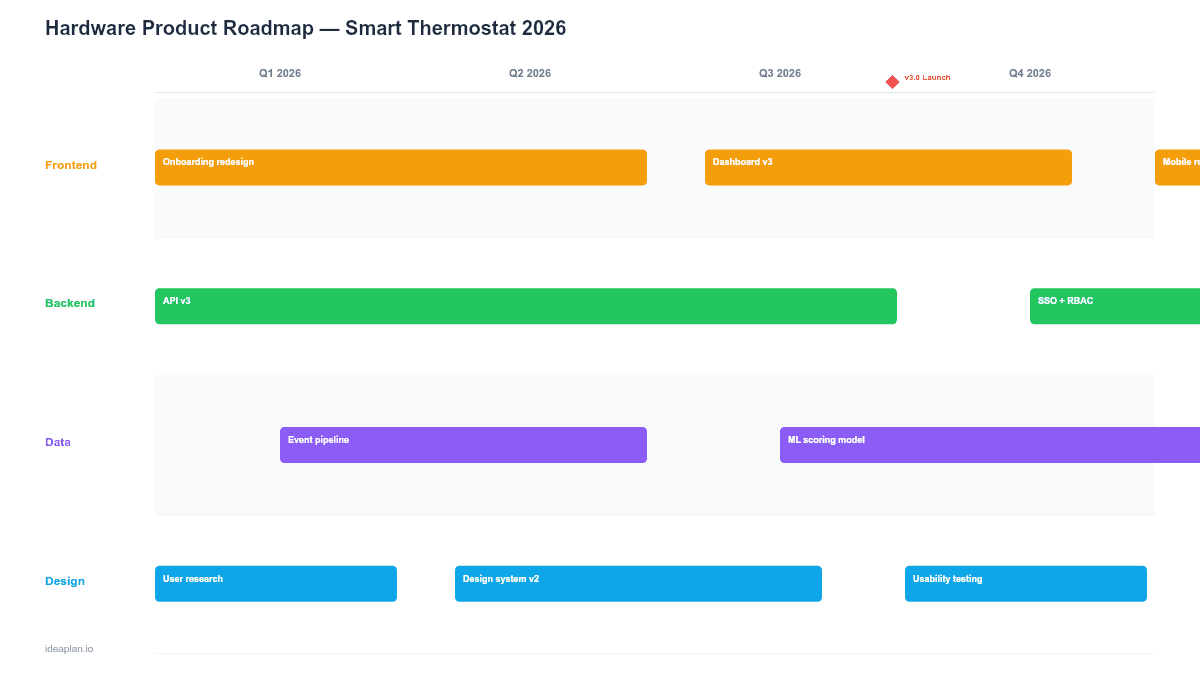
- Filled example slide. A realistic hardware product roadmap for a smart thermostat showing Gen 2 PCB design, FCC/UL certification, OTA update system, iOS app v3, and production run planning across 2026.
Why PowerPoint for Hardware Roadmaps
Hardware product roadmaps face a unique constraint that software roadmaps do not: hardware changes take 6-12 months from design to production. Industrial design revisions, PCB fabrication, tooling, certification (FCC, UL, CE), and manufacturing ramp all introduce fixed lead times that cannot be compressed by adding more engineers.
PowerPoint's swimlane format makes these constraints visible. When firmware features depend on new hardware sensors that will not ship until Q3, the roadmap shows the blocking dependency. When a production run for 10,000 units needs to start in Q2 to meet holiday demand, the roadmap shows the commitment point. The timeline becomes a sequencing tool, not just a communication artifact.
Template Structure
Hardware Track
The top swimlane covers industrial design, mechanical engineering, PCB design, component sourcing, tooling, and manufacturing. Each initiative includes: design phase (EVT, DVT, PVT), component lead time, certification requirements (FCC, UL, CE, RoHS), and production volume. This track typically has the longest lead times and the highest cost to change course.
Firmware Track
The middle swimlane maps embedded software that runs on the hardware: bootloaders, device drivers, sensor calibration, power management, OTA update systems, and local processing logic. Firmware work is often blocked by hardware availability (you cannot test firmware on hardware that does not exist yet), so the roadmap must show when engineering samples, DVT units, and production units become available.
Software Track
The bottom swimlane covers companion apps (mobile, web), cloud services, device management platforms, and integrations with third-party ecosystems (Alexa, Google Home, Apple HomeKit). Software work has shorter iteration cycles than hardware or firmware, so this track often includes multiple releases per quarter. Each initiative links to a hardware/firmware dependency if it requires new device capabilities.
Manufacturing & Certification Milestones
Vertical milestone lines span all three tracks and mark critical deadlines: EVT complete, DVT tooling locked, FCC filing, production run 1, retail availability. Each milestone has a fixed date and a clear gate: "Q2 end: FCC certification complete (required for production)." These milestones surface the critical path and show when the team loses flexibility.
How to Use This Template
1. Map hardware design phases to quarters
Hardware work follows a standard progression: EVT (engineering validation test), DVT (design validation test), PVT (production validation test), and mass production. Each phase has fixed duration: EVT 6-8 weeks, DVT 8-12 weeks, PVT 4-6 weeks. Place these phases on the timeline first. Everything else schedules around them.
2. Identify firmware-hardware dependencies
Firmware engineers cannot test code until hardware samples exist. Mark when engineering samples, DVT units, and PVT units become available. Schedule firmware work to start when the hardware is testable, not when the firmware spec is complete. If firmware depends on new sensors or components, show the dependency explicitly with a note or arrow.
3. Plan for certification lead times
FCC certification takes 8-12 weeks. UL certification takes 4-8 weeks. CE marking requires 6-10 weeks. These are fixed lead times that push backward from your launch date. If you need to launch in Q4 for holiday sales, FCC filing must complete in Q2. The roadmap makes this sequencing visible and prevents teams from committing to impossible schedules. The product launch guide covers launch planning for physical products.
4. Account for inventory and production ramp
Manufacturing lead time for the first production run is 8-16 weeks depending on component availability and factory capacity. If you are building 10,000 units for a Q4 launch, the production run must start in Q2. Add inventory planning milestones to the roadmap: "Q1: place component orders," "Q2: production run 1 (10K units)," "Q3: units arrive at warehouse." This prevents the common mistake of finishing product development on time but missing the launch window because manufacturing was not planned.
When to Use This Template
Hardware product roadmaps are essential when:
- Physical products with electronics, sensors, or mechanical components require coordinated hardware/firmware/software development
- IoT products combine connected hardware and cloud services with interdependent release schedules
- Manufacturing constraints (component lead times, tooling, production capacity) need visibility for executive and supply chain teams
- Regulatory certification (FCC, UL, CE, medical device) has fixed deadlines that affect launch dates
- Product refreshes (Gen 2, Gen 3) require planning 12+ months in advance to account for design and tooling lead times
If your product is purely software with no hardware component, use a technology roadmap instead. If your product has minimal embedded logic, a simpler platform roadmap may be sufficient.
Featured in
This template is featured in Technical and Engineering Roadmap Templates, a curated collection of roadmap templates for hardware, firmware, and infrastructure teams.
Key Takeaways
- Hardware roadmaps use three swimlanes (Hardware, Firmware, Software) to show cross-functional development work on a shared timeline.
- Manufacturing and certification milestones (EVT, DVT, PVT, FCC, production) have fixed lead times that push backward from launch dates.
- Firmware work schedules around hardware sample availability. Show these dependencies explicitly to prevent scheduling work that cannot be tested.
- Plan production runs 3-4 months before launch to account for component lead times, manufacturing, and shipping.
- Quarterly timelines work well for hardware products with 12-18 month development cycles. Monthly timelines are too granular for the long lead times involved.
- Compatible with Google Slides, Keynote, and LibreOffice Impress. Upload the
.pptxto Google Drive to edit collaboratively in your browser.