Quick Answer (TL;DR)
This free PowerPoint template gives data product managers a structured way to plan data pipeline builds, analytics feature releases, and data quality initiatives across quarters. It separates work into layers. Ingestion, transformation, storage, and consumption. So stakeholders can see where investment is going and what depends on what. Download the .pptx, map your planned data work onto the timeline, and use it to align engineering, analytics, and business teams on delivery sequencing.
What This Template Includes
- Cover slide. Title slide with data product name, planning horizon, and data team owner.
- Instructions slide. How to categorize data initiatives by layer, assign maturity levels, and read dependency connections. Remove before presenting.
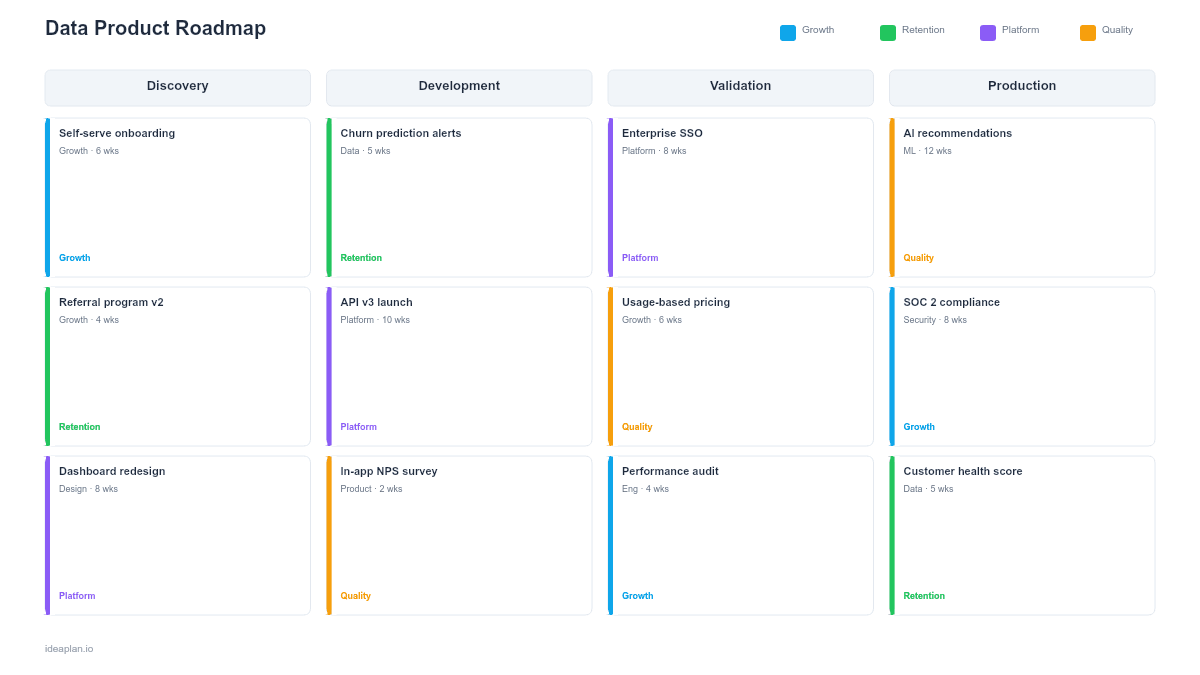
- Blank data product timeline slide. A four-quarter grid with rows for each data layer (ingestion, transformation, storage/modeling, consumption/analytics). Each initiative card shows estimated effort, data maturity stage, and owning team.
- Filled example slide. A realistic data product roadmap for a B2B SaaS company showing a customer data platform build, event tracking overhaul, dbt model migration, and self-serve analytics rollout, with dependencies mapped between layers.
Why PowerPoint for Data Product Roadmaps
Data product work is notoriously hard to communicate to non-technical stakeholders. A pipeline refactor or schema migration sounds abstract until you show it on a timeline next to the analytics features it enables. PowerPoint forces that translation. One slide that connects infrastructure investments to the dashboards and data products business teams actually care about.
The format also exposes sequencing problems early. When a VP of Product asks for real-time analytics next quarter but your event ingestion pipeline ships in Q3, the slide makes the dependency impossible to ignore. That conversation is worth more than weeks of backlog negotiation.
Template Structure
Data Layer Rows
Four rows represent the data stack: ingestion (sources, connectors, event capture), transformation (ETL/ELT pipelines, dbt models, data quality checks), storage and modeling (warehouse schema, data lake, feature stores), and consumption (dashboards, APIs, embedded analytics, ML features). This structure mirrors how data actually flows and shows where bottlenecks will form.
Initiative Cards
Each card contains the initiative name, estimated effort in person-weeks, a maturity badge (build / improve / maintain), and the owning team. Cards span their planned delivery window on the timeline. When two cards in the same row overlap, it signals competing demands on the same data engineers. A common cause of slipped deadlines.
Data Flow Dependencies
Arrows between layers show data dependencies. "the customer 360 dashboard requires the identity resolution pipeline to ship first." Cross-layer dependencies are the riskiest items on a data roadmap because they often involve different teams with different sprint cadences.
How to Use This Template
1. Audit your data initiative backlog
Gather all planned data work from engineering backlogs, analytics requests, and business intelligence wishlists. Classify each initiative by data layer. If a project spans multiple layers (most will), place it in the layer where the majority of effort sits and add dependency arrows to downstream layers.
2. Assess maturity and effort
For each initiative, estimate effort in person-weeks. Assign a maturity stage: build (net-new capability), improve (enhancing existing infrastructure), or maintain (keeping current systems healthy). The product metrics guide can help you identify which consumption-layer features will move the needle for stakeholders.
3. Map dependencies and sequence work
Place initiatives on the timeline starting with the lowest layer (ingestion). Data flows upward. You cannot build a dashboard on data that does not exist yet. For each consumption-layer item, trace backward to confirm its upstream dependencies are scheduled to ship first. The dependency map template pairs well here for complex multi-team scenarios.
4. Review with data and business stakeholders
Present to both technical leads (data engineers, analytics engineers) and business stakeholders (product, finance, ops). Technical reviewers validate effort estimates and dependency accuracy. Business stakeholders validate that consumption-layer deliverables match their actual priorities. Not what they asked for six months ago.
When to Use This Template
Data product roadmaps add the most value when:
- Multiple data teams (engineering, analytics, ML) contribute to shared data infrastructure
- Business stakeholders request analytics features without understanding upstream dependencies
- Data quality initiatives need dedicated investment that competes with feature work
- Platform migrations (warehouse switch, new ETL tool, schema redesign) require multi-quarter planning
- Feature adoption of data products needs to be tracked against delivery milestones
If your data work is limited to a few dashboards maintained by one analyst, a simpler Kanban board is enough. This template shines when data infrastructure serves multiple downstream consumers.
Key Takeaways
- Data product roadmaps organize work by data layer (ingestion, transformation, storage, consumption) to expose where investment and bottlenecks concentrate.
- Dependency arrows between layers make it visible when an analytics feature cannot ship until upstream pipeline work is complete.
- Maturity badges (build / improve / maintain) help teams balance new capability development against reliability and quality work.
- Always start sequencing from the lowest layer and work upward. Data flows in one direction.
- Present to both technical and business audiences, but lead with the consumption layer for business stakeholders.
- Compatible with Google Slides, Keynote, and LibreOffice Impress. Upload the
.pptxto Google Drive to edit collaboratively in your browser.