Quick Answer (TL;DR)
This free PowerPoint template organizes cost reduction initiatives across four categories: Infrastructure & Cloud, Software Licensing, Operational Processes, and Technical Debt. Each category shows current spend, target spend, and the specific initiatives that close the gap. Quarter by quarter. Download the .pptx, populate it with your cost data, and use it to present a credible savings plan to finance and engineering leadership.
What This Template Includes
- Cover slide. Product or business unit name, total annual spend, and target savings percentage.
- Instructions slide. How to categorize costs, estimate savings confidence levels, and track realized savings versus projected. Remove before presenting.
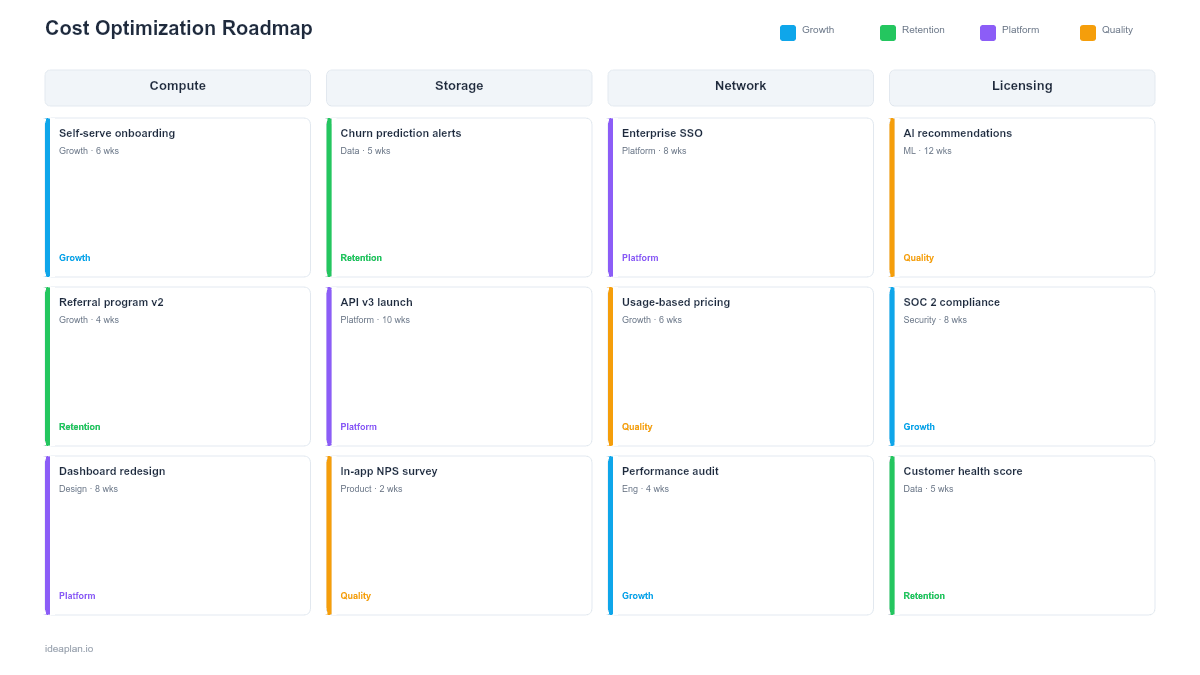
- Blank template slide. Four cost categories across a quarterly timeline with current spend indicators, savings initiative cards, and cumulative savings tracker.
- Filled example slide. A SaaS company cost optimization roadmap showing cloud right-sizing ($180K annual savings), license consolidation ($65K), support workflow automation ($40K), and monolith decomposition ($90K projected savings), with confidence ratings on each estimate.
Why Cost Optimization Needs a Roadmap
Cutting costs without a plan creates chaos. Teams panic-cancel tools they depend on. Engineers rush infrastructure changes that cause outages. Contractors get cut mid-project. The result is often higher costs from rework and lower output from disrupted teams.
A structured roadmap sequences cost reductions by risk, effort, and business impact. Quick wins (unused license cleanup, reserved instance purchases) go first because they deliver savings without affecting product velocity. Longer-term structural changes (architecture redesign, vendor consolidation) get proper planning time so they reduce costs permanently rather than deferring them.
The roadmap also builds credibility with finance. Instead of vague promises to "optimize spending," you present specific initiatives with estimated savings, timelines, and confidence levels. Finance teams can model the savings into forecasts, and engineering leadership can plan capacity around the work. The product strategy guide covers how cost efficiency fits into broader strategic planning.
Template Structure
Infrastructure & Cloud Category
Covers compute, storage, networking, and cloud service costs. Common initiatives: right-sizing over-provisioned instances, purchasing reserved capacity, migrating cold data to cheaper storage tiers, consolidating redundant services, and implementing auto-scaling to match spend with actual demand. Each card shows current monthly spend, estimated savings, implementation effort, and risk level.
Software Licensing Category
Covers SaaS tools, development tools, analytics platforms, and enterprise software. Most organizations pay for 20-40% more licenses than they actively use. Initiatives include: license audits to identify unused seats, vendor consolidation where two tools serve overlapping purposes, renegotiation of contracts approaching renewal, and migration from per-seat to usage-based pricing where it saves money.
Operational Processes Category
Covers manual workflows, support operations, and repetitive tasks that consume team time. Each hour of manual work has a loaded cost. Initiatives include: automating deployment pipelines, implementing self-serve support (customer effort score reductions), streamlining approval workflows, and reducing meeting overhead. Savings are calculated as hours recovered multiplied by loaded hourly cost.
Technical Debt Category
Covers architecture decisions that inflate ongoing operational costs. A monolithic application that requires 4x the compute of a properly decomposed service is a cost problem, not just a code quality problem. Initiatives include: microservices decomposition where it reduces infrastructure spend, database query optimization that reduces instance size requirements, and caching layers that cut API call volume to expensive third-party services.
How to Use This Template
1. Build a cost inventory
Pull spend data from cloud billing dashboards, procurement records, and finance reports. Categorize every line item into the four template categories. Most teams are surprised by what they find. A $2,000/month analytics tool that three people use, a staging environment running 24/7 that is used four hours a week, or a database tier sized for 10x current load.
2. Identify savings opportunities
For each cost category, list potential reductions. Be specific: "Downsize production database from db.r6g.4xlarge to db.r6g.2xlarge" not "optimize database costs." Estimate monthly savings, implementation effort (hours), and confidence level (high/medium/low). High confidence means the savings are certain once implemented. Low confidence means the savings depend on assumptions that need validation.
3. Sequence by risk and payoff
Place high-confidence, low-effort items in Q1. These are your quick wins. License cleanup, reserved instance purchases, shutting down unused environments. Save structural changes (vendor migrations, architecture refactors) for later quarters when early wins have built credibility and the team has learned the optimization discipline.
4. Set cumulative savings targets
The template includes a cumulative savings tracker that shows total savings realized over time. Set quarterly milestones: "$50K by end of Q1, $150K by end of Q2." This framing turns cost optimization from a one-time exercise into an ongoing program with measurable progress. Track actual savings against projections monthly using burn rate comparisons.
5. Present with confidence ratings
When presenting to leadership, be transparent about confidence levels. "We are highly confident in $200K from infrastructure right-sizing. We estimate an additional $80K from vendor consolidation, pending contract renegotiations." Honest confidence ratings build trust and prevent the roadmap from becoming a fantasy document that no one believes.
When to Use This Template
A cost optimization roadmap is the right tool when:
- Burn rate exceeds targets and leadership wants a structured plan to reduce spend without cutting headcount
- Cloud costs are growing faster than revenue and need systematic reduction
- A funding round or downturn creates urgency to extend runway
- Annual planning includes efficiency targets that need specific initiatives, not just percentage goals
- Engineering and finance need a shared artifact that translates technical changes into dollar savings
If your focus is specifically on infrastructure architecture rather than cross-category cost reduction, the infrastructure roadmap PowerPoint template provides deeper structure for that layer. For revenue-side planning, the revenue growth roadmap PowerPoint template covers expansion and monetization.
Key Takeaways
- Cost optimization roadmaps organize savings initiatives by category (infrastructure, licensing, operations, technical debt) with specific dollar estimates per initiative.
- Sequence quick wins first to build credibility, then tackle structural changes that deliver larger but slower savings.
- Confidence ratings on each initiative prevent the roadmap from becoming a wish list that finance cannot rely on.
- Track cumulative realized savings against projections monthly to maintain accountability and adjust plans.
- PowerPoint format lets you present cost plans to finance, engineering leadership, and executives in a single artifact that everyone understands.
- Compatible with Google Slides, Keynote, and LibreOffice Impress. Upload the
.pptxto Google Drive to edit collaboratively in your browser.
The AI Cost Optimization Template for AI Products pairs well with this one.