Quick Answer (TL;DR)
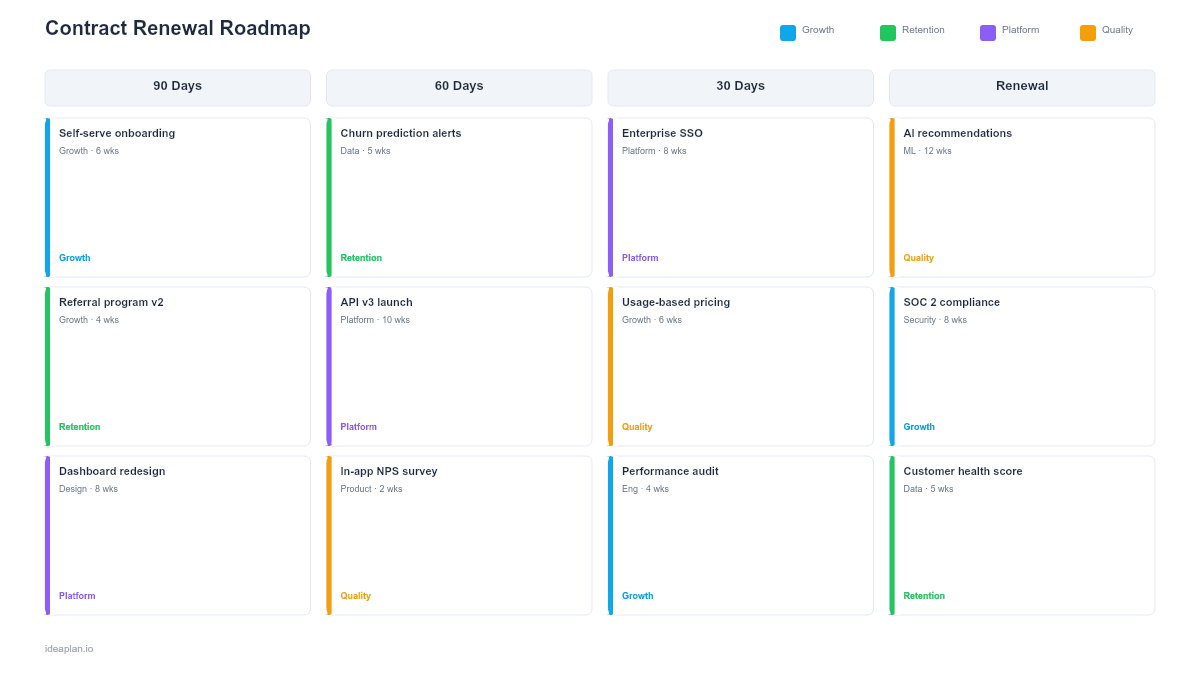
Renewal season should not feel like a fire drill. This free PowerPoint template gives revenue and customer success teams a single view of every upcoming renewal. Risk-scored, expansion-tagged, and sequenced on a rolling calendar. Each slide covers a quarter of renewals with health indicators, expansion signals, and negotiation prep notes. Download the .pptx, populate it from your CRM, and use it to run renewal pipeline reviews that protect gross revenue retention while surfacing upsell opportunities.
What This Template Includes
- Renewal calendar slide. All contracts mapped by renewal date across four quarters, color-coded by risk tier (green, yellow, red) with ARR per account.
- Risk scoring matrix slide. A grid showing how health score, engagement trend, support ticket volume, and contract age combine into a renewal risk rating for each account.
- Expansion opportunity slide. Accounts flagged for upsell or cross-sell during the renewal conversation, with recommended offers and projected uplift.
- Negotiation prep slide. Per-account notes covering key stakeholders, historical pricing, competitive threats, and concession boundaries.
Why Contract Renewals Need a Roadmap
Most SaaS companies manage renewals reactively. The contract comes up in 30 days, a CSM scrambles to check usage, and the negotiation starts from a weak position. The result is last-minute discounting, missed expansion opportunities, and preventable churn.
A renewal roadmap shifts the timeline. By scoring risk and expansion potential 90-120 days before each renewal, the team has time to intervene on at-risk accounts, prepare expansion proposals for healthy ones, and enter negotiations with data instead of hope. The difference between a 90% and 95% gross revenue retention rate often comes down to preparation time.
The roadmap also makes renewal outcomes visible to leadership. Instead of individual CSMs managing renewals in isolation, the entire pipeline is on one deck. Reviewed weekly, updated with outcomes, and used to forecast revenue with confidence.
Template Structure
Renewal Calendar
The calendar view shows every contract renewal across four quarters. Each account card displays the company name, ARR, renewal date, risk tier, and assigned CSM. Sorting by renewal date within each quarter ensures no renewal is missed. Accounts with renewal dates in the next 90 days are highlighted for immediate attention.
Risk Scoring Matrix
Risk scoring combines four signals into a single tier:
- Product engagement. Is usage trending up, flat, or down over the past 90 days?
- Support health. Has the account filed escalations or complaints recently?
- Stakeholder stability. Is the original champion still in place, or has there been turnover?
- Competitive exposure. Has the account evaluated alternatives or mentioned competitors?
Each signal gets a red/yellow/green rating. Two or more red signals make the account high-risk. The matrix makes risk visible and actionable rather than relying on a CSM's gut feeling.
Expansion Opportunity Tags
Healthy accounts approaching renewal are the best candidates for expansion conversations. The template flags accounts where usage is near plan limits, teams have grown, or feature requests align with a higher tier. Each tag includes a recommended expansion offer and the projected revenue increase if accepted.
How to Use This Template
1. Export your renewal calendar
Pull all contracts with renewal dates in the next 12 months from your CRM or billing system. Include ARR, contract start date, current plan, assigned CSM, and primary contact. This raw data feeds every slide in the template.
2. Score each account for risk
Apply the risk scoring matrix to every account renewing in the next two quarters. Use product analytics for engagement data, your support platform for ticket trends, and your CRM for stakeholder changes. If you do not have a formal customer health score, the four-signal matrix in this template serves as a starting point.
3. Flag expansion opportunities
Review healthy accounts for expansion signals: usage approaching limits, team size growth, or feature interest that maps to a higher tier. For each flagged account, draft a specific expansion proposal with pricing. The renewal conversation is the natural moment to present these. The customer is already thinking about the product's value.
4. Prepare negotiation notes
For high-risk accounts and large renewals, fill in the negotiation prep slide: key stakeholders, their priorities, historical pricing and discounts, competitive alternatives they might consider, and your concession boundaries. Walking into a renewal conversation with this information prepared changes the outcome.
5. Review weekly and update outcomes
Run a 30-minute weekly renewal pipeline review with CS leadership. Cover accounts renewing in the next 60 days, review risk scores, and update outcomes for completed renewals. Track win rate, average discount given, and expansion attach rate to measure the program's effectiveness over time.
When to Use This Template
Contract renewal roadmaps deliver the most value when:
- Annual contract renewals make up a significant portion of revenue and losing even a few large accounts materially impacts ARR
- Renewal outcomes are inconsistent. Some accounts renew smoothly while others churn or demand steep discounts, and the team cannot predict which is which
- CS and sales lack a shared pipeline view for renewals, leading to duplicated outreach or accounts falling through cracks
- Expansion during renewals is an untapped opportunity. The team renews at flat rates when healthy accounts would accept and benefit from upgrades
- Leadership needs a revenue forecast that accounts for renewal risk, not just a list of contracts with dates
For broader retention strategy beyond the renewal event itself, the Retention Strategy Roadmap covers the full lifecycle. For post-churn recovery, see the Win-Back Roadmap.
Key Takeaways
- Start renewal preparation 90-120 days before the contract date. Last-minute renewals lead to discounting and missed expansion.
- Risk-score every account using engagement, support health, stakeholder stability, and competitive exposure. Four signals that predict renewal outcomes.
- Flag healthy accounts for expansion during the renewal conversation, when the customer is already evaluating the product's value.
- Run weekly pipeline reviews to ensure no renewal falls through the cracks and outcomes feed back into forecasting.
- Track renewal win rate, discount rates, and expansion attach rate to measure and improve the program over time.
- Compatible with Google Slides, Keynote, and LibreOffice Impress. Upload the
.pptxto Google Drive to edit collaboratively in your browser.